Grackles at Your Feeder: ID, Behavior and Backyard Tips
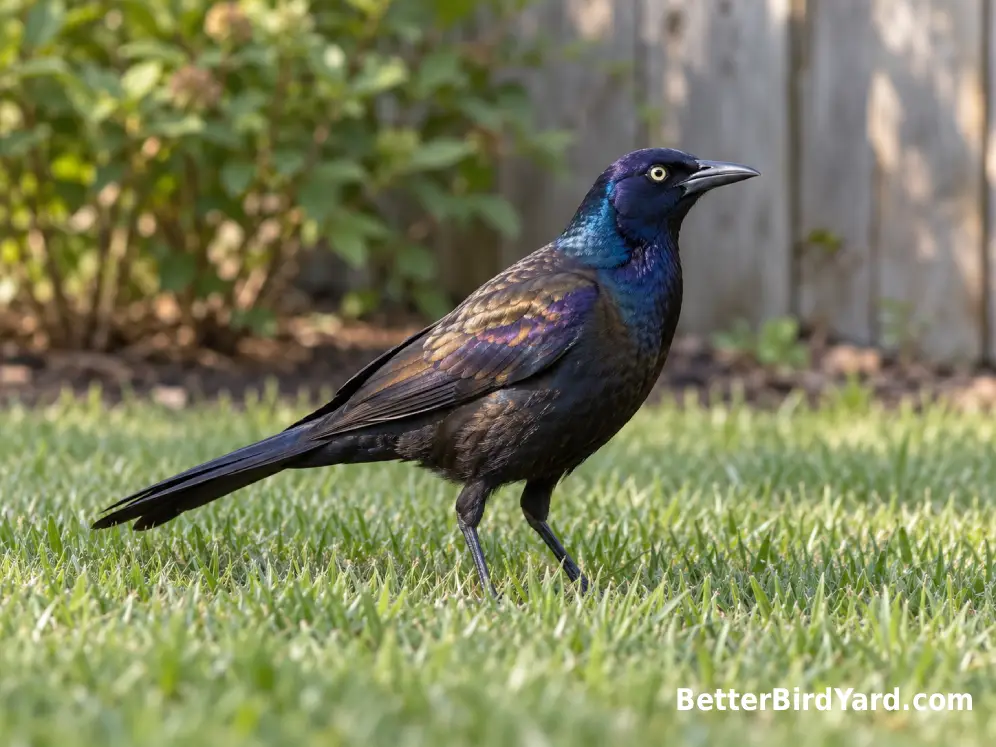
A grackle bird can look plain black from across the yard, but good light tells a different story. Adult males often flash blue, purple, green, or bronze iridescence, and their long legs, long tails, pale eyes, and confident walk give them a distinctive look. Grackles are not crows. They belong to the New World blackbird family, Icteridae, alongside other blackbirds and orioles.
Three grackle species occur in the United States: the Common Grackle, Great-tailed Grackle, and Boat-tailed Grackle. Which one you are seeing depends heavily on location and habitat. For many eastern and central backyard bird watchers, the familiar visitor is the Common Grackle. In much of the West and southern Great Plains, an exceptionally long tail may point toward a Great-tailed Grackle, while coastal marshes of the East and Gulf Coast are prime Boat-tailed Grackle country.
They are intelligent-looking, noisy, adaptable birds, and a flock can quickly change the mood around a feeder. Understanding what grackles are doing makes it easier to appreciate them as wild birds while still keeping a backyard feeding station workable for smaller species.
What Is a Grackle?
Grackles are large, long-legged songbirds in the genus Quiscalus. Although people often group every glossy black yard bird together, grackles have a recognizable combination of a relatively long bill, elongated body, long tail, and strong walking gait. Common Grackles are larger and longer-tailed than many familiar blackbirds, while male Great-tailed and Boat-tailed Grackles can look dramatically larger because of their especially long tails.
Calling a grackle a blackbird is accurate in the family sense, but that does not mean every blackbird is a grackle. Red-winged Blackbirds, cowbirds, meadowlarks, and orioles are relatives in the same broader family, while grackles form their own recognizable group.
They are also highly adaptable. Depending on the species, you may encounter grackles on lawns, around ponds and marshes, in parks, agricultural areas, parking lots, coastal communities, and suburban neighborhoods. That ability to use both natural and human-altered habitats is one reason grackles can seem especially conspicuous.
How to Identify a Grackle Bird
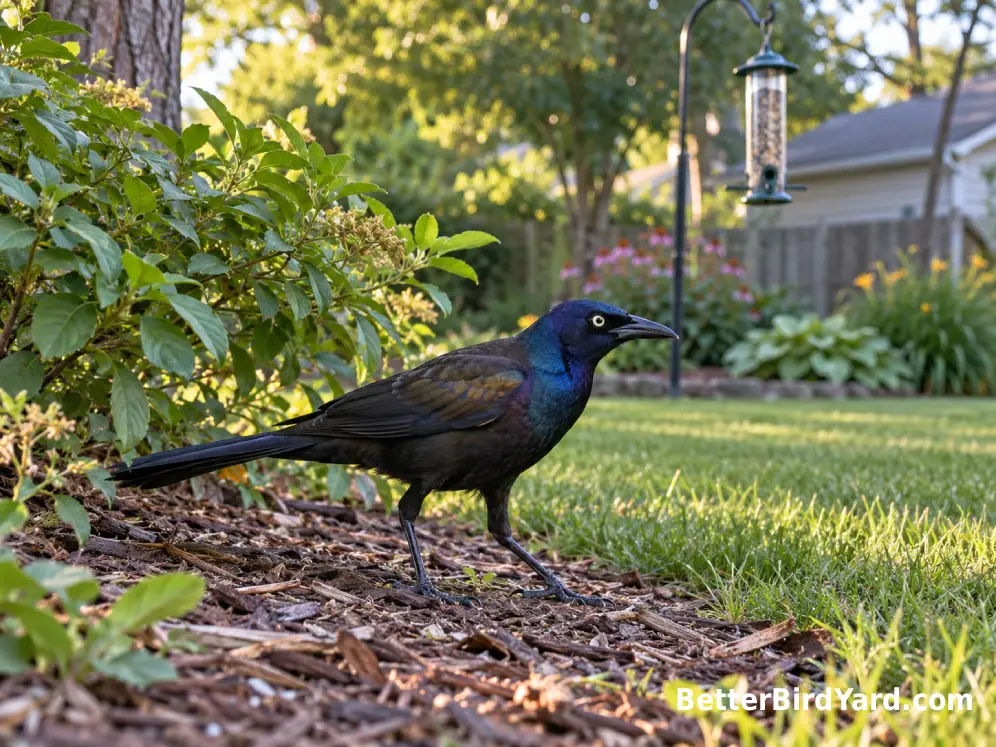
Start with shape rather than color. A Common Grackle is a lanky bird with long legs, a substantial pointed bill, and a tail that looks unusually long compared with most feeder birds. Cornell Lab describes adults as dark overall, with males showing a bluish iridescent head and often a bronzy body in favorable light. Adult eyes are strikingly pale, while juveniles are browner and have dark eyes.
- Look for a long body and tail rather than the compact build of a starling.
- Watch the bird walk. Grackles commonly stride across lawns and open ground while pecking for food.
- Check the eye, but do not use eye color alone; age, species, and even geographic variation can matter.
- Look again when sunlight hits the feathers. Plumage that first looked flat black may suddenly show blue, violet, green, or bronze.
- Notice the bill. A grackle’s bill is longer and more tapered than that of many smaller blackbirds.
A crow is much heavier-bodied, with a broader overall silhouette and a heavier bill. Great-tailed and Boat-tailed Grackles can approach crow-like lengths because of their tails, but their bodies remain much more slender.
The Three Grackle Species in the United States
Location is one of the fastest ways to narrow down a grackle species. Audubon recognizes three grackle species in the United States, and their typical habitats and distributions differ enough to be useful for backyard identification.
| Species | Useful Identification Clues | Where You Are Most Likely to Notice It |
|---|---|---|
| Common Grackle | Long-tailed and lanky; adult male often has a bluish or purple head with bronzy body; adults have pale eyes | Much of the eastern and central U.S., including suburban lawns, parks, fields, woodland edges, and wetlands |
| Great-tailed Grackle | Male has an exceptionally long V-shaped tail, glossy dark plumage, and pale yellow eyes; female is much smaller and brown | Open developed and agricultural landscapes through much of the West, Southwest, southern Great Plains, and parts of the Midwest, often where water is nearby |
| Boat-tailed Grackle | Large male with a very long keel-like tail; female is brown and substantially smaller; eye color varies geographically | Primarily Atlantic and Gulf coastal areas, especially marshes and places near water; Florida birds can occur well inland |
Female Great-tailed and Boat-tailed Grackles deserve special attention because they can look surprisingly different from the glossy males. Both are brown, and the size difference between the sexes is substantial. A brown, long-legged bird standing near a giant glossy male may therefore be a female grackle rather than a completely different species.
Where Great-tailed and Boat-tailed Grackles approach one another along parts of the Gulf Coast, identification becomes more challenging. In that situation, photographs of the bird’s proportions, eye, tail, and habitat are more useful than relying on a single characteristic.
Why Grackles Visit Yards and What They Eat
Grackles are opportunistic omnivores, which helps explain why they do so well around people. Common Grackles eat seeds and agricultural grains as well as insects and other animal foods. Great-tailed Grackles also eat grains, fruits, insects, spiders, snails, worms, and other prey. Boat-tailed Grackles often forage around water for aquatic invertebrates and other small prey while also eating seeds and grain.
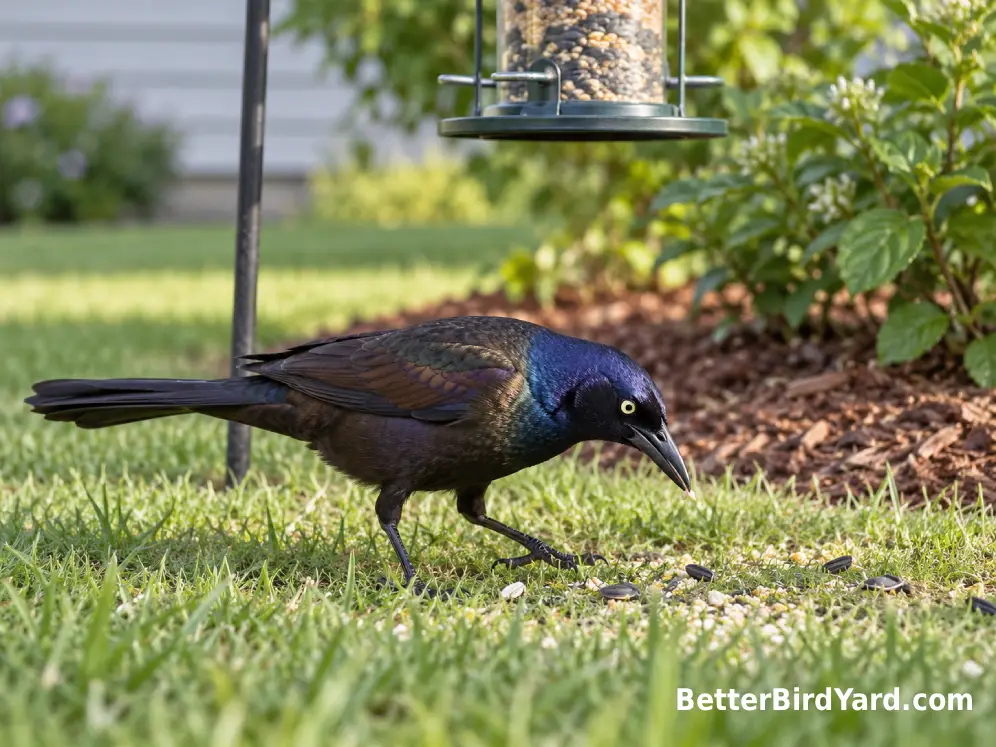
At a backyard feeding station, the attraction is often straightforward: easy access to seed. Cornell notes that Common Grackles readily eat sunflower seed, and large platform, hopper, and ground-feeding setups can accommodate them easily. Great-tailed Grackles also take food spilled beneath feeders.
This is one of those details that matters more than beginners expect: what lands under the feeder can matter as much as what is inside it. A tray that spills heavily onto the lawn effectively creates a second feeding station for grackles, doves, squirrels, and potentially rodents.
That does not mean you need a sterile yard. It means matching the amount of food to actual bird use, keeping seed reasonably dry, and routinely clearing old hulls and spoiled material. Project FeederWatch specifically recommends keeping the ground below feeding areas tidy because accumulated food and waste can create sanitation problems and attract rodents.
Are Grackles Bad for Backyard Birds?
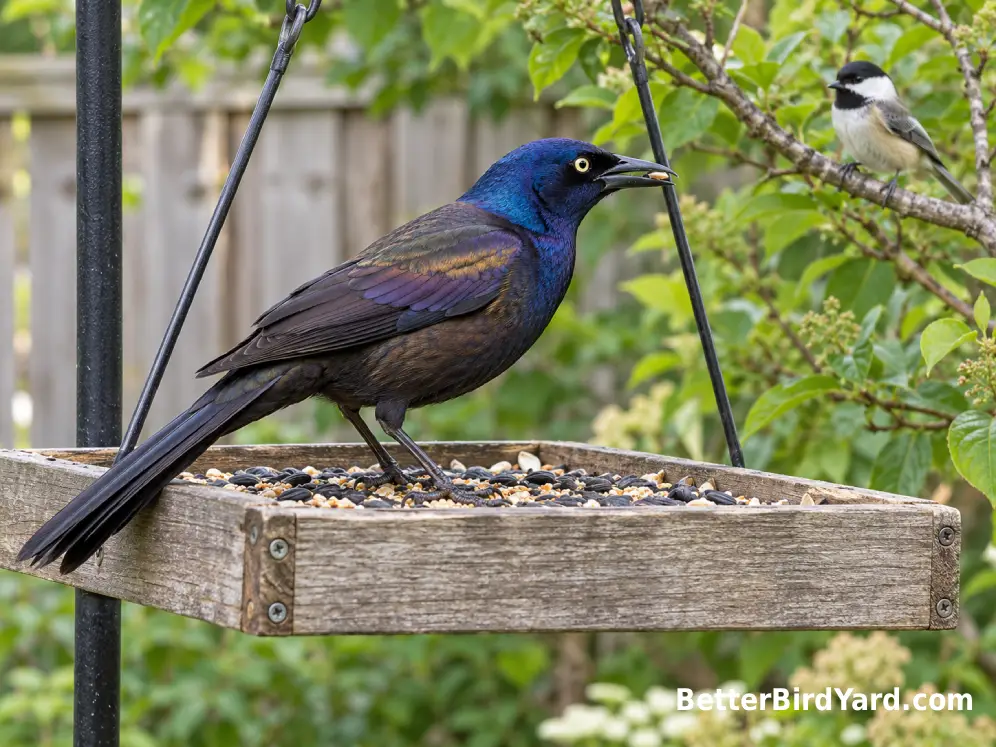
Grackles can certainly be difficult feeder guests. Common Grackles are large enough to push smaller birds away, and Cornell describes them as conspicuous feeder visitors that may dominate access to food. Great-tailed Grackles can do the same where they occur.
That feeder behavior is different from saying grackles are inherently bad birds. They are native wild birds filling ecological roles as omnivorous foragers. Their diets can include insects and other animal prey, and some grackle species sometimes take eggs or young birds, but that behavior is one part of a much broader natural diet.
There is also an important conservation wrinkle. The Common Grackle remains widespread, but Cornell Lab classifies it as a Common Bird in Steep Decline. Its species account cites North American Breeding Bird Survey data showing a substantial long-term decline between 1966 and 2019. That historical trend is worth remembering before treating every grackle simply as a nuisance.
For a backyard bird watcher, the practical goal is usually coexistence rather than elimination: keep the feeding setup sanitary, give smaller birds places they can use comfortably, and adjust the feeder itself if a large flock is emptying it too quickly.
How to Manage Grackles at a Bird Feeder
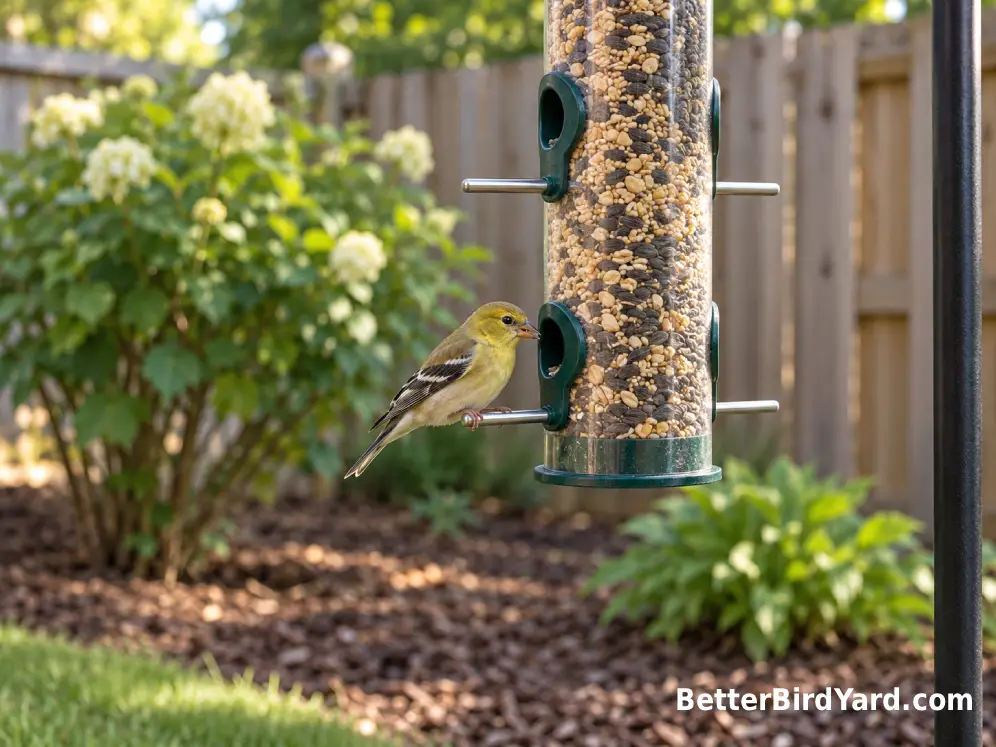
If grackles are taking over a feeder, start with feeder design rather than trying to frighten the birds away. Project FeederWatch notes that small hopper feeders can make it harder for larger birds such as grackles to perch comfortably, while tube feeders with short perches can accommodate smaller finches and similar birds while restricting larger species. Large platforms, by contrast, give a grackle plenty of room.
A simple backyard plan is usually enough:
- Move the main seed supply from a large open platform to a smaller hopper or short-perch tube feeder if smaller birds are your priority.
- Reduce unnecessary spill rather than deliberately scattering extra seed beneath the feeder.
- Offer only an amount your regular birds are likely to use instead of keeping a large ground buffet available all day.
- Clean up old seed, hulls, and droppings beneath heavily used feeders.
- Keep the feeder itself washable and maintain it regularly.
Project FeederWatch currently recommends washing seed and suet feeders regularly, roughly every week or two as a general example, with more frequent cleaning during heavy use or wet weather. Feeders should be thoroughly rinsed and completely dry before they are refilled.
BetterBirdYard editorial note: In a small yard or patio, I would keep this simple. One easy-to-clean tube feeder that suits the birds you most want to watch is usually more manageable than several large trays spilling seed in every direction.
If cleaning is becoming a chore, feeders are not the only way to support birds. Native plants appropriate to your region can provide natural food, shelter, and insects without concentrating every visitor in one spot. Our bird feeder cleaning routine makes any feeding setup easier to maintain.
Flocks, Seasons, and Everyday Grackle Behavior
Grackles are social birds, and what looks like a sudden backyard invasion may simply reflect normal flocking behavior. Common Grackles often forage and roost with other blackbirds outside the breeding season, sometimes gathering high in trees or on utility lines. Great-tailed Grackles are also highly social and can form conspicuous communal roosts.
Season matters, especially with Common Grackles. Cornell describes the species as resident or a short-distance migrant: birds from farther north and parts of the Great Plains move toward the central and southern United States for winter, while others remain year-round. Great-tailed Grackles are largely resident across their North American range, although birds near the northern edge may move south. Boat-tailed Grackles are primarily year-round residents.
So if the number of grackles around your feeder changes dramatically through the year, that does not necessarily mean your feeding setup suddenly went wrong. Local movements, migration, food availability, roosting behavior, breeding activity, weather, and habitat can all change what you see.
Their sounds are just as distinctive as their behavior. Grackle songs often include creaks, whistles, clacks, squeaks, and mechanical-sounding notes rather than the smooth melodies people expect from a songbird. Once you learn that sound palette, you may recognize grackles before you see them.
When a Grackle Looks Sick, Injured, or Unusual
A bird that is unusually easy to approach, persistently fluffed up, lethargic, visibly injured, or showing abnormal growths or crusting may need attention, but those signs are not enough to diagnose a disease from the backyard. Project FeederWatch recommends treating visible illness as a reason to improve feeder hygiene and reduce opportunities for disease transmission rather than trying to identify or medicate the problem yourself.
If you notice a potentially sick bird using a feeder, clean the feeder and feeding area thoroughly and consider temporarily removing the feeder it was using. Check current guidance from your state wildlife agency if there is a local outbreak or unusual mortality event. Do not add medication to seed or water.
For a grackle that appears injured or unable to function normally, avoid casual handling. Keep pets and unnecessary activity away from the bird and contact a licensed wildlife rehabilitator, local wildlife agency, animal control office, or another qualified local professional for guidance if intervention appears necessary.
Living With Grackles in Your Backyard
Grackles are easy to notice and easy to underestimate. Their glossy feathers, pale eyes, long tails, varied voices, and social behavior make them some of the more distinctive birds using ordinary American neighborhoods.
If one shows up in your yard, start with location and shape. A moderately sized iridescent grackle across much of the East or central U.S. is often a Common Grackle. A spectacularly long-tailed bird in the West or southern Great Plains may be a Great-tailed Grackle. Near Atlantic or Gulf marshes, a Boat-tailed Grackle becomes a strong possibility. Range boundaries are not perfect, so unusual sightings are worth checking against a current field guide or Cornell Lab identification resources.
At feeders, you do not have to choose between letting a large flock empty everything and treating grackles as enemies. Smaller feeders, short perches, controlled seed spill, routine cleaning, and more natural habitat around the yard can create a better balance. You may still see grackles—and that is part of having a yard used by wild birds—but your feeding station can remain useful to smaller visitors too.
Once you stop seeing a grackle as simply a big black feeder bird, there is much more to watch: the way sunlight changes its plumage, its deliberate walk across the lawn, the strange mechanical calls, seasonal flocks, and the surprisingly different shapes and colors of the three U.S. grackle species.