American Robin: How to Identify and Welcome This Backyard Bird
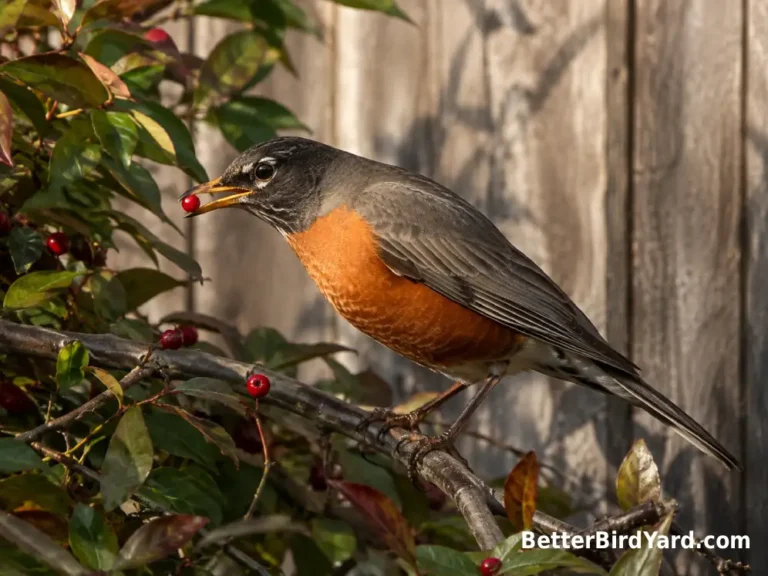
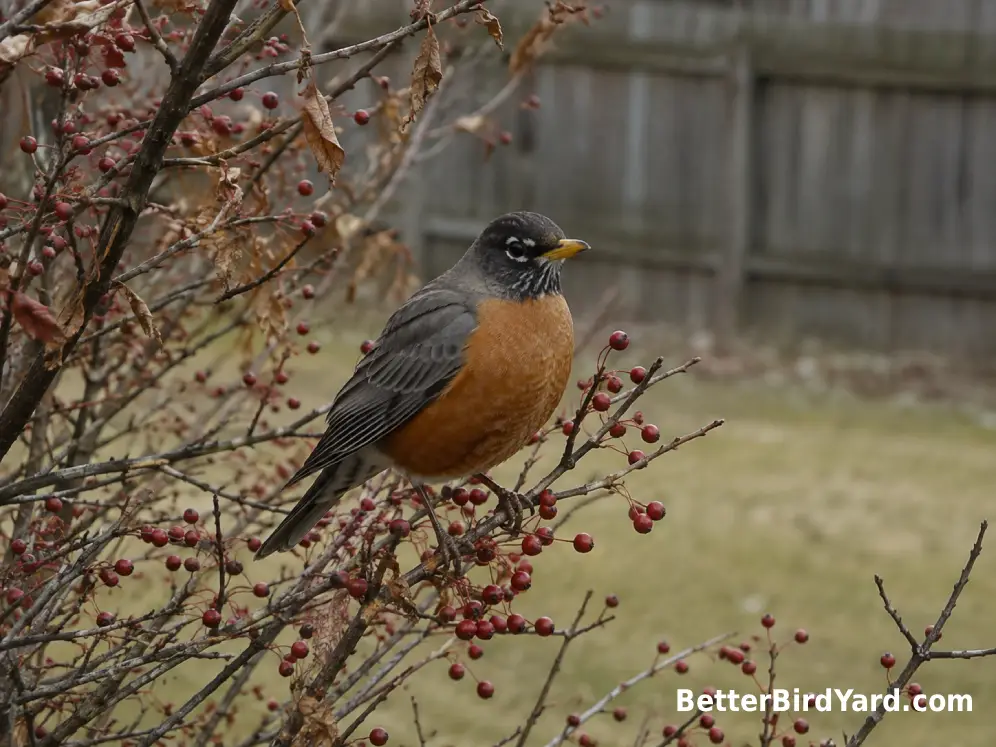
In the United States, the robin bird most people have in mind is the American Robin, Turdus migratorius. This familiar thrush is larger than many feeder birds, with long legs, a gray-brown back, a dark head, and warm orange underparts that are often casually described as a red breast. You are more likely to see one running across a lawn, tugging at an earthworm, or feeding in a fruiting tree than clinging to a tube feeder.
American Robins are common across much of North America, including suburbs, city parks, fields, forests, and gardens. They can also be surprisingly seasonal in their behavior: a robin that seems to vanish from your lawn in winter may simply have shifted to wooded areas and fruiting trees nearby.
For backyard bird watchers, the best way to support robins is not to chase a guaranteed feeder formula. Give them useful habitat: safe ground foraging, locally appropriate fruiting plants, clean shallow water, fewer pesticides, and protected nesting space. Those choices help robins while benefiting plenty of other backyard birds, too.
How To Identify An American Robin
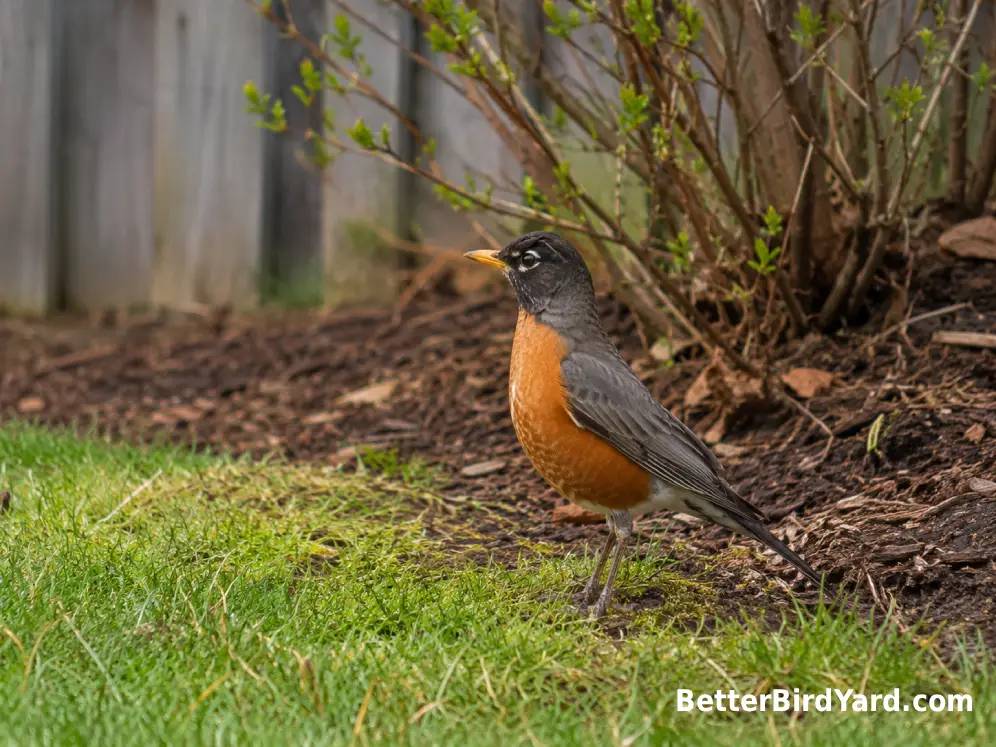
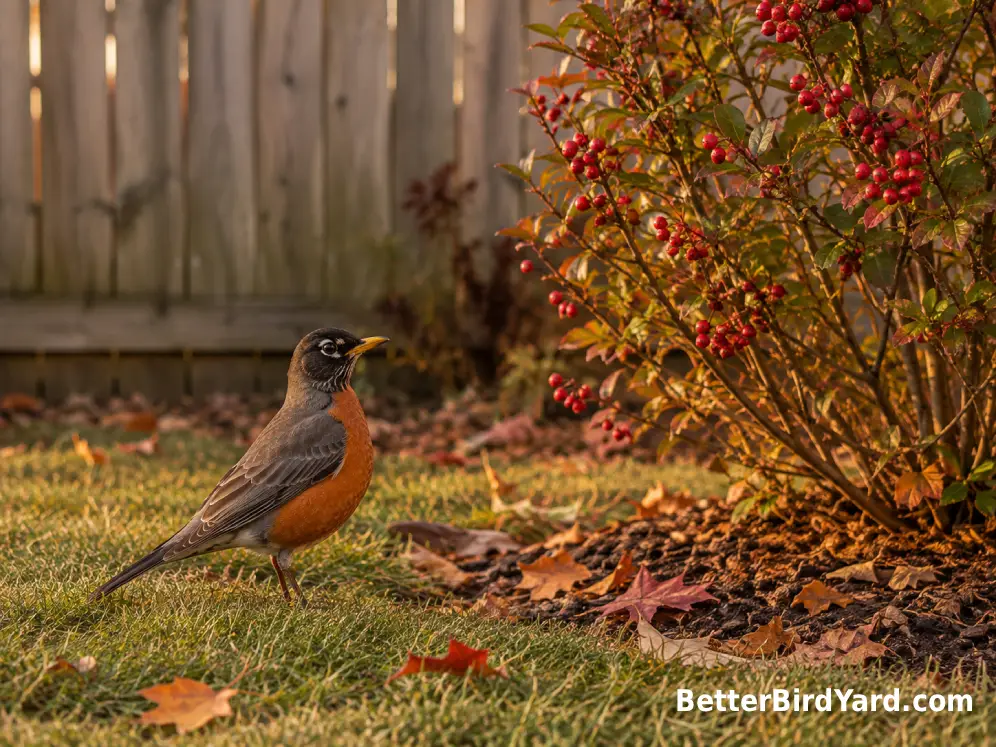
An adult American Robin has the classic shape of a large thrush: a rounded body, fairly long tail, and noticeably long legs. Cornell Lab measurements put adults at roughly 7.9–11 inches long, with a wingspan of about 12.2–15.8 inches.
| Feature | What To Look For |
|---|---|
| Breast And Belly | Warm rusty orange rather than a bright scarlet red |
| Back | Gray to gray-brown |
| Head | Usually darker than the back, especially on adult males |
| Bill | Mostly yellow in adults |
| Eye | Small pale markings around the eye |
| Juvenile | Spotted breast and mottled-looking upperparts |
| Behavior | Runs or hops across open ground, then pauses upright |
Male and female American Robins can look quite similar. Adult males tend to have darker heads and somewhat richer colors, while females and immature birds are often paler. Juveniles are easier to separate because their breasts are heavily spotted.
The familiar phrase red-breasted robin is understandable, but the American Robin’s breast is usually better described as orange or rusty orange. That color has also led to names such as robin redbreast and red robin bird in everyday conversation.
There is another useful distinction: the American Robin is not a close relative of the European Robin. The American species belongs to the thrush family Turdidae, while the European Robin belongs to the Old World flycatcher family Muscicapidae. The similar common name comes largely from their orange-breasted appearance.
Where American Robins Live And Why They Sometimes Disappear
American Robins use an unusually broad range of habitats. Lawns, parks, pastures, gardens, woodland edges, forests, mountain areas, and even tundra can all support them. In ordinary neighborhoods, the combination of open ground for feeding and nearby trees or shrubs for cover makes suburban landscapes especially familiar robin territory.
They are best thought of as residents or short-distance migrants rather than birds that follow one simple north-south schedule everywhere. Cornell notes that robins can be found year-round across much of the area south of Canada, while many birds breeding farther north move south in fall. Individual movements also depend on weather and food.
This explains one of the most common backyard mysteries. A lawn that hosted robins every morning in spring can look empty in December even though robins remain in the region. During fall and winter, they become more social and spend more time in flocks, wooded areas, and places with abundant fruit. Audubon notes that winter groups can wander as fruit supplies change rather than staying on the same breeding territories.
So a missing winter robin does not necessarily mean your yard has become unsuitable. Look beyond the grass. Check berry-bearing trees and shrubs, neighborhood woodland edges, park plantings, and other places where fruit remains available.
What Do American Robins Eat?
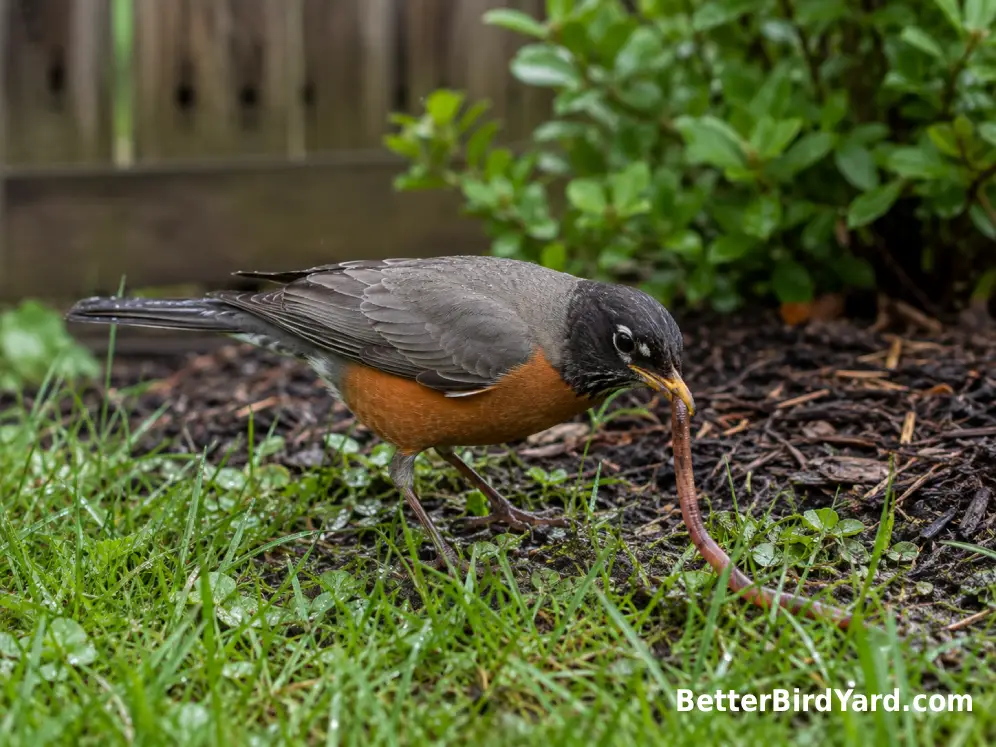
American Robins eat both animal prey and fruit, and the balance changes with the season. During the warmer part of the year they commonly take earthworms, insects, snails, spiders, and other invertebrates. Fruit becomes particularly important in fall and winter. Cornell lists foods such as dogwood, hawthorn, chokecherry, sumac, and juniper fruits among the many wild fruits robins use.
This is why watching the lawn gives you only part of the story. A robin hopping, stopping, and tilting its head toward the ground is using its normal ground-foraging behavior. Months later, that same species may spend much of its time high in fruiting vegetation instead.
If you want to make food available around a small yard or patio garden, focus first on natural habitat:
- Keep some pesticide-free ground available for natural invertebrate foraging.
- Plant fruiting shrubs or small trees native to your region where space allows.
- Leave some leaf litter beneath shrubs rather than making every bed completely bare.
- Use a clean shallow water source alongside food-producing habitat.
A standard hanging seed feeder is not the most direct way to appeal to a ground-foraging robin. If you want to experiment with supplemental food, Project FeederWatch materials include mealworms and fruit among foods robins may take, typically offered where the birds can access them from a platform or ground-level feeding area. Keep portions modest and remove wet or spoiled leftovers promptly rather than allowing food to accumulate.
BetterBirdYard note: If you only change one thing, improve the habitat before buying another feeder. Robins can find much of what they need from healthy soil, insects, fruiting plants, and water, and those improvements continue helping birds even when you are not filling a tray.
How To Make Your Yard More Robin-Friendly
You do not need a large property to make useful robin habitat. A small lawn edge, patio garden, shared courtyard, or narrow suburban planting strip can provide food, water, and cover if each feature does a practical job.
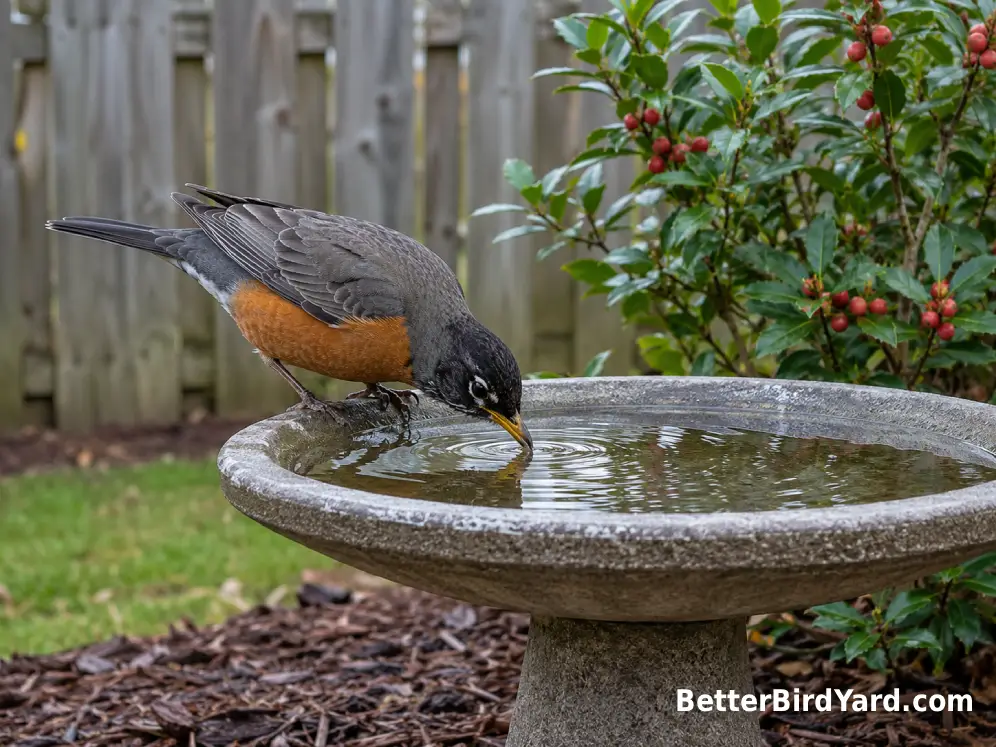
- Provide shallow clean water. Cornell recommends bird baths that resemble shallow pools, with gently sloping sides and water roughly 1 inch deep at the edges and no more than about 2 inches in the middle. Replace the water frequently and scrub the basin whenever it becomes dirty or develops algae.
- Add locally native fruiting plants. Choose species suited to your state, soil, light, and available space instead of assuming the same shrub belongs everywhere in the US. The National Wildlife Federation recommends native plants as a way to provide fruit, seeds, insects, cover, and other natural resources for birds.
- Keep some open foraging ground. Robins regularly hunt in lawns and other open areas, so you do not need to replace every square foot with dense vegetation. A useful small-yard design can combine open ground with planted edges.
- Reduce pesticide use. Because robins forage heavily on the ground and consume invertebrates, Cornell specifically notes their vulnerability to pesticide poisoning.
- Give birds an escape route. Place water and feeding areas where birds can see approaching danger, and keep free-ranging cats away. Cornell specifically cautions that birds at ground-level baths are vulnerable to cats.
If you add water, our bird bath guide can help you keep the setup practical and clean.
Robin Nests, Eggs, And Young Birds Around The House
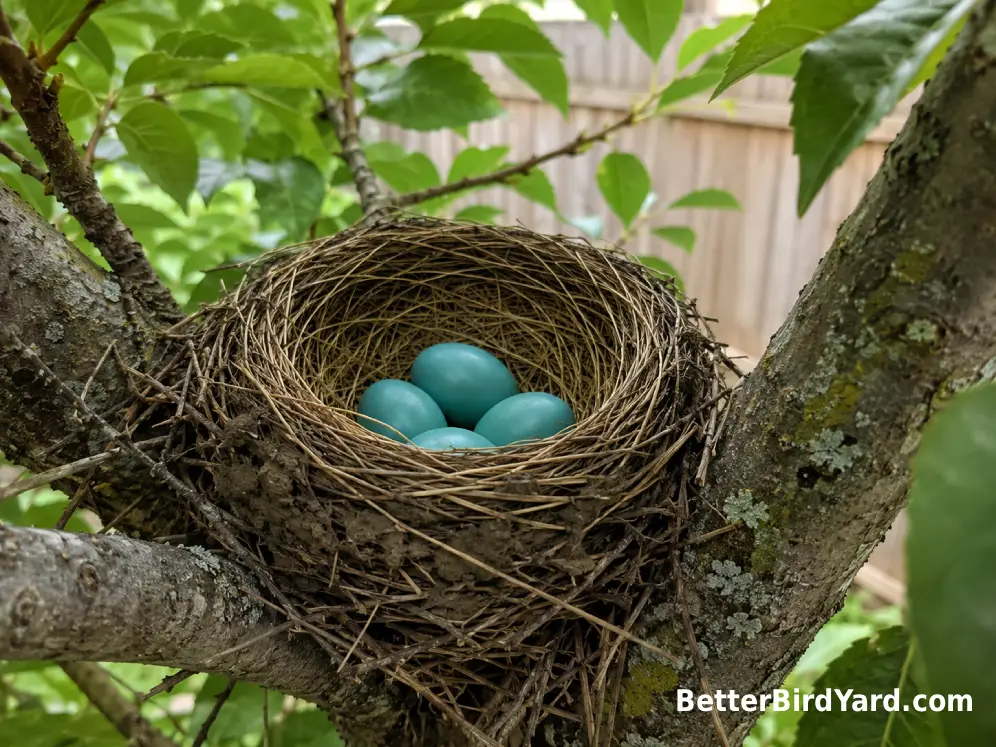
Robin nests are sturdy open cups built largely from grasses and other plant material, with mud reinforcing the structure. Females do most of the nest building. Typical sites include tree or shrub branches, but robins are adaptable and sometimes choose ledges, eaves, gutters, light fixtures, and other parts of buildings.
A typical clutch contains three to five blue or blue-green eggs, although individual nests vary. Cornell lists an incubation period of about 12–14 days and a nestling period of roughly 13 days, which helps explain why an active robin nest can seem to progress quickly.
If a robin nests near your porch or doorway, the most useful response is usually to reduce disturbance. Avoid repeated close inspection, keep pets away, and postpone optional work directly around the nest when practical. Cornell recommends observing nearby nests from a respectful distance rather than repeatedly approaching them.
A nest shelf can sometimes provide an alternative nesting structure for American Robins, particularly if you already know they regularly attempt to nest on a building. It is not a guarantee that a pair will use it, and it should be installed before nesting activity rather than used as a reason to disturb an active nest. Cornell includes American Robin nest structures among its backyard nesting resources.
Young robins on the ground can be alarming to beginners. A fully feathered fledgling that can hop or perch may be in a normal stage after leaving the nest, with parents still caring for it nearby. Keep pets indoors and watch from a distance rather than assuming the bird has been abandoned. If a young bird is visibly injured, truly orphaned, or in an unusual situation you cannot assess safely, contact a licensed wildlife rehabilitator or local wildlife agency for qualified guidance. Do not attempt to feed or raise a wild young bird yourself.
Common Backyard Mistakes That Can Put Robins At Risk
Robins are adaptable, but living close to homes creates hazards that do not exist in the same way in natural habitat. A few everyday choices make a bigger difference than elaborate feeding setups.
- Using lawn pesticides where robins forage. Earthworms and other ground-dwelling prey draw robins directly into treated areas. Reduce pesticide use and follow all product directions and local guidance where treatment is necessary.
- Leaving stagnant or dirty bird-bath water. Refill and clean the basin regularly rather than waiting for obvious slime or debris. Cornell recommends changing bird-bath water every day or two under ordinary warm-weather conditions and more often when it becomes dirty.
- Assuming one window sticker solves collisions. Birds may mistake reflected sky or vegetation for open space. Cornell recommends treatments that visibly cover the outside of the glass rather than leaving large untreated gaps; exterior screens are another effective option.
- Ignoring repeated window pecking. During territorial periods, a bird may react to its reflection. Reducing the exterior reflection or visually treating the glass is more useful than repeatedly chasing the bird away.
- Letting pets stalk ground-feeding birds or fledglings. Robins spend substantial time on the ground, and newly fledged birds can be especially vulnerable. Keeping cats indoors and supervising pets outdoors removes an avoidable backyard hazard.
- Moving or repeatedly checking an active nest. Give nesting birds space. If a nest location creates a genuine safety or property conflict, check with a local wildlife agency or qualified professional before taking action rather than improvising a relocation.
What Robin Behavior Can Tell You Through The Seasons
Spring is when many people notice American Robins most. Males sing frequently as breeding territories form, and birds spend conspicuous amounts of time on lawns and other open ground. In parts of the country, however, some robins may have been present through winter rather than arriving from far away. A sudden increase in singing and territorial behavior can therefore be a stronger sign of the changing season than the first individual robin you see.
During nesting season, watch for adults carrying food or nest material rather than trying to locate every nest. Later, spotted juvenile robins begin appearing, and newly fledged birds may spend time low in shrubs or on the ground while their parents continue caring for them.
By fall and winter, behavior can change dramatically. Robins form flocks, use trees more heavily, and move in response to fruit crops. That means a winter yard with native fruiting vegetation may suddenly host robins even if no birds were using the lawn the week before.
Local patterns still vary with latitude, elevation, weather, habitat, and the year’s food supply. Rather than expecting robins on a fixed calendar, keep notes on what they are doing. Their choice of lawn, tree canopy, berry patch, or nesting site can tell you more than the date alone.
A Good Robin Yard Is A Good Bird Yard
The American Robin is familiar enough to be overlooked, but it is one of the best birds for learning how a backyard actually functions as habitat. Watch one closely and you see the connections: healthy ground produces invertebrate prey, shrubs and trees provide fruit and nesting structure, shallow water offers a place to drink and bathe, and safer windows and pet practices reduce hazards around the home.
You also do not need to turn a small yard into a complicated wildlife project. A renter with a patio may be able to maintain a shallow clean water dish and a container-grown native plant appropriate for the region. A suburban homeowner may have room for a fruiting shrub, a pesticide-free lawn edge, and safer window treatments. The useful changes are the ones you can maintain consistently.
And if the red-breasted robin you expected to see at a seed feeder never shows up there, that does not mean you have failed. Look down at the lawn, up into fruiting branches, and around the quieter edges of the yard. American Robins often respond more strongly to good habitat than to another tube of seed—and that makes supporting them a practical starting point for a healthier backyard for wild birds in general.