American Goldfinch: The Bright Backyard Finch That Changes With The Seasons
The American Goldfinch is one of the most recognizable backyard birds in the United States—at least when an adult male is wearing his brilliant spring and summer colors. That same bird can look surprisingly subdued in winter, which is why beginners sometimes wonder where all their yellow finches went.
American Goldfinches are small, seed-eating finches with a bouncy flight, a short conical bill, and a strong preference for open, seed-rich habitats. They readily visit suburban yards and feeders, especially where sunflower or nyjer seed is available. The species’ current scientific name is Spinus tristis; older references may list Carduelis tristis. Cornell Lab currently places the American Goldfinch in the finch family Fringillidae and genus Spinus.
How To Identify An American Goldfinch
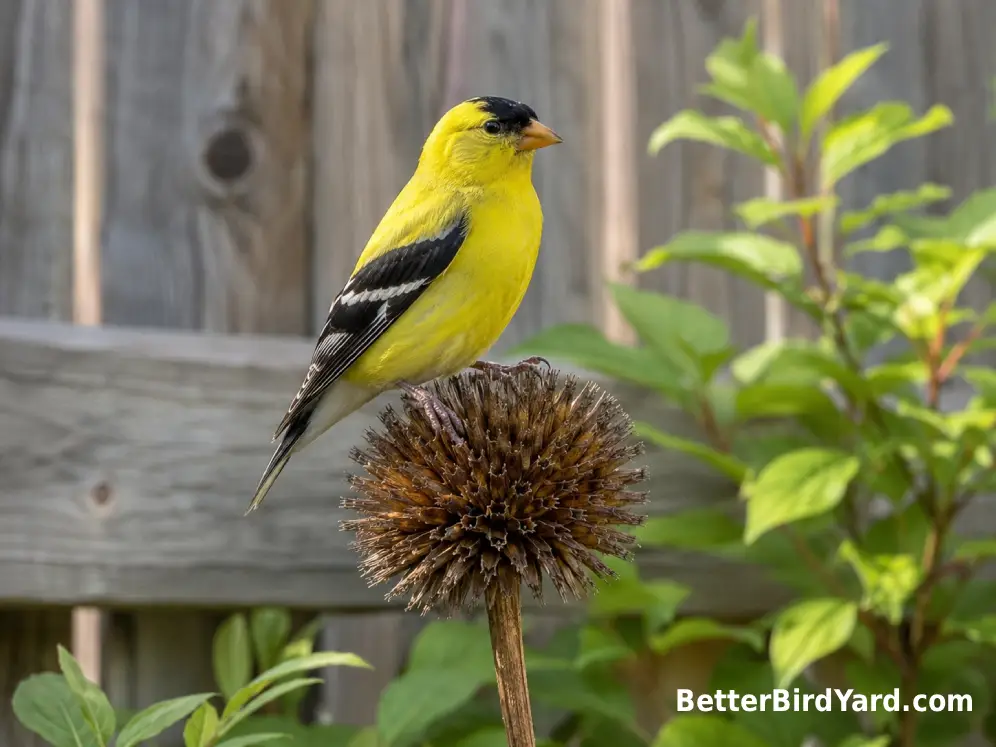
A breeding male is the easy version: look for a small, intensely yellow bird with a black forehead, black wings, white wing markings, and a dark tail. American Goldfinches are roughly sparrow-sized, measuring about 4.3 to 5.1 inches long. Their short, pointed-looking conical bill is well suited to handling seeds.
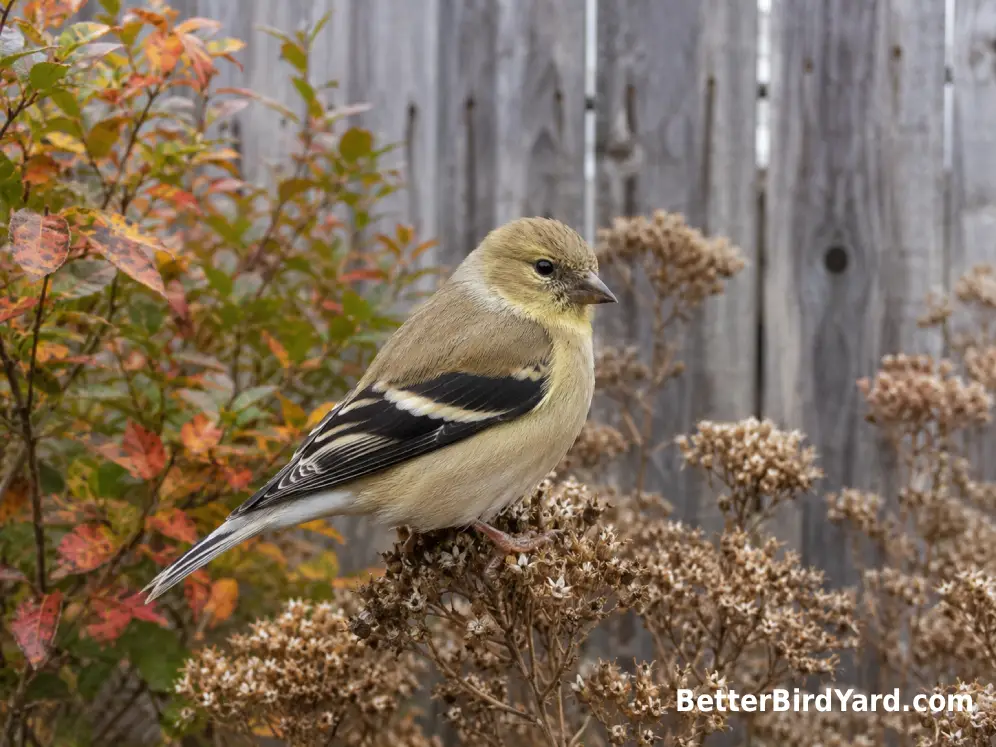
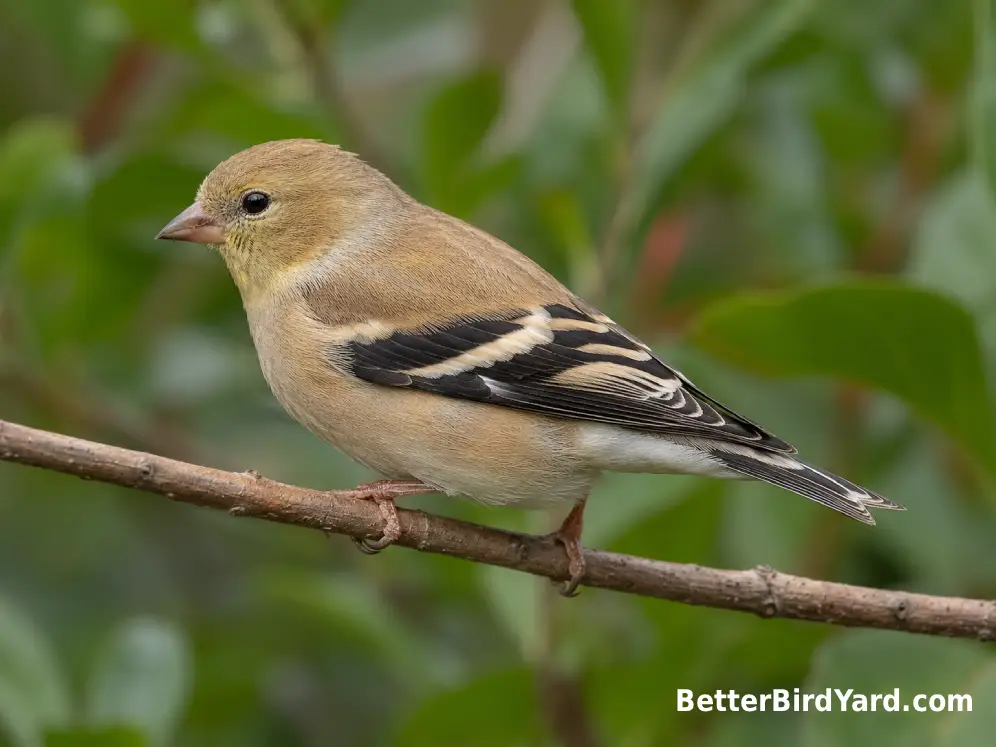
Females are less flashy. During the breeding season they tend to be yellow below and more olive above, without the male’s black forehead. Immature birds are browner and paler. In winter, both sexes become much less conspicuous, although the dark wings, pale wingbars, unstreaked body, and notched tail remain useful identification clues.
- Look for a small finch rather than a robin-sized yellow bird.
- Notice whether the breast and belly are mostly unstreaked.
- Watch for blackish wings with pale markings.
- Listen for calls during the bird’s dipping, undulating flight.
One of the best field clues is behavior. Goldfinches routinely cling to flexible seed heads and feeders at odd angles, and their flight rises and falls in a distinctive series of arcs. Cornell describes their common flight call with the familiar mnemonic “po-ta-to-chip.”
Why Do Goldfinches Lose Their Bright Yellow Color?
The dramatic color change is normal. American Goldfinches replace their body feathers twice each year. Adult males develop their familiar bright yellow breeding plumage before the nesting season and molt into a much duller appearance later in the year. Females also change seasonally, although their breeding plumage never becomes as brilliant as the male’s.
During a molt, a male can look patchy—part bright yellow, part brownish or olive. That awkward in-between appearance can make an otherwise familiar backyard bird surprisingly difficult to recognize.
For backyard identification, the practical lesson is simple: do not rely on yellow alone. Check the wing pattern, compact finch shape, bill, unstreaked body, flight style, and flocking behavior. If the little gold finches you enjoyed in summer seem to have disappeared in fall, some may simply be wearing their quieter seasonal colors.
Where Do American Goldfinches Live?
American Goldfinches occur widely across the United States, but whether you see them year-round or mainly during part of the year depends on location, weather, and food availability. Their seasonal movements are somewhat irregular, so a backyard that hosts a large flock one winter may have fewer birds the next. Audubon notes that winter movements can vary with food conditions.
The habitat is often easier to predict than the calendar. Goldfinches favor open and semi-open places with plenty of seed-producing plants: weedy fields, roadsides, floodplains, woodland edges, parks, gardens, and suburban yards. Dense forest interiors are much less typical.
That preference is useful for small-space bird watchers. You do not need a large rural property. A sunny patio border, small suburban planting bed, community garden edge, or modest yard can provide useful feeding habitat if it includes seed-producing plants and a reasonably safe place for birds to perch nearby.
Seasonal variation also means an empty feeder does not automatically mean something is wrong. Natural seed crops, weather, migration, neighborhood habitat, and other food sources can all change how often goldfinches visit.
What Do American Goldfinches Eat?
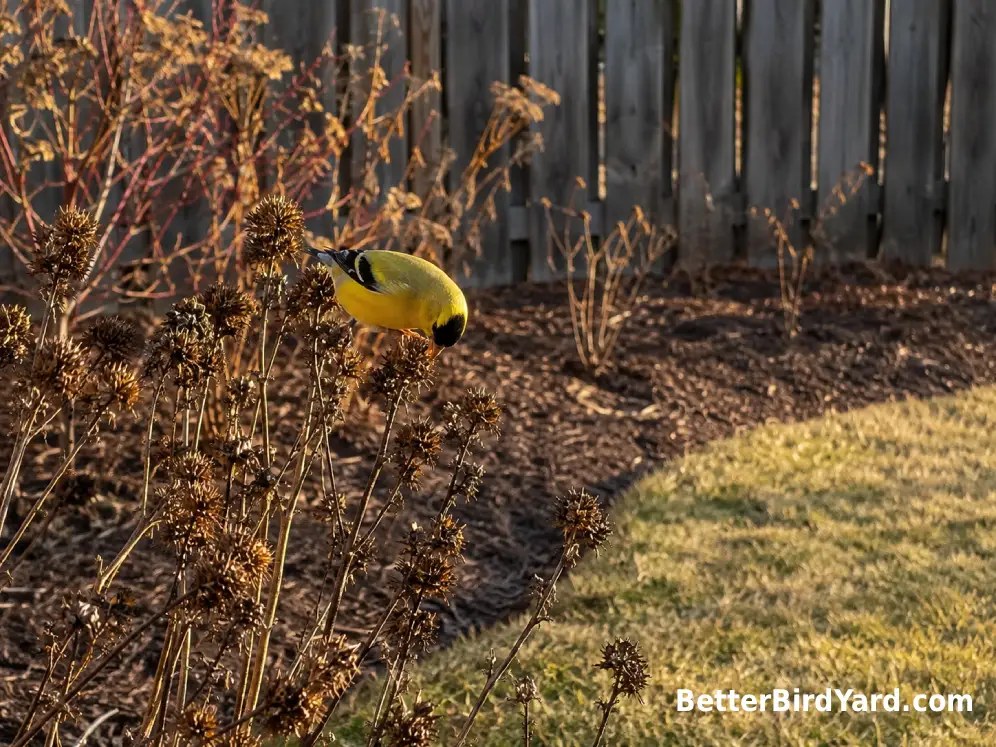
Seeds dominate the American Goldfinch diet. In natural habitat they feed heavily on seeds from plants such as sunflowers, asters, thistles, grasses, and several seed-producing trees. They are unusually seed-focused even during the nesting season.
At feeders, two straightforward choices stand out:
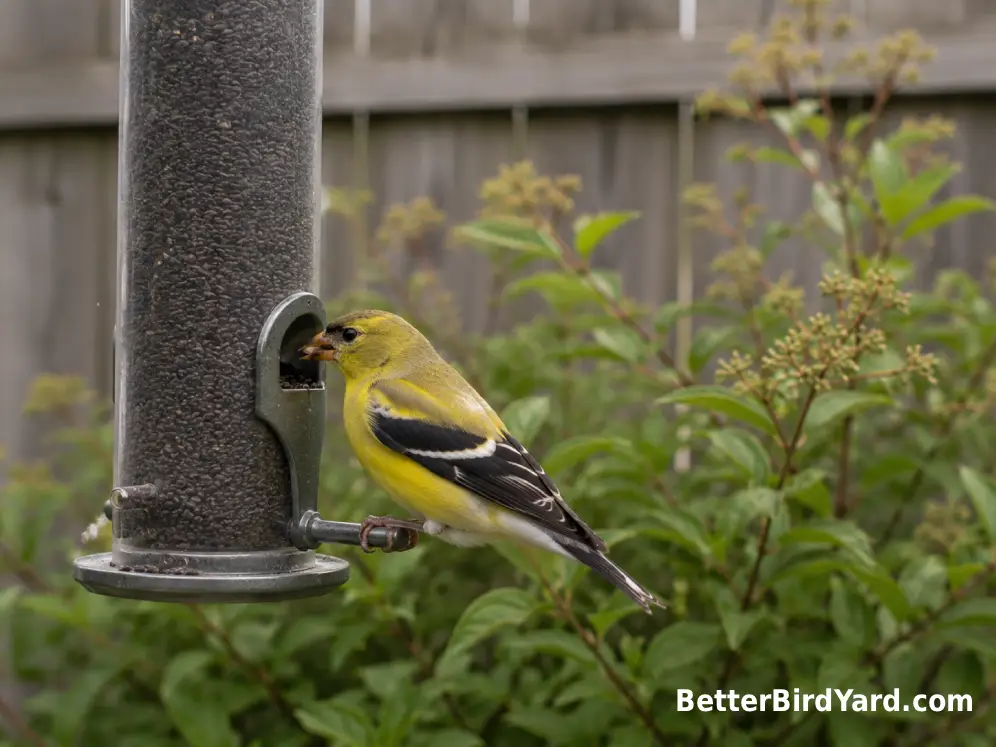
- Nyjer seed works especially well in feeders with very small ports designed to hold the tiny seed.
- Sunflower seed is another reliable option and can be offered in several common feeder styles.
Project FeederWatch notes that nyjer—sometimes sold as “thistle seed”—actually comes from an African plant and is not a North American thistle seed. Its tiny size is why a purpose-built finch feeder helps reduce waste.
For a beginner, buying a modest amount of good seed is usually more practical than filling several feeders at once. Keep seed dry and discard anything damp, moldy, or spoiled. A feeder that sits full for weeks is not helping birds simply because food is technically available.
A common mistake we see is focusing entirely on purchased seed while removing every spent flower head from the yard. Leaving some safe, pesticide-free seed heads standing gives goldfinches another place to forage naturally and makes the yard useful even when a feeder is temporarily empty.
For more feeder-food choices, see our backyard bird seed guide.
How Can You Attract American Goldfinches To A Small Yard Or Patio?
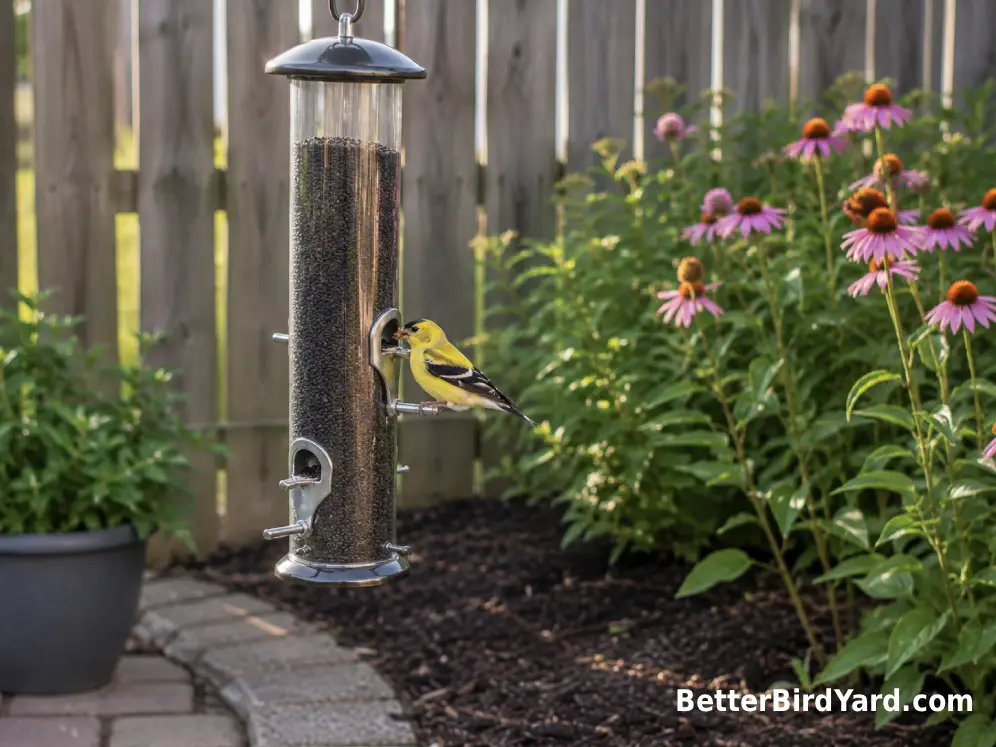
Goldfinches do not require an elaborate feeding station. In a small yard, renter-friendly patio, or compact garden, keeping the setup easy to clean is more useful than hanging several different feeders.
- Start with one clean tube or finch feeder.
- Offer nyjer, sunflower seed, or both depending on the feeder.
- Add region-appropriate seed-producing native plants where space permits.
- Leave selected seed heads standing after flowering.
- Watch for excessive spilled seed and clean the area beneath the feeder.
Cornell specifically recommends native thistles, other plants in the sunflower family, and native milkweeds as useful backyard plants for American Goldfinches. Because appropriate species vary around the country, use a state extension service or reputable local native-plant resource when choosing plants rather than assuming every thistle or wildflower sold nationally belongs in your region.
A container garden can still contribute. Even one sunny pot or planter with suitable native flowers can produce seed heads and vegetation around an otherwise bare patio. If building rules, an HOA, or a landlord regulate feeders or balcony feeding, check those rules before setting up a feeding station.
If you only change one thing, start with consistency rather than quantity: a clean feeder with fresh seed and a little natural plant cover is a better foundation than several neglected feeders.
Why Do American Goldfinches Nest So Late?
American Goldfinches are notably late nesters compared with many familiar North American songbirds. Cornell reports that pairs commonly wait until mid-summer, when thistles and other plants have begun producing both abundant seed and fibrous material useful for nest building.
The female builds a compact open cup, usually in a shrub or sapling in a relatively open setting. Plant fibers form much of the structure, with soft plant down used in the lining and spider silk helping secure the nest to its supporting branches.
For a homeowner, the best response is usually restraint. If you discover an active nest, observe from a distance rather than trimming branches, moving the nest, repeatedly approaching it for photographs, or trying to improve it. Nesting schedules differ with latitude and local conditions, so avoid treating a single calendar date as universal.
Leaving some native shrubs and late-season seed-producing plants in place also supports the kind of habitat goldfinches naturally use without requiring you to locate or manage a nest directly.
What Backyard Mistakes Can Make A Goldfinch Feeder Less Safe?
A feeder can concentrate birds in a small space, so sanitation matters. Seed hulls, droppings, wet food, and accumulated debris should not be allowed to build up indefinitely. Project FeederWatch recommends regular cleaning, removal of visible debris, thorough rinsing after disinfection, and complete drying before feeders are refilled.
- Do not leave wet, moldy, or spoiled seed in the feeder.
- Do not let old seed and droppings accumulate underneath.
- Do not assume a lethargic or unusually approachable bird simply needs more food.
- Do not crowd several feeders into one tiny area if birds are constantly packed together.
- Do not ignore highly reflective windows near active bird-feeding areas.
If a bird at your feeder appears unusually weak, remains fluffed up for long periods, has obvious eye problems, or otherwise seems compromised, avoid trying to diagnose or treat it yourself. Project FeederWatch recommends removing the feeder being used by a sick bird for a couple of weeks, thoroughly cleaning the feeder and feeding area, and allowing birds to disperse. Check local wildlife-agency guidance if an outbreak is being reported in your area. A wild bird that clearly needs intervention should be referred to a licensed wildlife rehabilitator or other qualified local professional.
Windows and predators deserve attention too. Exterior markings that break up reflections can help birds recognize glass as a barrier, and keeping pet cats indoors reduces predation risk around feeding areas.
Our bird feeder cleaning guide covers routine feeder care in more detail.
How Can You Tell An American Goldfinch From Other Yellow Finches?
Yellow finch is a useful description, but it is not a precise species name. Several North American finches can show yellow, and western bird watchers in particular may encounter more than one goldfinch species.
| Bird | Useful Backyard Clue | Where Confusion Happens |
|---|---|---|
| American Goldfinch | Small, unstreaked body; dark wings with pale markings; breeding male bright yellow with black forehead. | Winter birds lose much of the bright yellow that beginners expect. |
| Lesser Goldfinch | Another small yellow-and-dark finch, found mainly in western parts of the Americas. | Adult males can look very similar at a quick glance. |
| Pine Siskin | Brown and strongly streaked, often with yellow edging in the wings and tail. | Frequently mixes with other finches and may visit the same feeders. |
| Lawrence’s Goldfinch | Adult male combines gray, black, and yellow rather than the American Goldfinch’s mostly yellow breeding body. | Most relevant in California and parts of the Desert Southwest. |
Cornell lists Lesser Goldfinch, Lawrence’s Goldfinch, and Pine Siskin among the useful comparison species for American Goldfinch identification.
Why Do The Names Eastern Goldfinch And Carduelis Tristis Still Appear?
Older books, websites, signs, and state documents can make goldfinch naming look more complicated than it is. The current scientific name used by Cornell Lab is Spinus tristis. The name Carduelis tristis is an older classification; Cornell’s Clements taxonomy moved the American Goldfinch and other New World goldfinches from Carduelis into Spinus in its 2009 update.
Eastern goldfinch is also an older common name that still survives in official material. Iowa’s state-symbol information, for example, says the legislature designated the eastern goldfinch—also called the American goldfinch—as the state bird in 1933. Washington officially uses the historic name willow goldfinch for its state bird. New Jersey also recognizes the American Goldfinch as its state bird.
These names do not mean you are looking at several different eastern goldfinch birds. In this context they refer to the same species now widely called the American Goldfinch.
The biggest lesson with this little yellow-and-black bird is that observation gets easier once you stop expecting it to look identical all year. Learn the dark wings, pale wing markings, compact seed-eating bill, unstreaked body, dipping flight, and fondness for seed heads, and American Goldfinches become much easier to recognize in every season.
Supporting them is equally uncomplicated. Offer fresh nyjer or sunflower seed if you feed birds, keep feeders and the ground beneath them clean, leave useful seed-producing plants where practical, and make the feeding area safer from windows and roaming cats. Combine those habits with realistic expectations about seasonal movement, and even a modest yard or patio can become a worthwhile place to watch these lively finches.