Titmouse Bird Guide: Meet the Tufted Titmouse in Your Backyard
A titmouse bird can be easy to overlook for about two seconds. Then you notice the pointed crest, oversized dark eyes, quick movements, and surprisingly confident attitude around the feeder. For many people in the eastern United States, that bird is the Tufted Titmouse, a small gray songbird closely related to chickadees.
The Tufted Titmouse is gray above and pale below, with a noticeable crest, a dark patch on the forehead, and warm peach-colored flanks. It lives in wooded neighborhoods as well as forests, parks, and other places with mature trees. It also readily visits backyard feeders. Cornell Lab describes the species as a frequent feeder visitor that commonly takes sunflower seed, while insects make up an important part of its natural diet, especially during warmer months.
This guide focuses on identifying the Tufted Titmouse, understanding what it does around a yard, and supporting it responsibly. It also explains why a titmouse in Texas, California, or the interior West may be a different species entirely.
What Does A Tufted Titmouse Look Like?
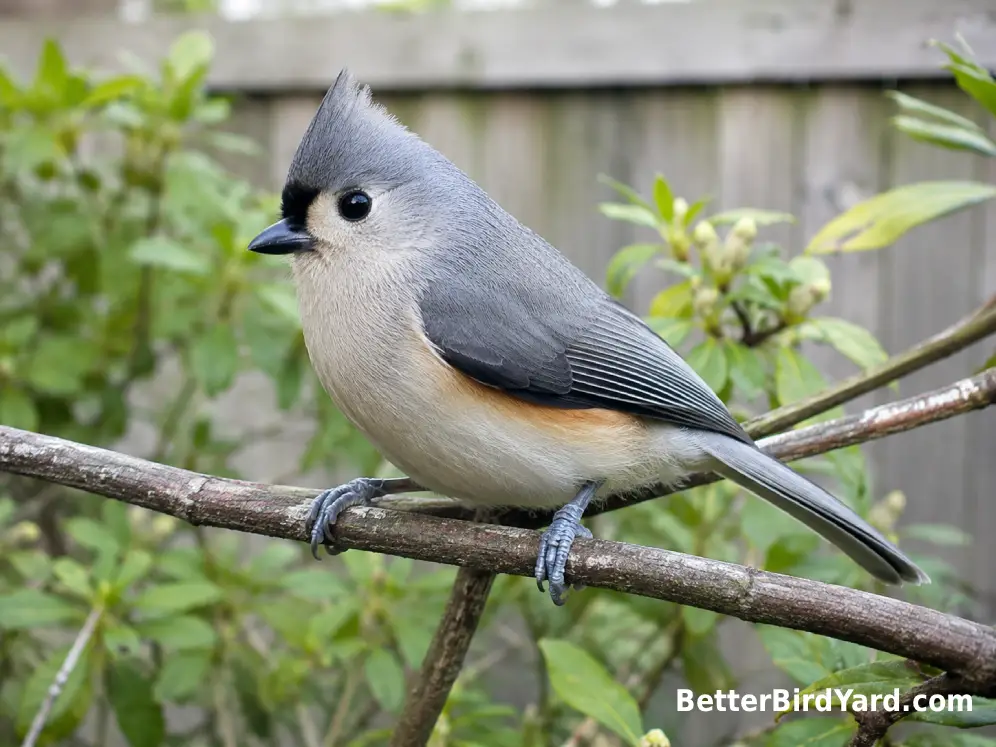
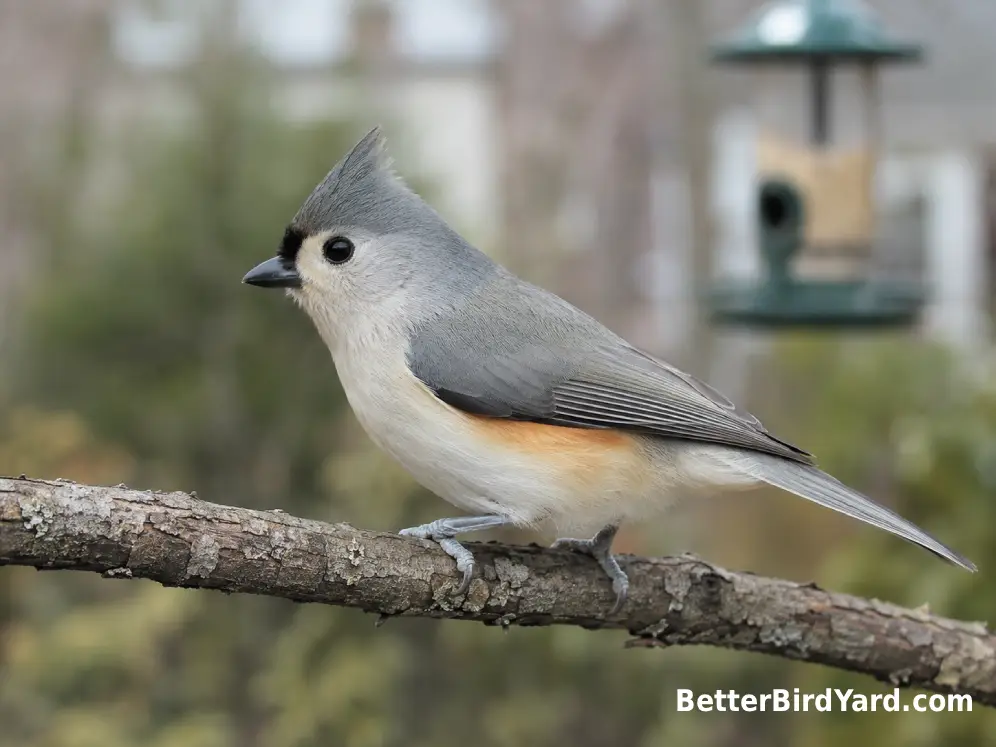
If you are wondering what a Tufted Titmouse looks like, start with shape before color. It has a relatively large head for such a small bird, a thick-looking neck, a short stout bill, and a pointed crest that can be raised or lowered. Those features can make it look more substantial than a chickadee even though both are small backyard songbirds.
Cornell Lab lists adult Tufted Titmice at roughly 5.5–6.3 inches long. The upperparts are soft silvery gray, while the belly is pale. Look for a small black patch directly above the bill and a rusty or peach wash along the sides. The large black eye stands out strongly against the otherwise pale face.
| Field Mark | What To Look For |
|---|---|
| Crest | Noticeable pointed gray crest that can lie flatter or stand upright |
| Face | Pale gray face with a large, dark eye |
| Forehead | Small black patch immediately above the bill |
| Back And Wings | Mostly plain silvery gray |
| Underparts | Whitish belly with peach or rusty coloring along the flanks |
| Overall Shape | Compact body, relatively large head, short bill, and medium-long tail |
The peach coloring is useful, but do not depend on it alone. Cornell notes that the flanks can appear less obvious on some individuals or in worn plumage. A combination of crest, black forehead, plain gray back, pale face, and location is much more reliable.
Where Do Titmouse Birds Live In The United States?
The Tufted Titmouse is primarily an eastern bird. Cornell describes it in eastern deciduous and mixed woodlands as well as parks, orchards, and suburban areas. Audubon also treats it as a largely permanent resident rather than a long-distance migrant.
That eastern range matters for identification because titmice are not limited to one species. Several related species occur in different parts of the United States.
| Species | Typical U.S. Setting | Useful Visual Clue |
|---|---|---|
| Tufted Titmouse | Eastern woodlands, parks, and wooded neighborhoods | Gray crest, black forehead, pale face, peach flanks |
| Black-crested Titmouse | Especially central and southern Texas | Bold black crest |
| Oak Titmouse | Mostly California and nearby southwestern Oregon | Plain gray-brown plumage with a small crest |
| Juniper Titmouse | Dry pinyon-juniper country of the interior West | Plain gray appearance and small crest |
| Bridled Titmouse | Mountain woodlands of the southwestern U.S. | Distinctive black-and-white face pattern |
Cornell describes the Black-crested Titmouse as characteristic of central and southern Texas, the Oak Titmouse as a bird of warm western oak country, the Juniper Titmouse as a specialist of dry pinyon-juniper woodland, and the Bridled Titmouse as a bird of southwestern mountain forests.
So if you see a crested titmouse bird well outside the eastern United States, location should be one of your first identification clues rather than an afterthought.
How Can You Tell A Tufted Titmouse From Similar Birds?
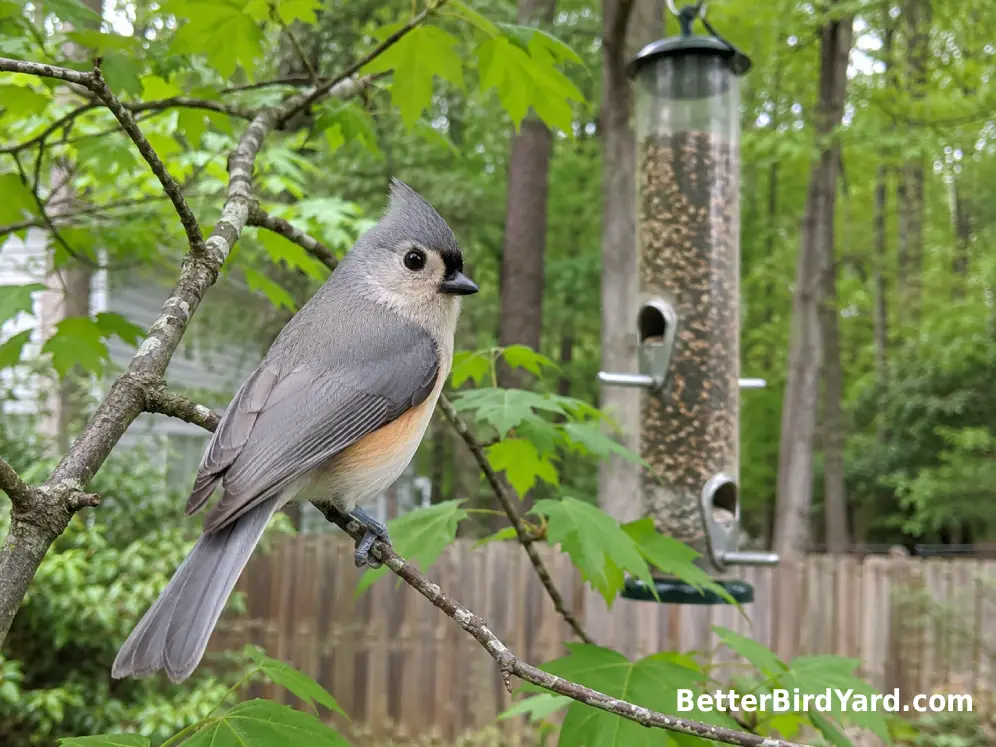
Chickadees are probably the most common source of confusion in an eastern backyard. Both groups are members of the chickadee-and-titmouse family, both move actively through trees, and both regularly investigate feeders. Tufted Titmice, however, look larger-headed and usually show an obvious crest. Black-capped and Carolina Chickadees have contrasting black caps and throats rather than a gray crest.
If you are sorting through a quick view or a backyard photo, check these clues in order:
- Look for the crest. A prominent gray crest immediately favors Tufted Titmouse over an eastern chickadee.
- Check the forehead. A Tufted Titmouse has a small dark patch right above its bill rather than a full black cap.
- Look at the flanks. Peach coloring along the sides supports a Tufted Titmouse identification.
- Consider location. In much of central Texas, compare carefully with Black-crested Titmouse instead.
- Watch the overall pattern. Tufted Titmice are relatively plain gray-and-white birds, without the strong black throat bib of a chickadee.
The bird’s voice can be another clue. One well-known Tufted Titmouse song is a repeated clear whistle often rendered as peter-peter-peter. They also produce numerous calls, so not every titmouse you hear will give that textbook song.
What Do Tufted Titmice Eat?
A feeder can make it seem as though titmice live on sunflower seed, but their natural diet is much broader. Cornell reports that Tufted Titmice eat many insects during summer, including caterpillars, beetles, ants, wasps, and other invertebrates. They also eat spiders, seeds, nuts, berries, acorns, and beech nuts.
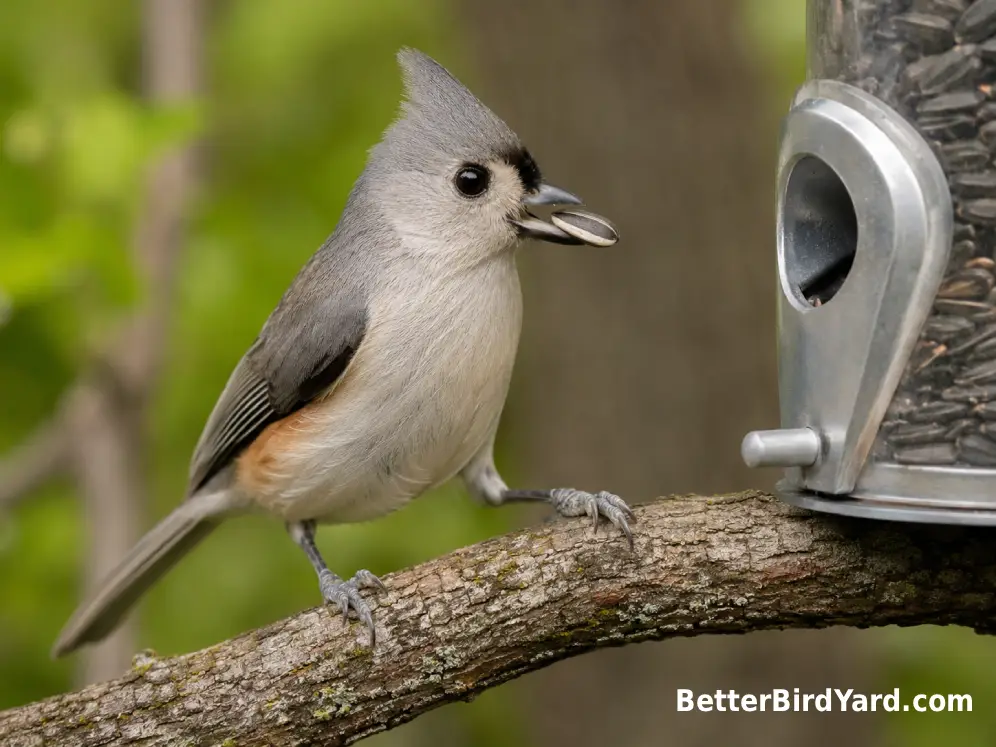
Their feeder behavior is especially fun to watch. A titmouse commonly lands, selects one substantial seed, and leaves rather than sitting at the feeder for a long meal. It may take the seed to a nearby branch, hold it with its feet, and hammer it open with its bill. Titmice also store food in fall and winter, tucking items into bark crevices and other hiding places for later use.
Useful supplemental foods include sunflower seed, peanuts, and suet. Cornell specifically lists these among the foods Tufted Titmice readily take at feeders.
For a simple backyard setup, sunflower seed is usually the most practical starting point. If you are choosing among seed types or trying to reduce waste, our bird seed guide can help you match food to the birds visiting your yard.
Feeding should remain supplemental. A yard with trees, shrubs, and insect life gives titmice opportunities to forage naturally in ways a feeder cannot replace.
How Can You Attract Tufted Titmice Responsibly?
You do not need a large wooded property to make a space more useful to titmice. A suburban lot with mature trees can work well, and even a small patio next to established neighborhood tree cover may receive visits. Results still depend on geography, habitat, season, and whether titmice already live nearby.
A practical setup has four basic pieces:
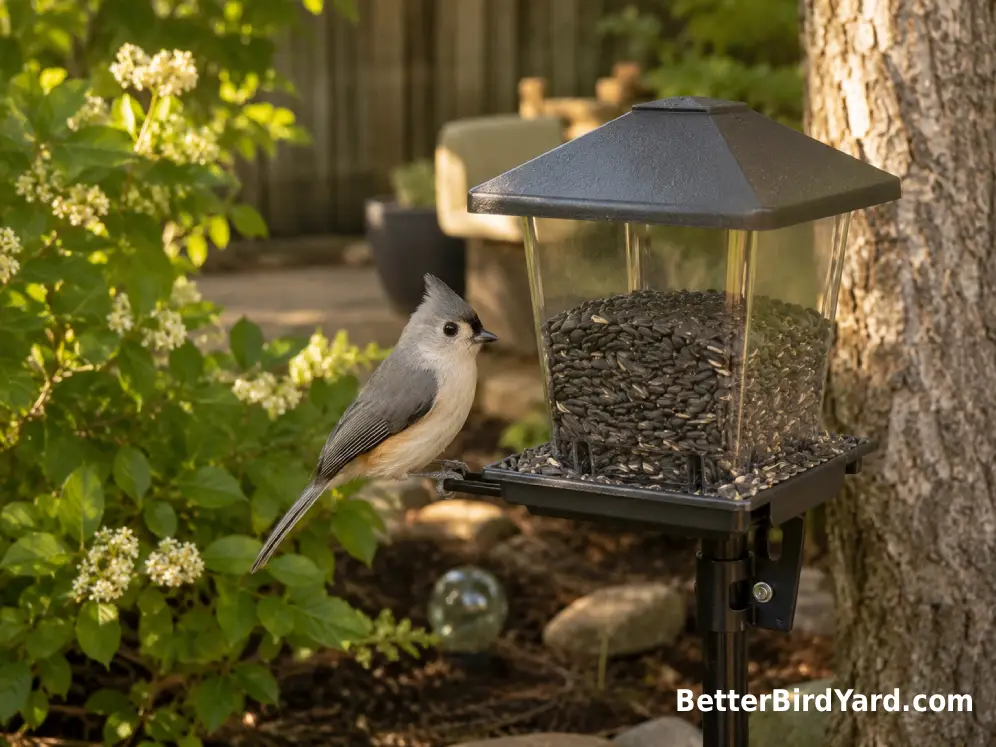
- Offer fresh sunflower seed in a feeder that is easy to dismantle and wash.
- Place the feeding area near useful tree or shrub cover while also making nearby reflective windows bird-safe.
- Provide clean water in a shallow bird bath if you can maintain it consistently.
- Add locally native trees, shrubs, or container plants suited to your region rather than relying entirely on feeders.
Cornell lists Tufted Titmice as regular feeder visitors that take sunflower seed, peanuts, and suet. Project FeederWatch recommends choosing feeders that can be cleaned thoroughly and keeping accumulated seed and hulls from building up underneath them.
Habitat deserves equal attention. Because insects are an important part of a titmouse’s natural diet, locally native plants can add more than visual cover. Audubon recommends native plants as a way to support insects as well as seeds, berries, shelter, and other bird resources. Plant choices should be matched to your own region rather than copied from a one-size-fits-all national list.
BetterBirdYard note: In a small yard, I would keep this simple. One easy-to-clean feeder, one patch of useful vegetation, and a maintenance routine you will actually follow are better than five feeders that become a chore.
Where Do Tufted Titmice Nest And What Are They Doing In Your Yard?
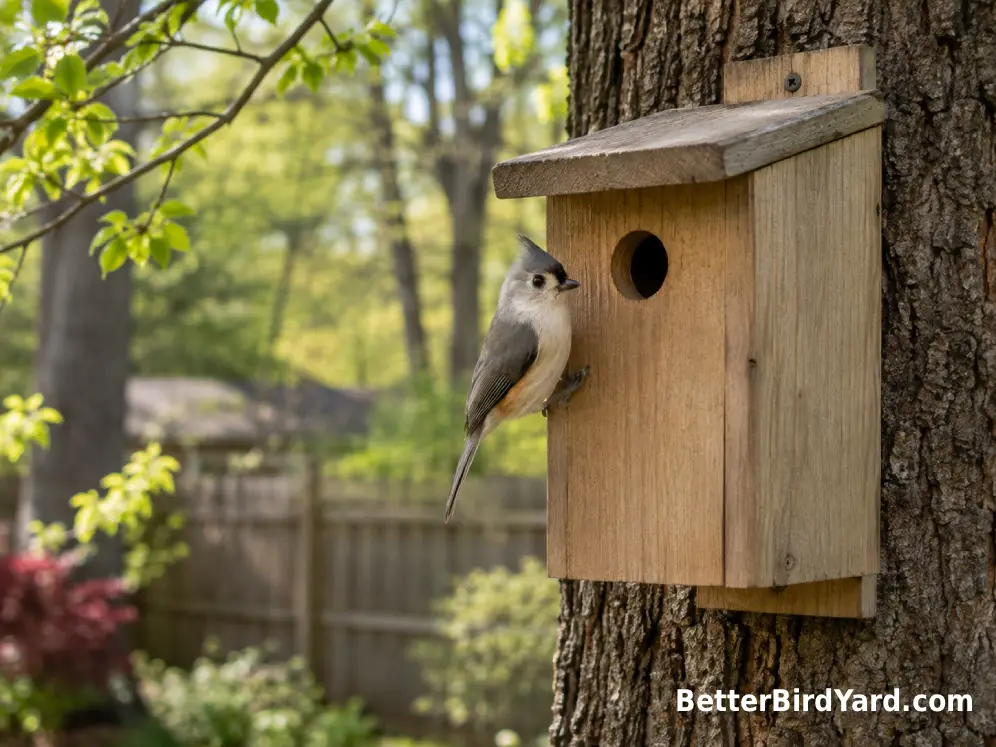
Tufted Titmice are cavity nesters. Unlike woodpeckers, they generally do not excavate a fresh cavity themselves. Cornell reports that they use natural holes, old woodpecker cavities, and sometimes nest boxes or other suitable cavities.
That makes mature trees especially valuable. Where it is safe and practical, preserving natural cavity habitat can benefit many birds besides titmice. A properly designed nest box may also provide an option where suitable cavities are limited. Use dimensions and predator-protection guidance from an authoritative resource such as Cornell’s NestWatch or All About Birdhouses rather than improvising a decorative box that may not suit the species.
A bird repeatedly carrying moss, leaves, or other nesting material toward the same cavity may be part of a breeding pair. Once a nest is active, observation from a respectful distance is the better approach. Avoid repeatedly opening or approaching the nest just to check progress.
Outside nesting season, titmice are often seen working through branches methodically, sometimes hanging sideways or upside down while searching leaves and bark. They may join mixed feeding groups with chickadees, nuthatches, woodpeckers, and other woodland birds.
What Common Titmouse Feeding Mistakes Should You Avoid?
Titmice are fairly straightforward feeder visitors, which makes it tempting to put out seed and forget about everything else. Most problems come from maintenance rather than from choosing a fancy feeder.
- Do not keep topping off old seed indefinitely. Empty out damp, spoiled, or heavily contaminated food rather than burying it under fresh seed.
- Do not ignore feeder hygiene. Project FeederWatch currently recommends cleaning seed and suet feeders regularly, such as every week or two, and more often during heavy use or wet conditions. Let feeders dry completely before refilling.
- Do not let old seed pile up underneath. Sweep or rake away accumulated hulls, droppings, and spoiled food. This also helps reduce opportunities for rodents.
- Do not overlook nearby glass. Cornell advises making windows near feeders bird-friendly because reflections of vegetation and sky can cause collisions. Current Cornell guidance emphasizes treating dangerous glass rather than relying only on an assumed safe feeder distance.
- Do not expect one feeder to replace habitat. Titmice naturally eat insects, seeds, nuts, and other foods gathered from trees and vegetation.
If cleaning is becoming difficult to keep up with, reduce the number of feeders rather than lowering the maintenance standard. See our bird feeder cleaning guide for a routine that is easier to maintain.
What Should You Do If A Titmouse Looks Sick Or Injured?
A fluffed-up bird that remains unusually still, has obvious eye or facial abnormalities, appears unable to fly normally, or behaves very differently from the other feeder visitors may be sick or injured. Those signs are not enough to diagnose a condition from the backyard.
If an apparently sick bird is using your feeder, avoid handling it. Clean the feeders, baths, and surrounding feeding area carefully, and consider temporarily reducing or pausing feeding while you check current guidance from Project FeederWatch and your state or local wildlife agency. Project FeederWatch advises additional cleaning and may recommend removing feeders when sick birds are present so birds are not repeatedly congregating at the same feeding site.
For an injured, stunned, or severely compromised wild bird, contact a licensed wildlife rehabilitator, local wildlife agency, or other qualified wildlife professional for instructions. Do not medicate wild birds, add medicine to food or water, or attempt home treatment. Project FeederWatch specifically advises against trying to treat compromised wild birds yourself.
A Small Gray Bird Worth Watching Closely
Once you know the combination of a pointed gray crest, dark forehead, large black eye, pale belly, and warm peach flanks, a Tufted Titmouse becomes one of the easier eastern backyard birds to recognize. Its habit of taking a single seed and carrying it away can make identification even easier when you have time to watch rather than relying on one quick glimpse.
Remember that titmouse identification is partly geographic. The familiar Tufted Titmouse dominates much of the East, while Black-crested, Oak, Juniper, and Bridled Titmice occupy different portions of the country. A good identification combines appearance, habitat, location, behavior, and voice rather than relying on the crest alone.
For backyard support, keep the formula uncomplicated: fresh appropriate food, clean feeders and water, safer windows, locally suitable vegetation, and space for birds to behave naturally. Those details may not guarantee that a Tufted Titmouse visits tomorrow, but they create a more responsible yard for the titmice and other wild birds already living in your neighborhood.