Mourning Dove: Meet the Soft-Cooing Regular in Your Backyard
The Mourning Dove is one of those backyard birds you may hear before you notice it. Its low, drawn-out coo can drift across a neighborhood early in the day, while the bird itself sits quietly on a fence, utility wire, roofline, or open branch. On the ground, a pair may seem almost invisible against dry grass and mulch until they suddenly launch into fast flight.
If you have ever called this bird a “morning dove,” you are not alone. The standard name is Mourning Dove, referring to the mournful quality people hear in its song. Its scientific name is Zenaida macroura, and it is a widespread North American member of the pigeon and dove family. Cornell describes Mourning Doves as common across the continent and especially characteristic of open country, woodland edges, neighborhoods, and other places with open feeding areas and nearby perches.
For backyard bird watchers, Mourning Doves are particularly approachable as a species to learn. Their shape is distinctive, they often feed where you can watch them closely, and you do not need a large property or elaborate feeder station to make your outdoor space more useful to them.
How To Identify A Mourning Dove
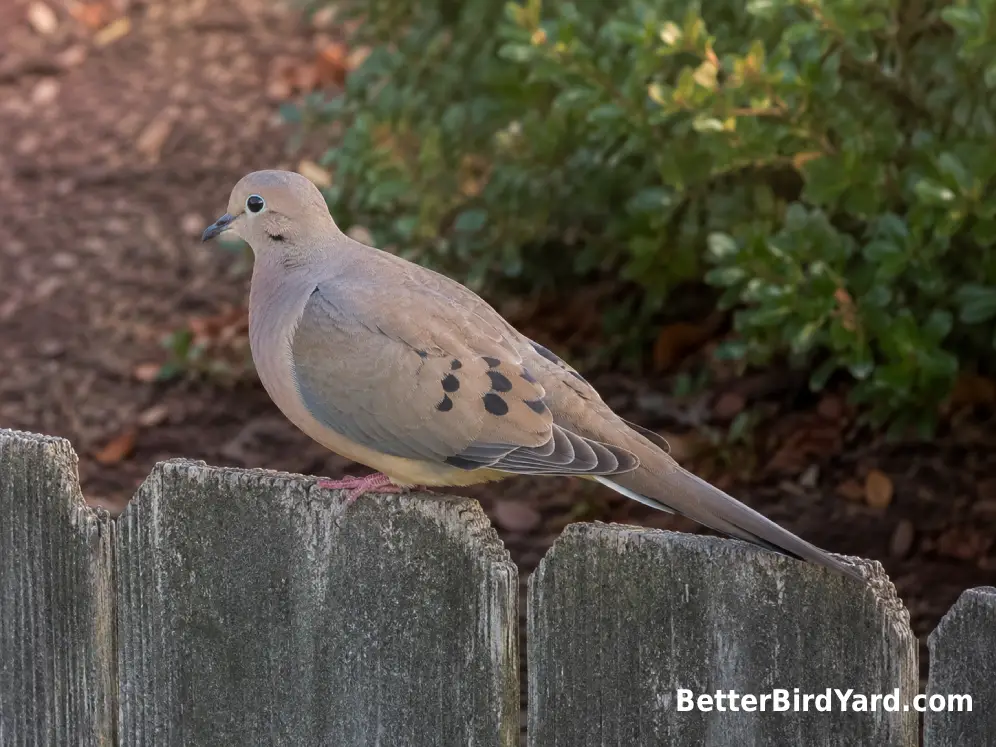
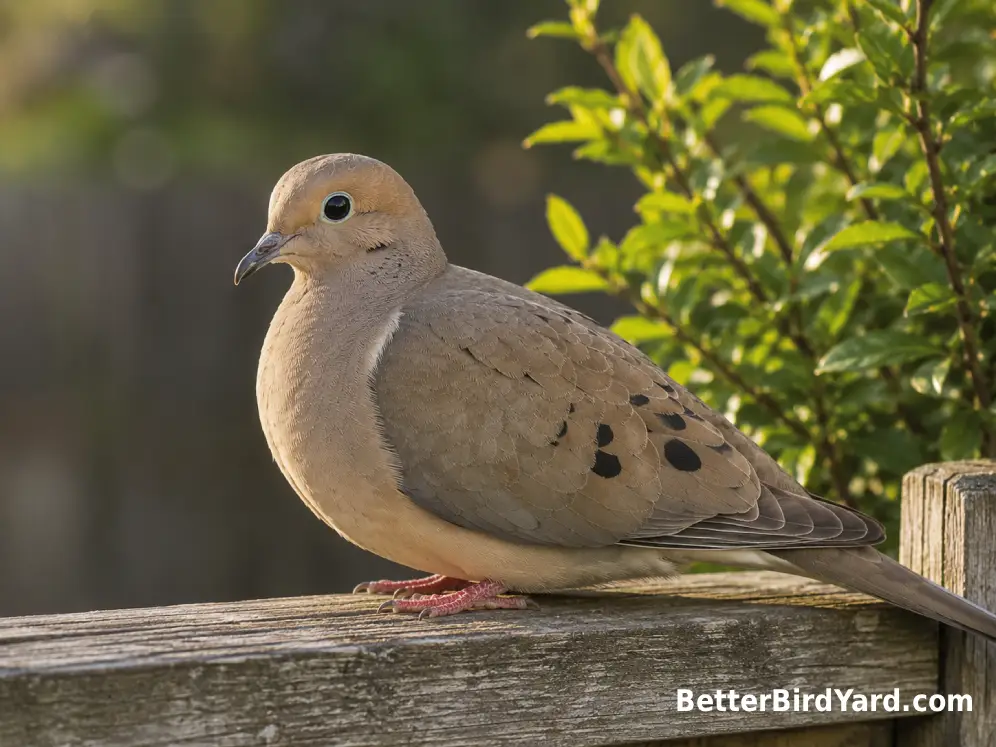
Start with the silhouette. Mourning Doves have relatively small heads, plump bodies, short legs, and unusually long, pointed tails. Their overall color is a soft brown, gray, or buffy tan rather than a single flat shade. Adults typically show dark spots on the wings, and the outer tail feathers have white tips that become easier to see when the tail fans in flight. Cornell lists males at roughly 9.1 to 13.4 inches long, with a wingspan around 17.7 inches.
The pointed tail is especially useful because several other doves can visit U.S. neighborhoods. A Eurasian Collared-Dove, for example, looks chunkier and has a more squared-off tail, while Mourning Doves have that tapered, almost spear-shaped profile. Exact species possibilities vary by region, so shape, tail pattern, size, and voice are more useful than judging color alone.
There are two sounds worth learning. The first is the familiar soft cooing song, given mainly by males. The second is a sharp whistle made by the wings when a Mourning Dove takes off or lands. If a quiet brown dove rockets away from the lawn with a burst of whistling wings, that combination of shape, behavior, and sound is a strong identification clue.
What Mourning Doves Eat
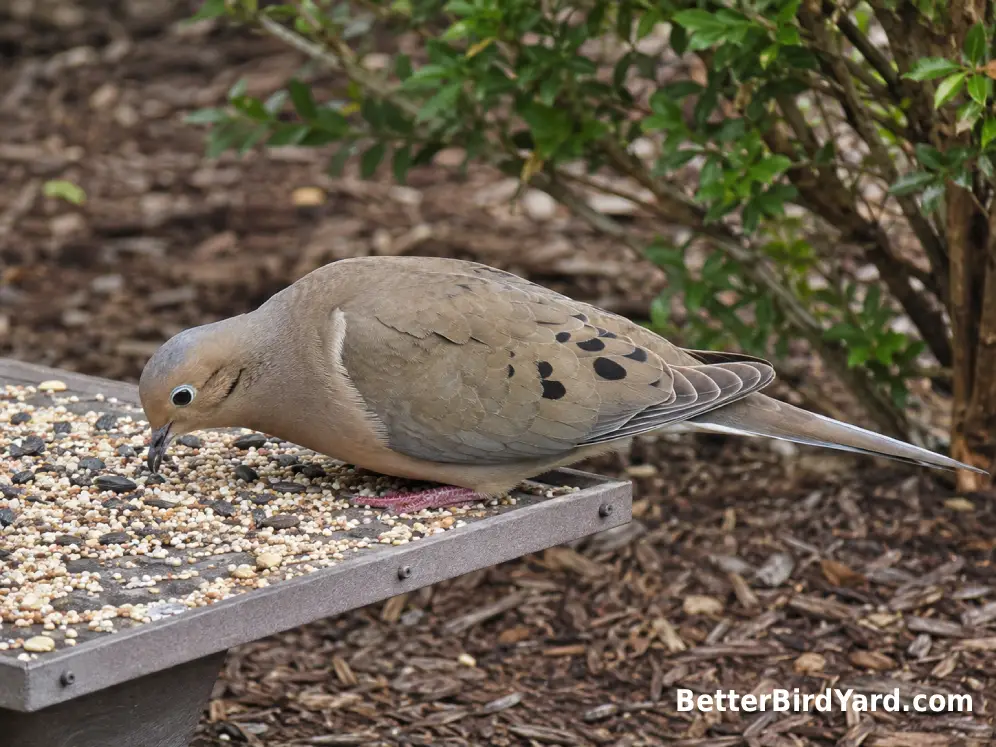
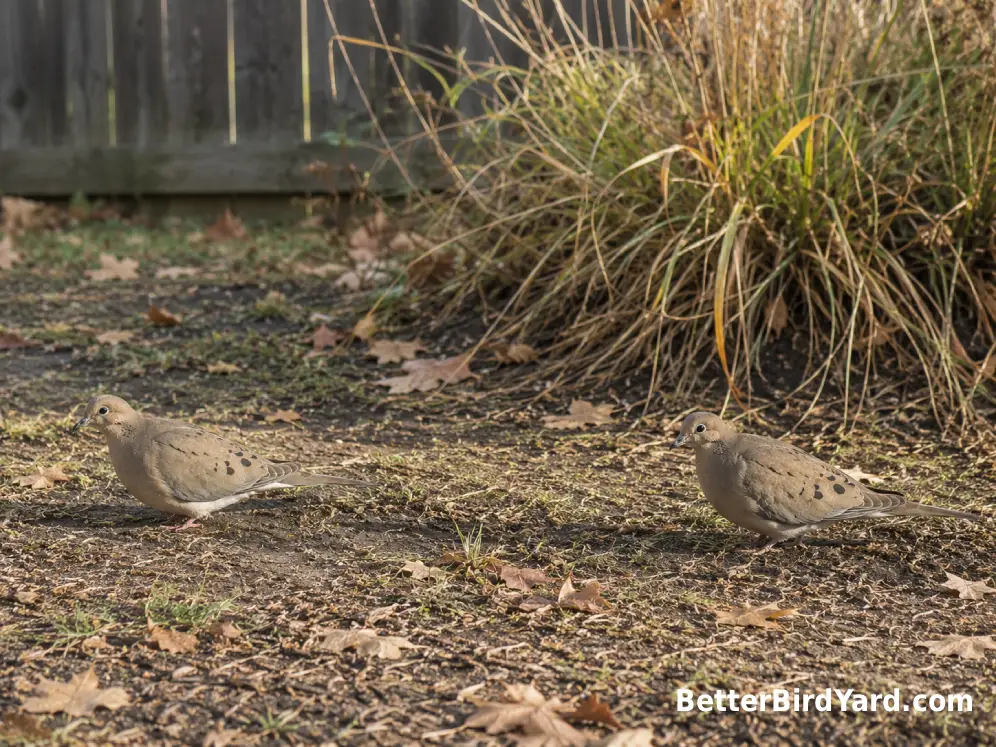
Mourning Doves are primarily seed eaters. Cornell reports that seeds make up about 99 percent of their diet, including seeds from grasses, weeds, herbs, cultivated grains, and other plants. That explains why you are so likely to see them walking across lawns, bare soil, driveways, and the ground beneath feeders rather than hanging from a tiny tube feeder port.
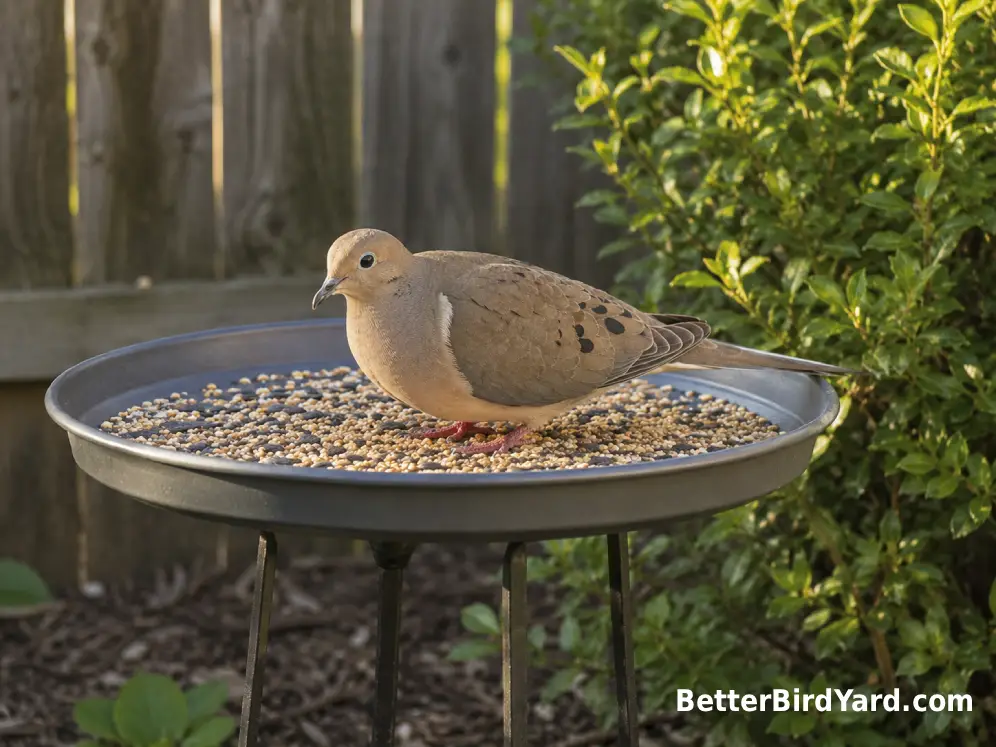
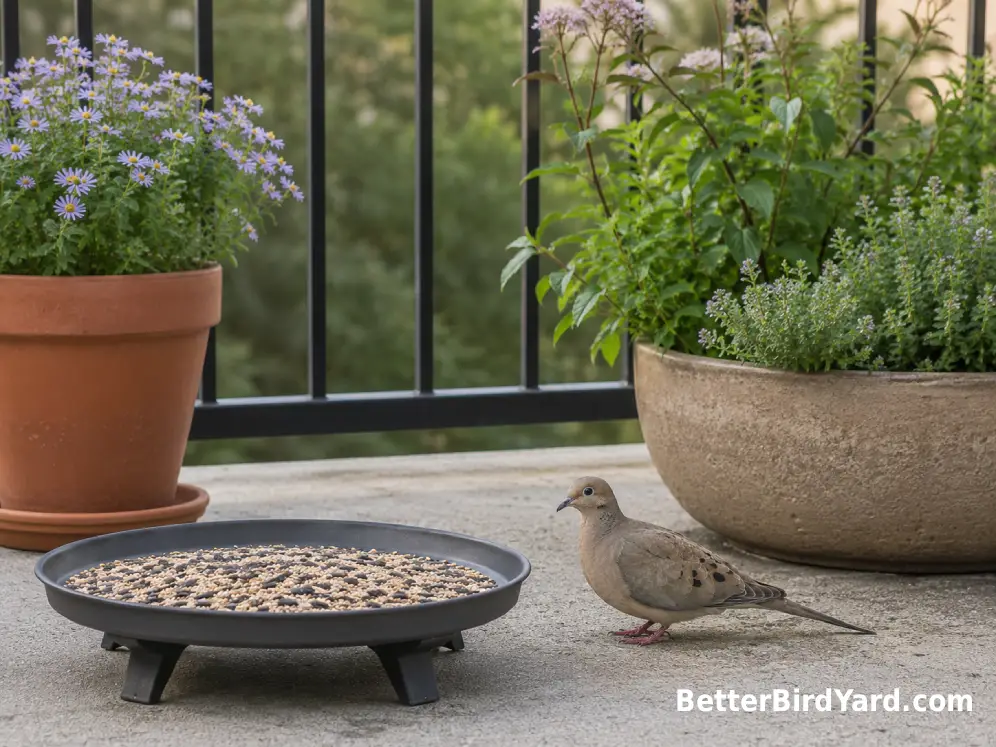
At a backyard feeding station, millet is particularly well suited to their natural feeding style, and Mourning Doves may also eat sunflower seed and other suitable grains or seeds. Cornell specifically recommends ground or platform feeding and notes a preference for millet. A broad platform generally works better than a narrow perch because these are relatively large-bodied feeder birds.
You do not need to keep dumping seed onto the lawn to accommodate them. In fact, a low platform or tray can be easier to keep clean and can reduce the amount of seed disappearing into wet grass or mulch. If you are choosing food for several species at once, our backyard bird seed guide can help you separate useful ingredients from filler that birds leave behind.
Watch what happens after a dove finds a good patch of seed. Mourning Doves can gather seed rapidly into an expandable part of the digestive tract called the crop, then move to a safer perch while digestion continues. That is why an individual may feed intensely for a few minutes and then appear to lose interest suddenly.
How To Attract Mourning Doves Without Making A Mess
The simplest Mourning Dove setup is not complicated: provide an open place to feed, suitable seed, nearby cover, and clean water if you have room for it. Results still vary with region, season, neighborhood habitat, predators, and the birds already living around you, so think of this as making your space more suitable rather than guaranteeing a visit.
- Use a broad platform, tray, or other feeder with enough room for a dove to stand comfortably.
- Offer suitable seed in modest quantities instead of letting large piles accumulate.
- Keep nearby shrubs or other cover available without creating a hiding place for roaming cats immediately beside the feeding area.
- Add fresh water in a shallow, easy-to-clean bird bath if your space allows.
- Clean spilled seed and hulls before they become wet, moldy, or attractive to rodents.
Cornell also recommends dense shrubs or evergreen trees as potential nesting cover. For renters or people with patios rather than yards, even a simple feeding tray and locally appropriate container plants can make a small outdoor space more useful. Audubon notes that patio and balcony container gardens can contribute bird-friendly habitat when locally native plants are chosen appropriately.
A practical BetterBirdYard rule is to start smaller than you think you need. Put out enough seed for the birds using your space now, watch how quickly it disappears, and adjust. A common beginner mistake is filling a large ground area with seed because doves like feeding low. Much of that food may instead become wet, buried, or available to rodents.
If Mourning Doves already walk beneath your other feeders, you may not need another feeder at all. Adding a catch tray or providing a dedicated platform nearby can give them easier access while making cleanup more predictable.
Where Mourning Doves Nest And What To Expect
Mourning Dove nests often look surprisingly fragile. Cornell describes them as loose arrangements of twigs, pine needles, and grass stems, commonly placed in trees, shrubs, vines, or other supported locations. Doves also sometimes choose distinctly human surroundings such as gutters, ledges, equipment, and other flat structures.
| Nesting Detail | Typical Mourning Dove Pattern |
|---|---|
| Clutch | Usually 2 white eggs |
| Incubation | About 14 days |
| Time As Nestlings | About 12–15 days |
| Parents | Both participate in caring for the young |
| Broods | Multiple nesting attempts can occur in a season, varying with conditions and region |
Cornell reports one to six broods in its species account, while Audubon notes that pairs in southern areas may raise several broods in a year. Those figures should not be treated as a prediction for one pair in one backyard; nesting success and seasonal opportunities vary considerably.
If a nest creates an unavoidable safety or access issue, check with the U.S. Fish and Wildlife Service, your state wildlife agency, or another qualified local authority before taking action.
How Long Do Mourning Doves Live?
The most useful answer to how long Mourning Doves live needs an important distinction: a longevity record is not the same thing as a typical lifespan.
Cornell reports that the oldest known Mourning Dove was a banded male that reached at least 30 years and 4 months. He had been banded in Georgia in 1968 and was recovered in Florida in 1998. That is an exceptional record, not what a homeowner should expect from the average dove visiting a feeder.
Wild birds face substantial mortality from predators, weather, collisions, disease, hunting where legally permitted, and other hazards. U.S. Fish and Wildlife Service banding programs therefore track annual survival rather than assuming a simple fixed lifespan; survival rates also differ between younger and older birds and among regions.
So if you are trying to recognize the same Mourning Dove from year to year, plumage usually will not give you enough certainty. Unless a bird has a readable research band or an unusually distinctive feature, two similar-looking adult doves are difficult to tell apart reliably. Enjoy repeat visitors, but be cautious about assuming a familiar-looking bird is necessarily the same individual.
Why Mourning Doves Sometimes Disappear From Your Yard
A pair that seems permanently attached to your feeder in one month may be much less visible later. That does not automatically mean something is wrong. Mourning Dove numbers and movements change with season, weather, breeding activity, natural seed availability, and region. Some populations are present year-round, while others make seasonal movements. Cornell’s range information shows the species widely distributed across the continental United States, but the local pattern is not identical everywhere.
Natural food can also change where the birds spend their time. Because Mourning Doves eat seeds from wild grasses, weeds, and other plants, a productive field edge or weedy patch can temporarily be more appealing than a backyard feeder. A sudden reduction in feeder visits is therefore not a good reason to dramatically increase the amount of seed you put out.
Outside the breeding period you may also see more doves together. Cornell notes that Mourning Doves can occur in flocks during the nonbreeding season. At other times, your most obvious visitors may be a pair occupying a familiar feeding or nesting area.
Common Mourning Dove Feeding Mistakes To Avoid
Because Mourning Doves feed comfortably on the ground, it is easy to assume that almost any low feeding arrangement is good enough. The details matter more than beginners expect.
- Do not let wet seed accumulate. Remove old, damp, spoiled, or moldy food instead of topping it with fresh seed.
- Do not ignore the ground beneath feeders. Seed and hull buildup can become unsanitary and may attract rodents.
- Do not overfill a platform feeder. Smaller amounts that stay dry and get eaten are easier to manage.
- Do not create a cat ambush point. Mourning Doves spend considerable time on the ground, making roaming cats a particular concern.
- Do not overlook nearby glass. Feeding birds near reflective windows can add collision risk unless the glass and feeder placement are managed appropriately.
Project FeederWatch currently recommends cleaning seed and suet feeders regularly—roughly every week or two as a general example—and more often during wet weather or heavy use. Feeders should be scrubbed clean, rinsed thoroughly, and allowed to dry fully before seed is returned. Their guidance also emphasizes keeping the ground beneath feeding stations tidy.
For a straightforward routine, remove uneaten seed before it spoils, wash the feeder whenever residue builds up, and shorten the interval when weather is wet or bird traffic is heavy. Our bird feeder cleaning guide covers the process in more detail.
What To Do If A Mourning Dove Looks Sick Or Injured
A dove sitting quietly on the ground is not automatically sick. Mourning Doves normally spend a lot of time there. More concerning signs include a bird that is unusually easy to approach, persistently fluffed up or lethargic, visibly injured, unable to fly normally, or showing other clear abnormal behavior. Those signs can have many possible causes, so avoid trying to diagnose the bird yourself.
If a bird that appears ill is using your feeding area, focus first on reducing congregation and contamination. Project FeederWatch advises cleaning feeders and bird baths thoroughly and may recommend temporarily removing feeders when sick birds are present. Current guidance can vary with the situation, so checking your state wildlife agency or local outbreak guidance is worthwhile.
Do not give medications, add treatments to food or water, or casually handle a sick or injured wild dove. If the bird appears to need intervention, contact a licensed wildlife rehabilitator, state wildlife agency, animal control service, or another qualified local professional for instructions. Project FeederWatch similarly advises against trying to treat compromised wild birds yourself.
A Small Space Can Still Be Good Mourning Dove Habitat
You do not need a large lawn to support Mourning Doves. A patio, townhouse garden, or compact suburban yard can provide useful resources if you concentrate on a few basics: a clean feeding surface, fresh water where practical, some nearby vegetation, and a feeding area you can maintain without leaving seed everywhere.
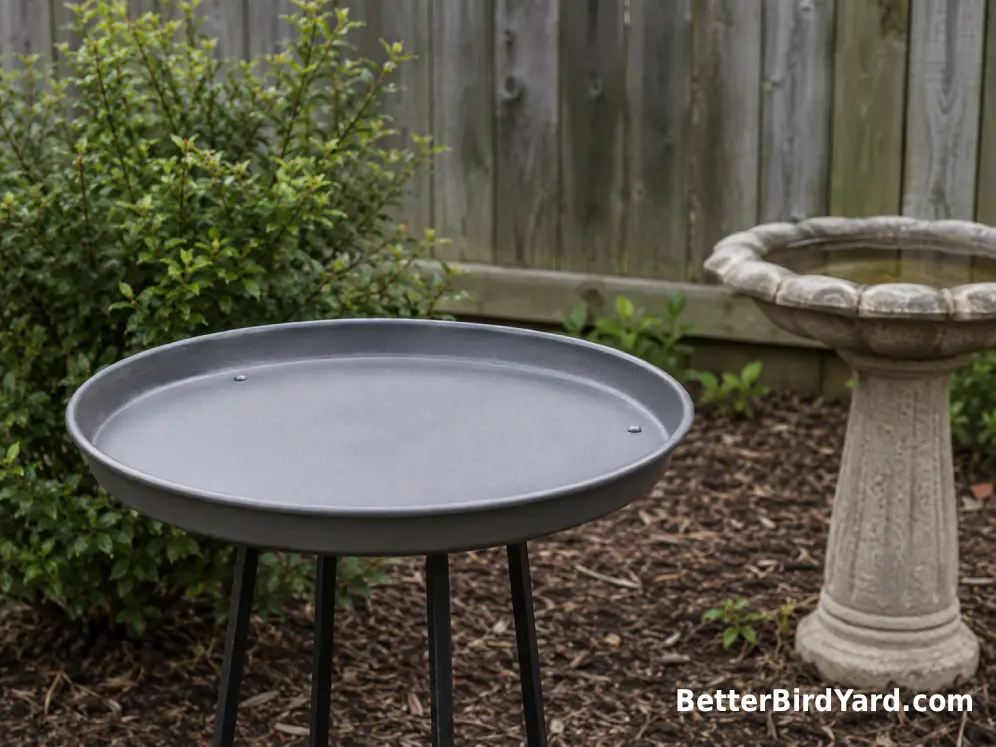
For renters, a wide tray attached securely to a stand or railing may be more practical than scattering seed. Check your lease, building rules, HOA requirements, and local ordinances before feeding birds, particularly where spilled seed could affect neighbors or attract rodents and other wildlife.
If you can plant, locally native grasses, shrubs, and other seed-producing plants add food and shelter without requiring birds to depend entirely on a feeder. Plant recommendations vary considerably across the United States, so use a state extension service, local native plant society, or Audubon regional resource rather than assuming a plant that is useful in another part of the country belongs in your yard. Audubon encourages locally native vegetation and notes that even container gardens can contribute habitat in small spaces.
The goal is not to create the busiest feeding station on the block. For Mourning Doves, a relatively quiet space with dependable seed, safe footing, nearby cover, and sensible maintenance is often a better fit.
Getting To Know The Mourning Doves Around You
Mourning Doves are common enough to be overlooked, but they reward a closer look. Notice the long pointed tail instead of simply seeing a brown dove. Listen for the difference between the male’s soft coo and the sudden whistle of wings. Watch how quickly a bird gathers seed, then moves to a quiet perch. In nesting season, you may even begin to recognize the repeated routes a local pair uses between feeding areas, perches, and cover.
Supporting them does not require complicated equipment. A broad, clean feeding surface with suitable seed, fresh water when you can maintain it, locally appropriate vegetation, and protection from preventable hazards can make an ordinary yard or patio more welcoming. Just as importantly, keeping seed fresh, cleaning feeding areas, reducing cat and window risks, and giving nests appropriate space helps ensure that attracting birds does not create new problems.
And while the exceptional Mourning Dove can live for decades, the real pleasure is not knowing exactly how old each visitor is. It is getting familiar enough with this quiet backyard species that the soft coo from the fence or the sudden whistle from the lawn immediately tells you who has arrived.