Meet the Blue Jay: Backyard Behavior, Food, and Identification
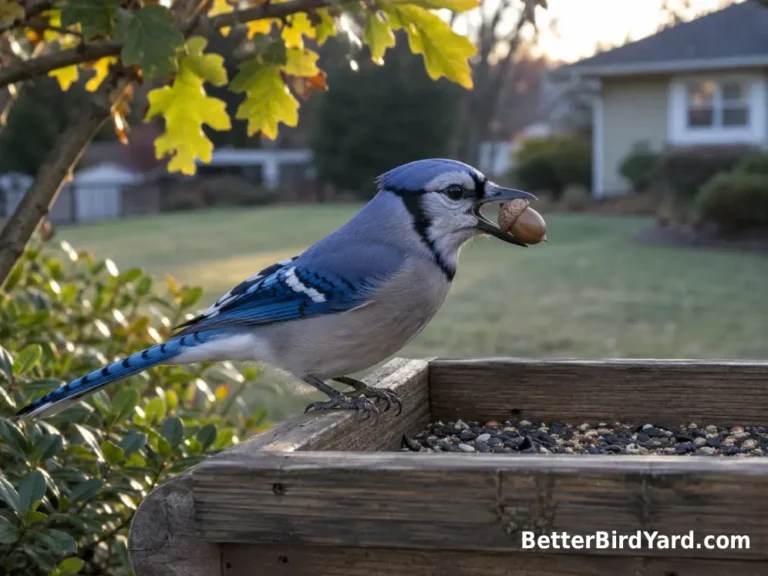
The Blue Jay bird is hard to overlook. With a tall crest, blue-and-white wings, black facial markings, and a voice that can carry across a neighborhood, this familiar backyard visitor brings plenty of personality to a feeder or bird bath.
The Blue Jay, Cyanocitta cristata, belongs to the Corvidae family alongside crows, ravens, and other jays. Cornell Lab of Ornithology describes it as a large, crested songbird of forest edges, woodlots, parks, towns, and suburban yards, especially in places with oak trees. It is an omnivore that eats everything from acorns and insects to seeds and other plant foods.
For backyard bird watchers, Blue Jays are particularly interesting because they do much more than grab a seed and leave. They cache food, communicate with a surprisingly broad range of calls, mimic hawks, travel in loose flocks, and sometimes change their seasonal movements in ways researchers still do not completely understand. A sturdy feeder, fresh water, and a yard with useful cover can make your space more appealing to them without turning feeding into an all-day maintenance job.
How To Identify A Blue Jay
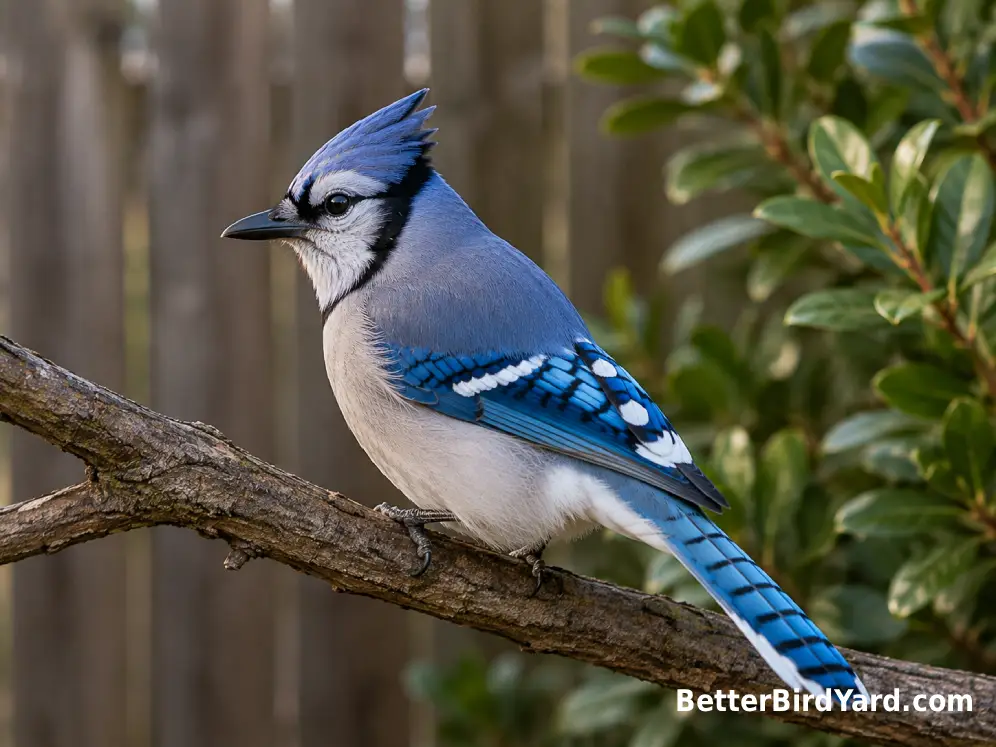
A Blue Jay is roughly 10–12 inches long, putting it between an American Robin and an American Crow in overall size. Both sexes have the same basic blue, white, gray, and black pattern, so you normally cannot identify a male or female simply from plumage.
| Feature | What To Look For |
|---|---|
| Scientific Name | Cyanocitta cristata |
| Family | Corvidae, the crow and jay family |
| Size | About 10–12 inches long |
| Head | Prominent crest with black markings around the face and throat |
| Body | White to pale gray underneath and blue above |
| Wings And Tail | Blue with strong black barring and conspicuous white markings |
| Bill | Strong, straight, dark bill suited to handling seeds, nuts, and other foods |
When comparing Blue Jay bird images, pay particular attention to the crest, black necklace, white wingbar, and white patches in the tail. Those features help separate a true Blue Jay from other blue-colored birds. Cornell notes that Florida Scrub-Jays, for example, lack the Blue Jay’s prominent crest, black necklace, and white wingbars.
One surprising detail is that the vivid blue appearance does not come from blue pigment. Cornell explains that microscopic feather structures scatter light to create the blue color. That is one reason the shade can seem to change depending on the light and viewing angle.
Where Do Blue Jays Live?
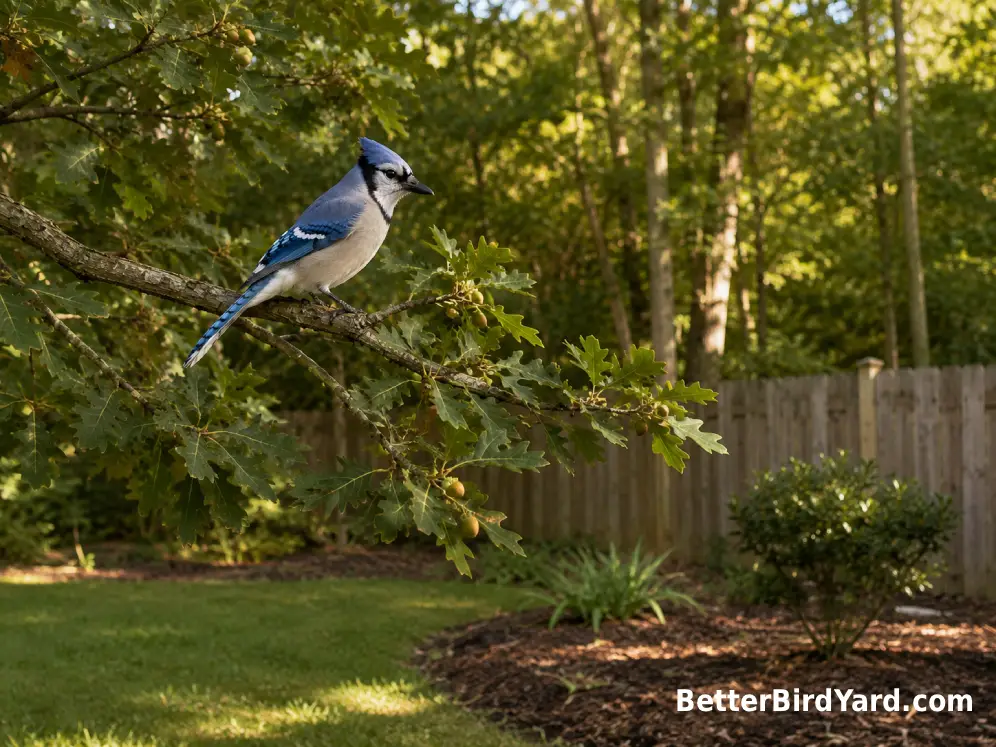
Blue Jays are especially associated with forest edges rather than deep, uninterrupted forest. Woodlots, wooded neighborhoods, city parks, and yards with mature trees can all provide suitable habitat. Oaks are particularly useful because acorns are an important natural food.
In the United States, Blue Jays are most familiar across the eastern and central parts of the country. If you live farther west, a blue jay-like bird may instead be a Steller’s Jay, California Scrub-Jay, Woodhouse’s Scrub-Jay, or another regional species. Checking the Cornell Lab’s regional range information or eBird observations can help when location makes an identification uncertain.
Blue Jay movements are unusually variable. Cornell classifies the species as resident or a short-distance migrant, but some individuals remain in one area while others migrate. Large groups can be seen moving along shorelines and migration watch sites, and the reasons individual birds migrate in some years but apparently not others are still not fully understood.
For a backyard observer, that means a Blue Jay disappearing for part of a season does not necessarily indicate that anything is wrong with your feeder. Local food crops, weather, migration, nesting behavior, and changes in nearby habitat can all affect how often you see them.
What Do Blue Jays Eat?
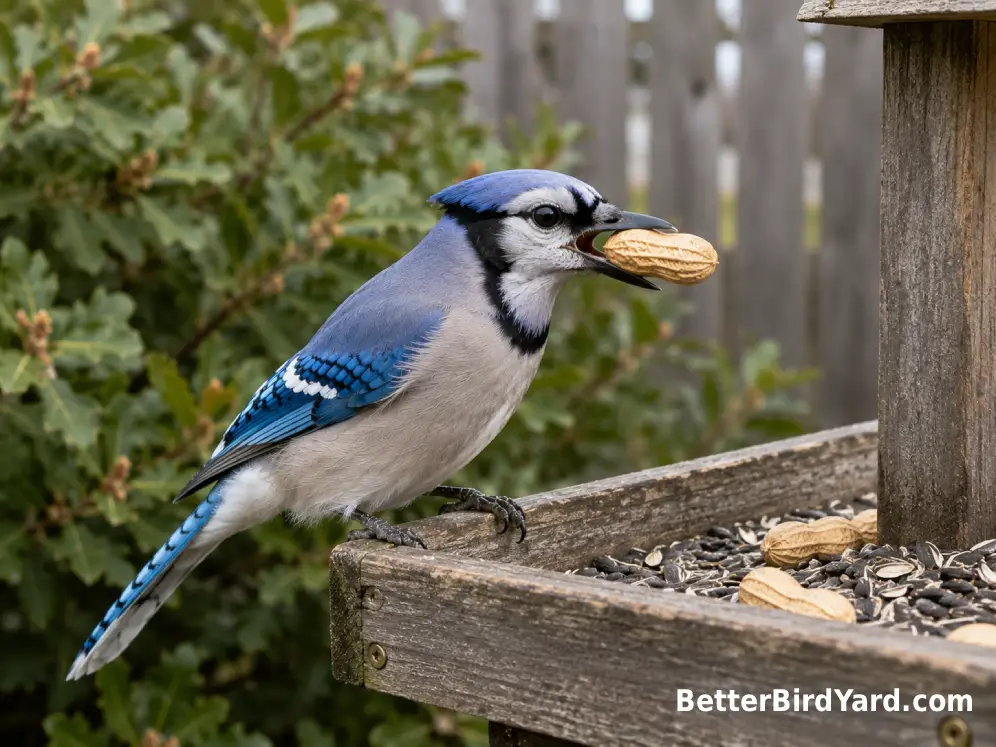
Blue Jays are omnivores with a broad natural diet. Cornell describes them eating acorns and other nuts, seeds, grains, fruits, and insects, along with a smaller amount of animal food. They also cache food for later, often carrying a nut or seed away rather than eating everything at the feeder.
At a backyard feeding station, practical choices include:
- Unsalted, unflavored peanuts, either shelled or in the shell.
- Sunflower seeds, especially where a sturdy feeder gives the bird room to land.
- Suet in an appropriate feeder, particularly when local conditions make it practical to offer safely.
- Fresh water in a clean bird bath.
Project FeederWatch specifically notes that jays readily take peanuts and may carry several away to cache. Peanuts can be raw or roasted, but salted, flavored, or coated nuts should be avoided. Cornell also recommends tray or hopper feeders for Blue Jays and lists peanuts, sunflower seeds, and suet among their common feeder foods.
A common mistake is assuming that more food automatically produces more Blue Jays. Large piles of seed can instead create waste, attract rodents and squirrels, and become wet or spoiled before birds finish it.
If you only change one thing, start with a modest portion in a feeder you can easily empty and clean. You can always add more when birds are consistently finishing what you provide.
How To Attract Blue Jays Without Creating A Mess
You do not need a large property to make Blue Jay visits more likely. The most useful setup is usually simple: enough landing space for a fairly large songbird, suitable food, clean water, and some nearby woody cover.
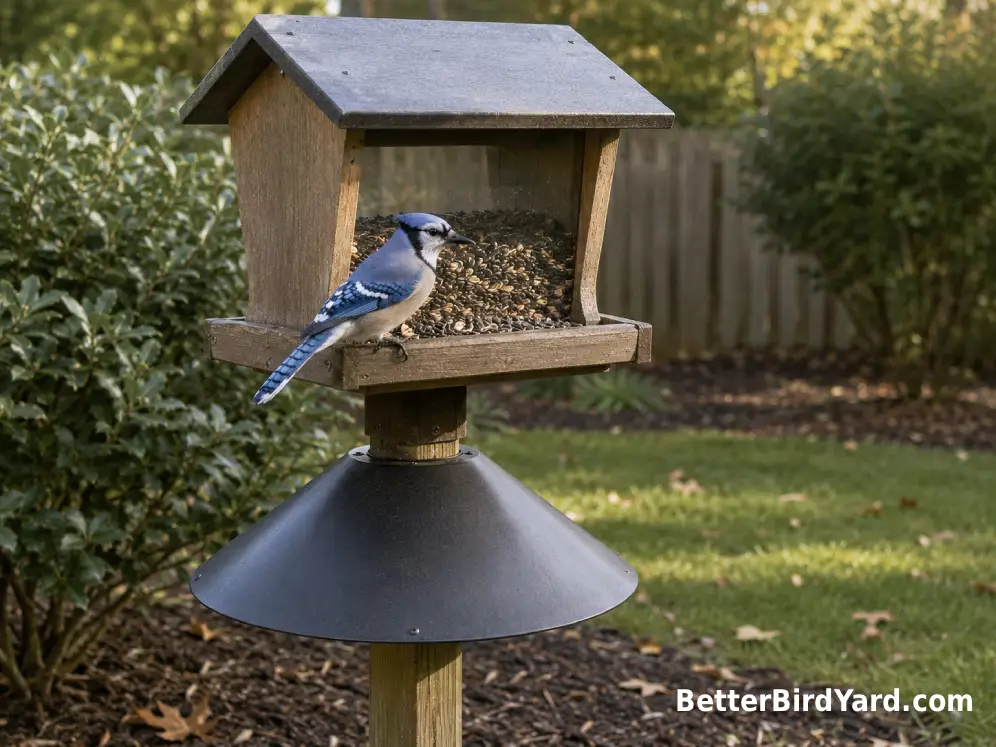
A practical approach is to use a sturdy tray or hopper feeder rather than relying only on a narrow tube feeder. Blue Jays are larger than chickadees and finches, so a broad perch or platform is easier for them to use. Cornell specifically identifies tray and hopper feeders as good options for this species.
In a small yard or patio, keep the feeding station manageable. Offer a small amount of food, watch how quickly it disappears, and increase only if necessary. Shelled foods can reduce discarded hulls, while placing a tray beneath the feeder can make cleanup easier.
If several jays start crowding smaller birds, a second feeding point can help spread activity around the yard. Putting peanuts or other jay-friendly foods at one sturdy feeder while keeping smaller-seed feeders elsewhere may give chickadees, finches, and other birds more room.
Where you own the property and have enough space, region-appropriate native trees and shrubs add far more long-term value than a feeder alone. An oak can eventually supply natural acorns, cover, and habitat, but it is obviously not a practical choice for every patio or rental. In limited spaces, a clean feeder, fresh water, and suitable nearby vegetation are enough to keep the setup useful and realistic.
Why Are Blue Jays So Loud?
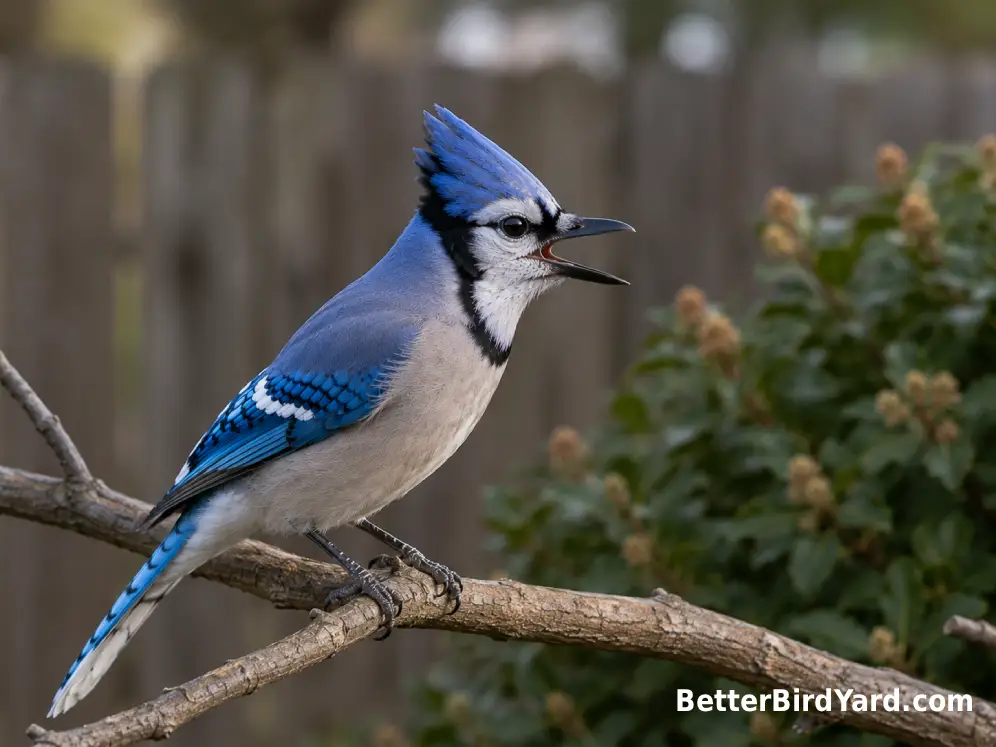
Blue Jays have a much larger vocal repertoire than the familiar harsh jay call suggests. Cornell describes loud jeers, whistles, gurgling notes, softer sounds, and a quiet vocalization often called a whisper song.
They are also convincing mimics. Wild Blue Jays frequently imitate hawks, particularly Red-shouldered Hawks, and sometimes Red-tailed Hawks. Researchers do not have one simple explanation for every imitation. In some situations the call may alert other birds to a predator, while at feeders it may occasionally send nearby birds scattering.
The crest provides another clue to a jay’s behavior. A relaxed bird feeding with familiar companions may hold its crest relatively flat, while an agitated or aggressive bird often raises it. That is useful to watch because a Blue Jay’s posture can tell you almost as much as its voice.
Blue Jays are also prolific food cachers. Instead of assuming a bird taking peanut after peanut is eating all of them immediately, watch where it goes. Jays frequently carry food elsewhere and hide it for later use. That behavior is part of the reason a feeding station can seem exceptionally busy even when only a few individual birds are visiting.
Are Blue Jays Really Backyard Bullies?
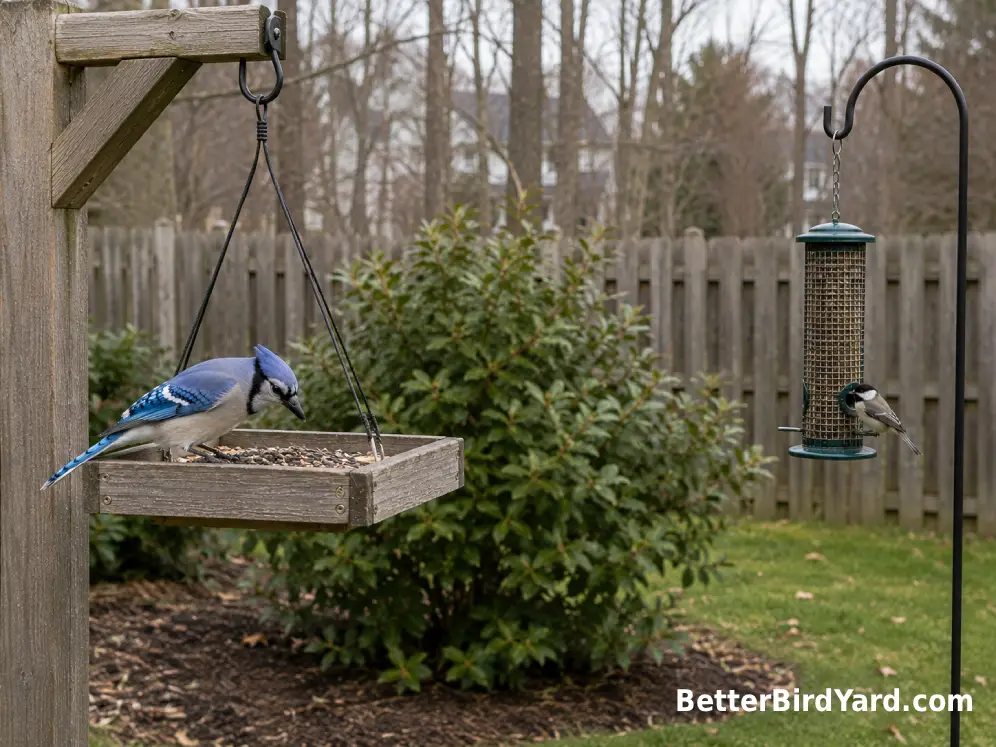
Blue Jays can be assertive at feeders, and their size, loud calls, and quick movements make that behavior easy to notice. A jay landing on a platform may cause smaller birds to move aside for a moment.
That does not mean Blue Jays dominate every bird they meet. Cornell summarizes observations in which several other birds and gray squirrels sometimes displaced Blue Jays at feeders. Feeder interactions depend on species, numbers, available food, feeder design, and individual behavior.
If Blue Jays are monopolizing a feeding station, the easiest fix is usually not to try to exclude them completely. Spread resources out. One feeder with peanuts or sunflower seed can serve larger birds, while another feeder with smaller perches can give smaller species a separate place to feed.
Also look at how much food is being offered. A heavily stocked open platform can attract a rush of birds and other wildlife at once. Smaller portions and multiple feeding locations can make the yard calmer and easier to keep clean.
Do Blue Jays Eat Other Birds’ Eggs?
Yes, Blue Jays sometimes eat eggs or nestlings, but that behavior can easily be exaggerated into the idea that they primarily live by raiding nests.
Cornell’s Blue Jay life-history account notes that nuts, seeds, fruits, grains, and insects make up most of the diet. In a historical examination of 530 Blue Jay stomachs, traces of bird eggs or nestlings appeared in only six, even though researchers were specifically looking for bird remains.
That does not mean nest predation never happens. It means it is more accurate to see the Blue Jay as an opportunistic omnivore rather than a specialized predator of backyard songbirds.
If you enjoy smaller nesting birds as well as jays, the practical response is to improve habitat rather than treating Blue Jays as villains. Dense native shrubs, appropriate nesting cover, fewer outdoor-cat visits, and reduced disturbance around active nests can all help create a safer yard for a variety of birds.
How Do Blue Jays Nest And Raise Their Young?
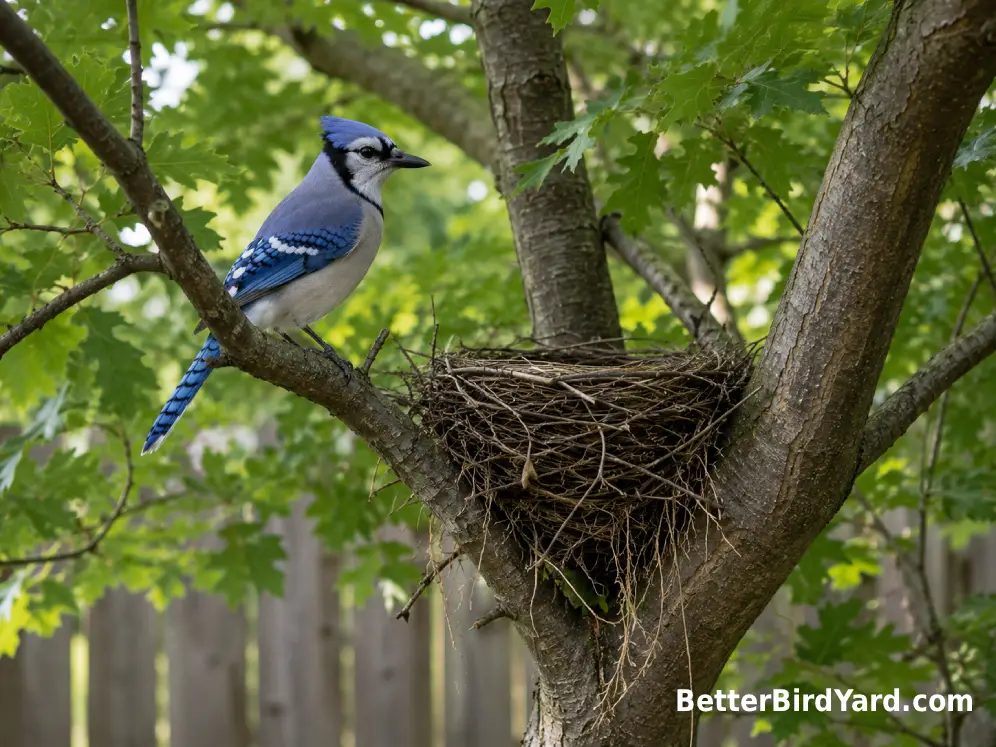
Blue Jays normally build open-cup nests in trees. Cornell’s photo and life-history material shows both sexes participating in nest building, using twigs and finer lining materials. Once young leave the nest, they can remain dependent on their parents for some time rather than becoming immediately independent.
This matters in a backyard because a young jay outside the nest is not automatically abandoned. During nesting season, keep your distance from active nests and avoid unnecessary pruning or disturbance around them.
If you find a young bird that appears injured, unusually weak, or truly orphaned, avoid trying to diagnose or raise it yourself. Keep pets and people back and contact a licensed wildlife rehabilitator or your state wildlife agency for situation-specific guidance.
What Is A Group Of Blue Jays Called?
If you want a clear, everyday term for a group of Blue Jays, call them a flock of Blue Jays. Cornell uses flock when describing both migrating and resident groups of the species.
You may encounter more colorful collective nouns for jays in trivia lists, but those are not necessary for bird identification or scientific communication. Flock is straightforward, widely understood, and accurately describes the loose groups backyard bird watchers may see traveling or feeding together.
How To Keep A Blue Jay Feeding Area Safe
A Blue Jay may be tough enough to crack an acorn, but a feeding station still needs routine care. Food that stays wet or develops mold should be discarded rather than topped off with fresh seed. Sweep or rake accumulated hulls, droppings, and old food from beneath feeders, especially after prolonged wet weather.
Clean feeders regularly and sooner whenever they become visibly dirty. Project FeederWatch recommends removing debris, washing the feeder, and allowing it to dry completely before adding food again; disinfection may be appropriate as part of a thorough cleaning routine. For a more detailed routine, see our bird feeder cleaning guide.
Water needs attention too. Refresh bird-bath water frequently and scrub the basin whenever it becomes visibly dirty. CDC guidance advises cleaning and refilling bird baths weekly or when dirty and washing hands after handling feeders, baths, or bird food.
If you notice birds that appear unusually lethargic, have obvious eye or facial abnormalities, or find sick or dead birds around the feeding area, do not try to diagnose or casually handle them. Temporarily remove feeders and baths, clean the equipment, keep pets away, and check current guidance from your state wildlife agency or a qualified wildlife professional.
Finally, look beyond the feeder itself. A busy feeding station close to reflective glass can increase collision risk, and free-roaming cats can threaten birds gathering near the ground. If your feeding area faces reflective windows, our window bird feeders guide covers practical ways to reduce that hazard.
The best backyard setup is not the one that attracts the greatest number of birds at once. It is the one you can keep clean, safe, and manageable over time.
Blue Jays can be loud, bold, cautious, clever, and surprisingly subtle depending on what they are doing. Once you recognize the crest, black necklace, barred blue wings, food-caching habits, and broad range of calls, they become much easier to understand as more than simply the large blue bird taking peanuts from the feeder.
For most yards, supporting them responsibly is uncomplicated: offer appropriate food in modest amounts, provide clean water, preserve useful trees and shrubs where possible, keep the feeding area sanitary, and give all backyard birds enough space to behave naturally. The result may not be a Blue Jay on demand, but it creates the kind of backyard habitat where jays and many other wild birds have good reasons to stop by.