Red-Winged Blackbird: How to Identify This Bold Backyard Visitor
If you have spotted a black bird with red wings—or what looked more like orange or yellow on the shoulder—you may have seen a Red-winged Blackbird. The adult male is one of North America’s easiest birds to recognize once you know where to look: a glossy black body paired with bright red shoulder patches usually bordered with yellow. Its scientific name is Agelaius phoeniceus.
Red-winged Blackbirds are especially associated with cattail marshes, wet fields, ponds, roadside wetlands, and other open habitats. They also visit suburban yards and feeders, particularly where open grassy or wet habitat is nearby. Cornell Lab notes that the species is widespread across North America and that birds may visit yards for mixed grains and seeds, particularly during migration.
The tricky part is that not every Red-winged Blackbird looks like the familiar black-and-red male. Females are brown and heavily streaked, young birds can look different again, and even a male can partly hide his colorful shoulder patches. Here is how to sort out what you are seeing and make your yard a useful, responsible stop for these striking birds.
How To Identify A Male Red-Winged Blackbird
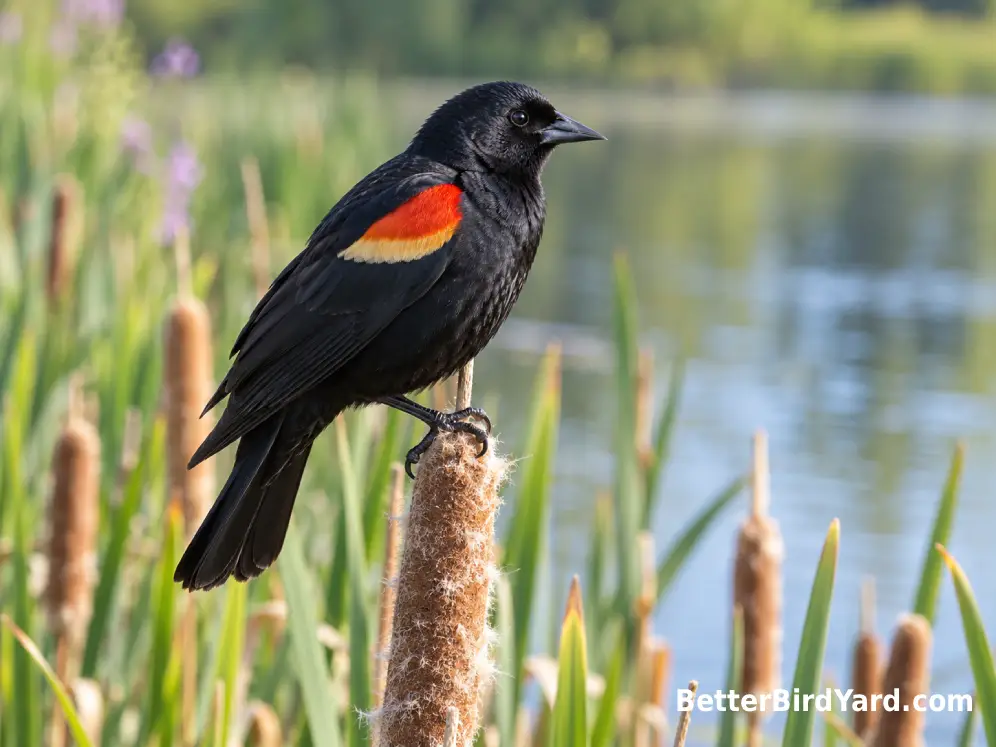
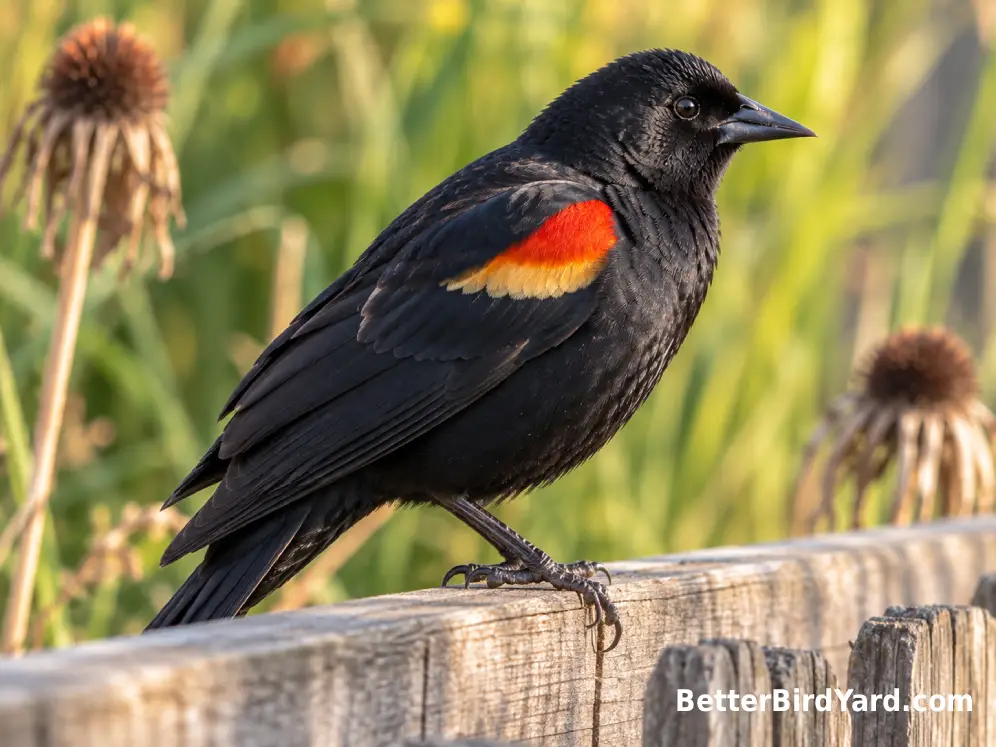
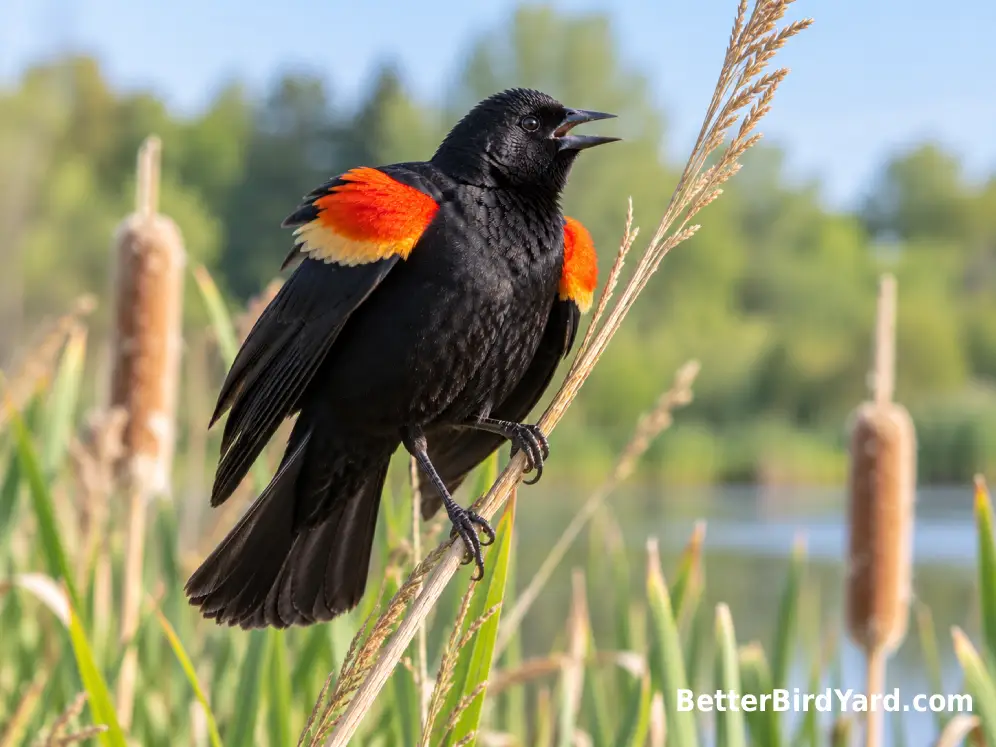
An adult male Red-winged Blackbird is mostly glossy black, with a stocky, broad-shouldered shape, a fairly long tail, and a slender, pointed bill. The feature to concentrate on is the patch at the top of each wing. Cornell describes the typical male as having a red shoulder badge bordered with yellow. The birds measure roughly 6.7 to 9.1 inches long, putting them in the general size range many beginners associate with a robin-sized songbird.
Those colored feathers are called epaulets. A male can make them conspicuous while singing or displaying, but he can also cover much of the red with surrounding black feathers. At times you may see only a narrow yellowish or reddish line instead of a large bright patch. Cornell observations show that males expose the epaulets more prominently during territorial displays and tend to conceal them more while feeding socially.
That variability matters if your first impression was a black bird with orange on its wings. Depending on how much of the patch is exposed, the viewing distance, and the light, a backyard observer may describe the badge as red, orange-red, yellow-orange, or a combination of red and yellow. The standard field mark to remember is still a black male with a red shoulder patch normally edged in yellow.
Why Do The Wings Sometimes Look Orange Instead Of Red?
One of the most common identification confusions comes from color descriptions. Someone may report a blackbird with orange wings, a black bird with orange shoulders, or even a black bird with an orange stripe on the wing. Those descriptions can fit the impression created by a male Red-winged Blackbird, but the color is not actually spread across the whole wing.
The colored area is concentrated at the shoulder. On a typical adult male, the upper portion is scarlet red and a yellow band borders it. Because the bird can expose or cover portions of the patch, you may see several different looks from the same individual within minutes. Cornell notes that displaying males spread their wings and puff out these shoulder patches, making them especially conspicuous.
There is also regional variation. The Red-winged Blackbirds known as California Bicolored Blackbirds lack the usual yellow border, so a bird in coastal California can show a more purely red shoulder patch.
For identification, use several clues together rather than judging the exact shade of the wing patch: overall size and shape, where the color occurs, habitat, behavior, and the bird’s pointed bill are all more dependable than deciding whether a distant patch looked red or orange.
Female Red-Winged Blackbirds Look Completely Different
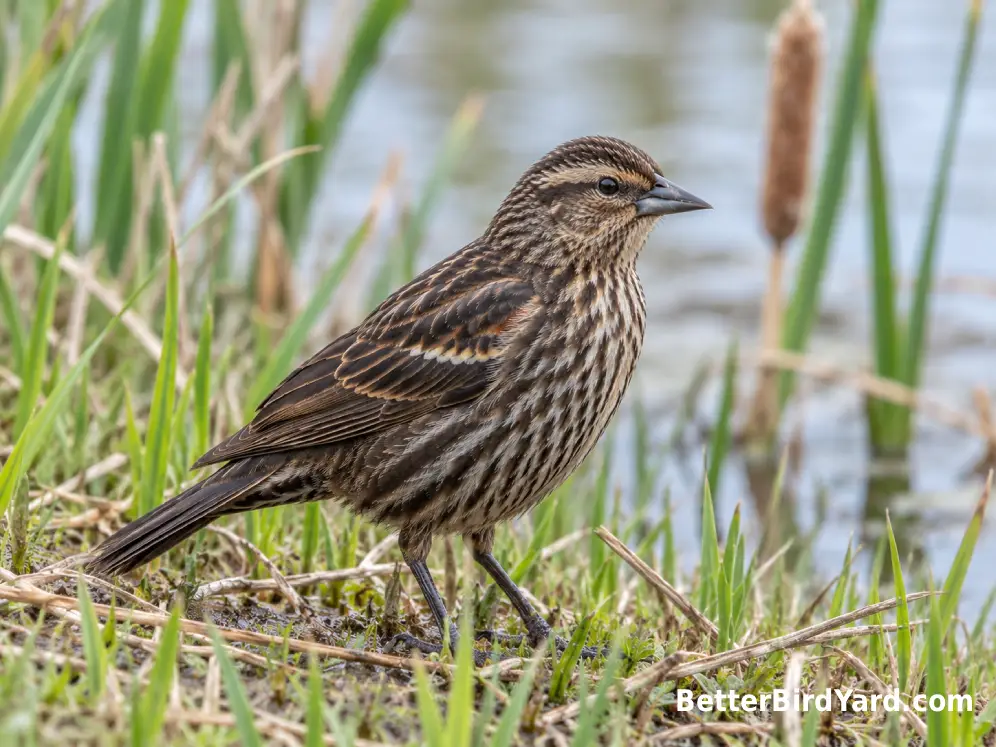
A beginner who learns only the black-and-red male can easily overlook the female. Instead of being black with bright shoulders, female Red-winged Blackbirds are dark brown and heavily streaked. They often show a pale eyebrow and can look surprisingly sparrow-like. Cornell describes females as stocky, broad-shouldered birds with the same slender, pointed bill seen in males.
If you see a large streaky brown bird working through cattails, tall grass, or low vegetation while a black-and-red male sings nearby, take a second look. Habitat and body shape can help separate a female Red-winged Blackbird from the smaller sparrows that may share the area.
A useful beginner checklist is:
- Look for heavy brown streaking rather than a solid brown body.
- Notice the relatively stocky shape and pointed blackbird-style bill.
- Watch whether the bird stays low in grasses, reeds, or marsh vegetation.
- Look and listen for male Red-winged Blackbirds in the same general habitat.
A common mistake is assuming that males and females must share the same red shoulder marking. They do not. Learning the female’s streaked appearance effectively gives you a second bird to recognize without adding another species to your study list.
Where Red-Winged Blackbirds Live And When You May See Them
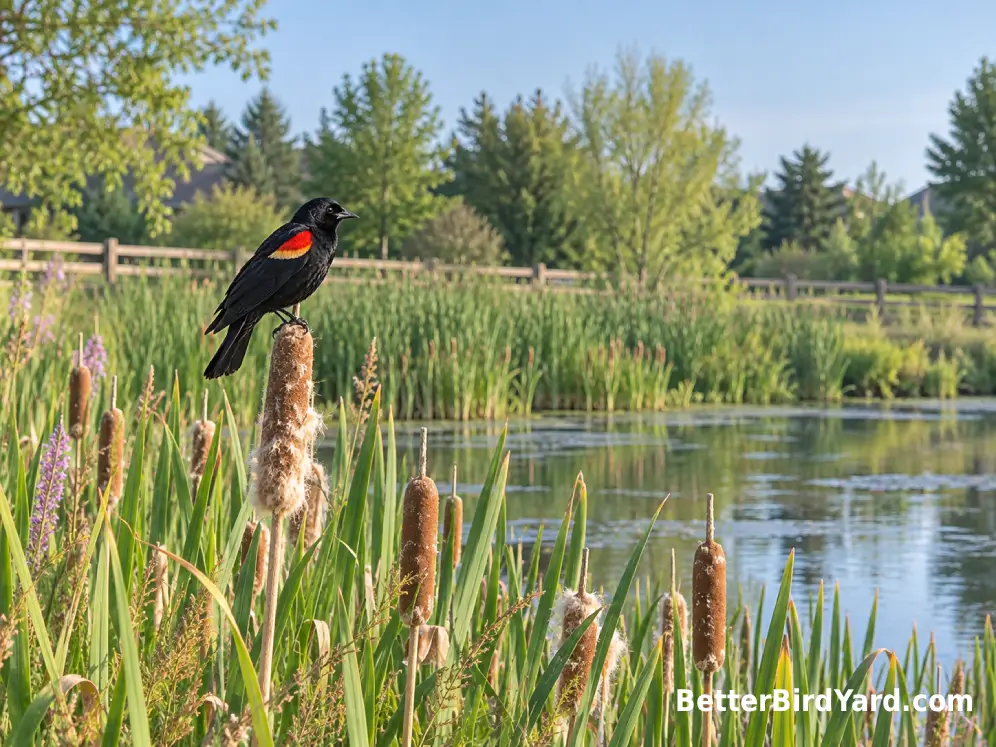
Wetlands are classic Red-winged Blackbird country. Cornell and Audubon list freshwater and saltwater marshes, wet roadsides, waterways, sedge meadows, wet fields, and similar open habitats among their common breeding environments. They can also use considerably drier places, including old fields, hayfields, pastures, and other grassy areas.
That means you do not need a large marsh behind your house to encounter one. A neighborhood retention pond, drainage area with tall vegetation, golf-course water hazard, open meadow, or nearby agricultural field may put your yard within easy commuting distance.
Season also changes what you see. Red-winged Blackbirds are resident or short-distance migrants. Cornell reports that northern populations generally move south for winter, while some southern and western populations remain in the same general region year-round. Outside the breeding season, the birds often gather in flocks with other blackbirds, grackles, cowbirds, and starlings.
So a yard that has no Red-winged Blackbirds in midsummer may suddenly receive several during migration or winter, while another yard near suitable breeding habitat may hear males singing regularly in spring and summer. Local habitat matters at least as much as the feeder hanging outside your window.
How To Attract Red-Winged Blackbirds Responsibly
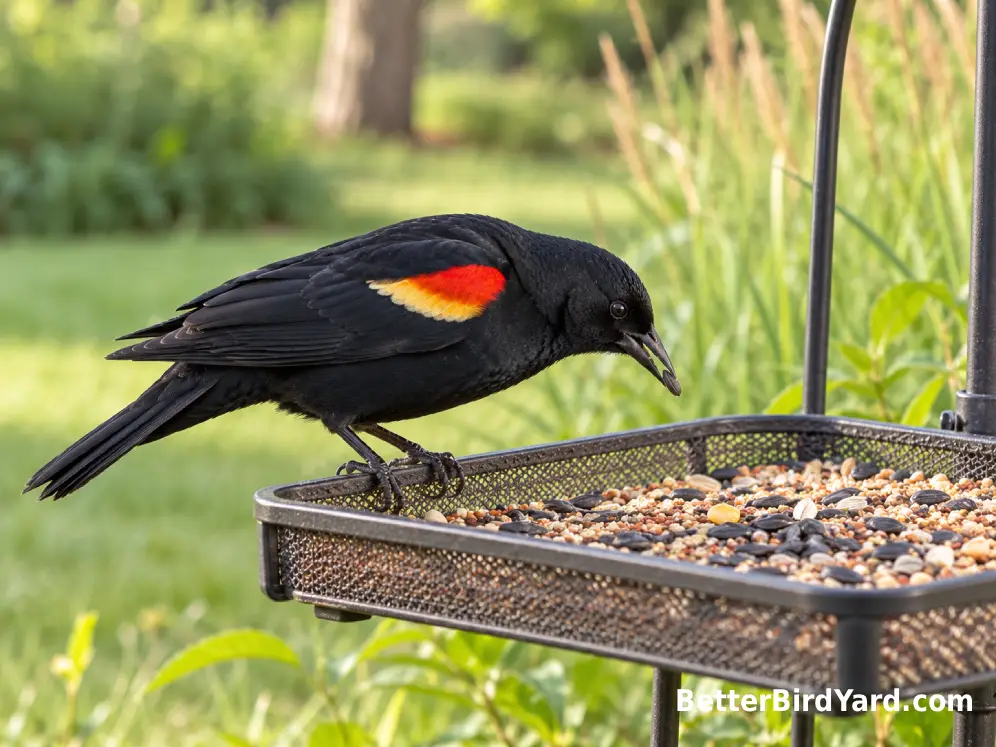
Red-winged Blackbirds are primarily ground foragers, so their feeder behavior can look different from that of chickadees or finches clinging to a small tube feeder. Cornell recommends mixed grains and seeds for backyard visitors and notes that spreading seed on the ground can appeal to their natural feeding style.
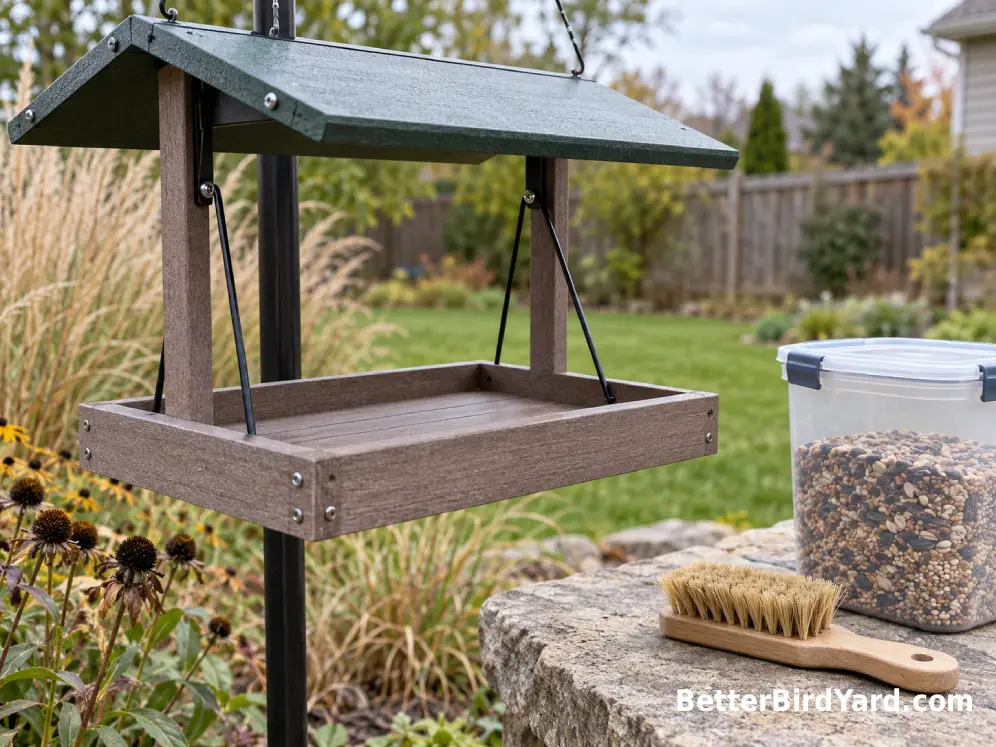
In an ordinary backyard, we would keep the setup a little more controlled than simply scattering large amounts of food across the lawn. A broad platform or tray close to an open feeding area can provide similar access while making it easier to monitor old food, hulls, and droppings.
Start with three simple priorities:
- Offer a modest amount of mixed seed or grain where larger ground-feeding birds can reach it.
- Keep the feeding area open enough that birds can see their surroundings.
- Remove wet, spoiled, or moldy seed instead of continually adding fresh food on top.
Red-winged Blackbirds do not live on feeder seed alone. Cornell describes a seasonally varied natural diet that includes insects and other small invertebrates as well as weed seeds, native sunflower seeds, corn, wheat, and other grains. Insects become particularly important during the warmer part of the year.
That makes habitat useful too. Locally native grasses, shrubs, and other plants can provide seeds, insects, shelter, and foraging structure. Audubon recommends choosing plants native to your particular region rather than assuming that one national plant list fits every yard. Even patio and balcony gardeners can use locally appropriate native plants in containers.
Why Red-Winged Blackbirds Can Seem Aggressive
A singing male perched above a marsh is not simply showing off his colors. During the breeding season, males use prominent perches, songs, and shoulder displays while defending territories. Both Cornell and Audubon describe Red-winged Blackbirds as vigorous defenders that may chase crows, hawks, other blackbirds, and occasionally people or other large animals that approach a nesting territory.
If a bird repeatedly calls, dives nearby, or becomes more agitated as you approach one particular patch of vegetation, the simplest response is to give that area more space. Do not search the vegetation for a nest or try to make the bird tolerate your presence. Changing your walking route temporarily is usually easier on both you and the birds.
This territorial behavior should not be confused with the birds’ behavior all year. Outside breeding territories, Red-winged Blackbirds are highly social and can feed or roost in large flocks. The same species that vigorously guards a patch of cattails in breeding season may later be one bird among many feeding together in an open field.
Editorial note: if a bird suddenly seems unusually defensive, consider what is happening around it before assuming it is simply an aggressive species. A nearby nest or fledgling may change the bird’s behavior substantially.
Other Black Birds With Orange Or Red On The Wings
A black bird with orange on the wings is not automatically a Red-winged Blackbird. Shape, size, habitat, and the location of the colored feathers help narrow the possibilities.
| Bird | Useful Visual Clue | Where The Color Appears | Helpful Context |
|---|---|---|---|
| Red-winged Blackbird | Stocky, mostly glossy-black male | Red shoulder patch, usually edged yellow | Often around marshes, wet fields, grasslands, and open feeding areas |
| American Redstart | Much smaller, active warbler | Orange on wings, sides, and tail | Often darts through trees and repeatedly fans its tail |
| Baltimore Oriole | Slender bird with extensive bright orange plumage | Orange body areas plus a white wing bar | More strongly associated with trees, woodland edges, parks, and backyards |
| Tricolored Blackbird | Very similar blackbird shape | Red shoulder patch bordered with white or cream | A western species strongly associated with California and much less widespread |
Cornell describes the male American Redstart as a small black warbler with orange patches on the wings, sides, and tail—quite different from the Red-winged Blackbird’s concentrated shoulder badge.
A male Baltimore Oriole has substantially more orange across the body and tail and a conspicuous white wing bar. The similarly shaped Tricolored Blackbird is a more important identification challenge in California: males have a red shoulder patch bordered below by white to cream rather than the typical yellow border of a Red-winged Blackbird.
Keep A Red-Winged Blackbird Feeding Area Healthy
Red-winged Blackbirds can arrive in groups, and a busy feeding area can accumulate seed hulls, droppings, and uneaten food quickly. That is the point where routine maintenance matters more than adding another feeder.
Project FeederWatch advises regular feeder cleaning and emphasizes removing debris and allowing feeders to dry completely before refilling them. Wet or moldy seed should be discarded rather than saved. Cleaning may need to be more frequent during warm, wet, or heavily used conditions.
A practical routine is to:
- Offer only as much seed as your visiting birds are likely to use before it becomes damp or stale.
- Empty and clean feeders whenever food becomes wet, dirty, or moldy.
- Remove significant accumulations of old seed and droppings beneath the feeding area.
- Watch for rodents or nuisance wildlife and reduce spilled food if they become regular visitors.
- Keep nearby windows in mind when choosing a feeding location and address hazardous reflections.
If you notice birds that appear sick around a feeder, avoid trying to diagnose them yourself. Clean the feeding and water areas, consider temporarily reducing or pausing feeding if birds continue to congregate there, and check current guidance from your state wildlife agency or another qualified wildlife authority. Project FeederWatch similarly recommends extra cleaning and, in some situations, temporarily removing feeders when sick birds are repeatedly present.
Our bird feeder cleaning guide covers a simple maintenance routine for everyday backyard setups.
Supporting Red-Winged Blackbirds Beyond The Feeder
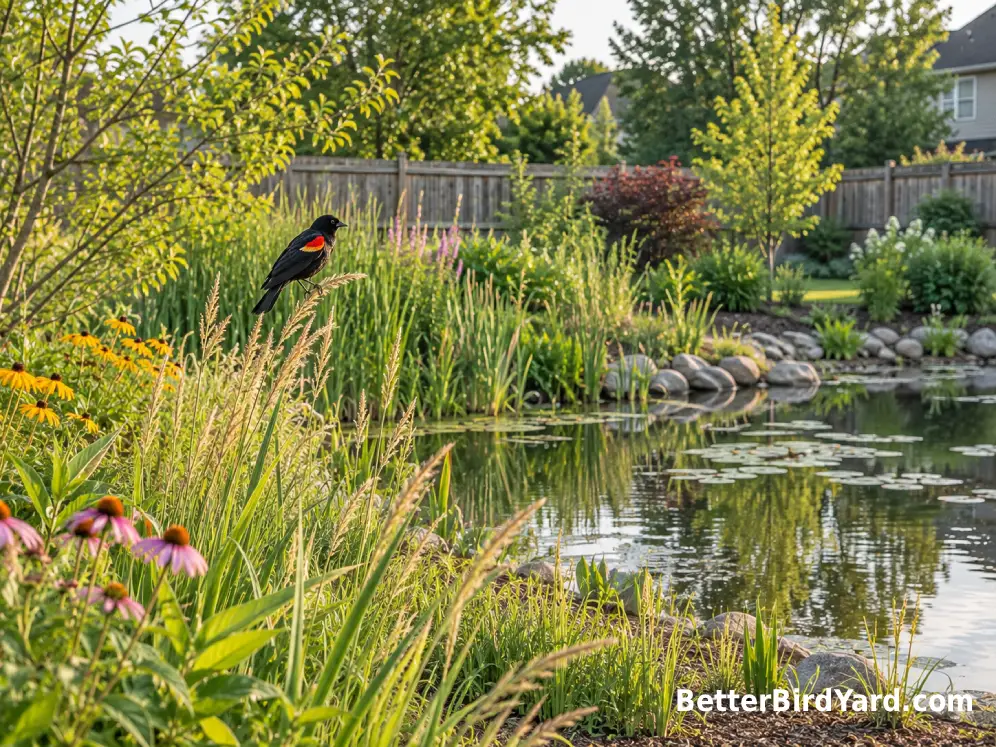
A feeder is optional habitat support, not the whole picture. Red-winged Blackbirds naturally use open landscapes with grasses, wetland vegetation, seeds, and abundant invertebrate life. If your property has a damp corner, pond edge, meadow-like planting, or open grassy border, maintaining some vegetation rather than mowing every square foot short can add useful structure.
For yards and patios without wet habitat, locally native plants are still a worthwhile starting point because they can provide seeds, shelter, and insect habitat for many bird species. Audubon’s native-plant guidance specifically recommends selecting plants for local conditions rather than treating a plant that is native somewhere in the United States as suitable everywhere.
You also do not need to turn a small yard into an artificial marsh to attract a Red-winged Blackbird. If the surrounding neighborhood lacks the habitat these birds naturally use, another species may simply be a better fit for your space. Supporting the birds already adapted to your local landscape is more realistic than trying to guarantee one particular visitor.
Keep pesticides to a minimum where practical, make glass safer for birds when reflections create a collision hazard, and keep pet cats from roaming where birds feed or nest. A bird-friendly yard works best when food and habitat improvements are paired with attention to common backyard hazards. Audubon likewise emphasizes that feeders and native plants should be combined with measures addressing threats such as windows and outdoor cats.
A Red-Winged Blackbird Is Worth A Second Look
Once you recognize the combination of glossy black plumage and a red-and-yellow shoulder badge, a male Red-winged Blackbird is difficult to forget. The bigger identification lesson is knowing how much the bird’s appearance can change. A folded wing may hide most of the red, the remaining colors may look orange from a distance, and a female may appear to be an entirely unrelated streaky brown bird.
Watch the setting as closely as the plumage. Cattails, wet fields, pond edges, grassy open spaces, conspicuous singing perches, and ground feeding all strengthen an identification. During other seasons, the same birds may appear in large, social flocks far from a nesting marsh. Cornell’s range information also makes clear that migration patterns vary across North America, so your local experience will depend on both season and region.
If Red-winged Blackbirds visit your yard, there is no need for an elaborate setup. Clean food offered in sensible amounts, locally appropriate plants, reduced backyard hazards, and enough space for natural behavior are the useful basics. And if that mysterious black bird with red shoulders suddenly lifts its wings and turns a thin colored line into a brilliant patch, you will know exactly what you are looking at.