Oriole Bird Feeders: A Practical Setup for Fruit, Jelly, and Nectar
Oriole bird feeders are different from ordinary seed feeders. Instead of sunflower seed or millet, they usually offer orange halves, small servings of grape jelly, sugar water, or a combination of all three. Baltimore, Bullock’s, Hooded, and Orchard Orioles may visit these foods where the species occurs, although feeder activity varies with region, season, habitat, and natural food availability.
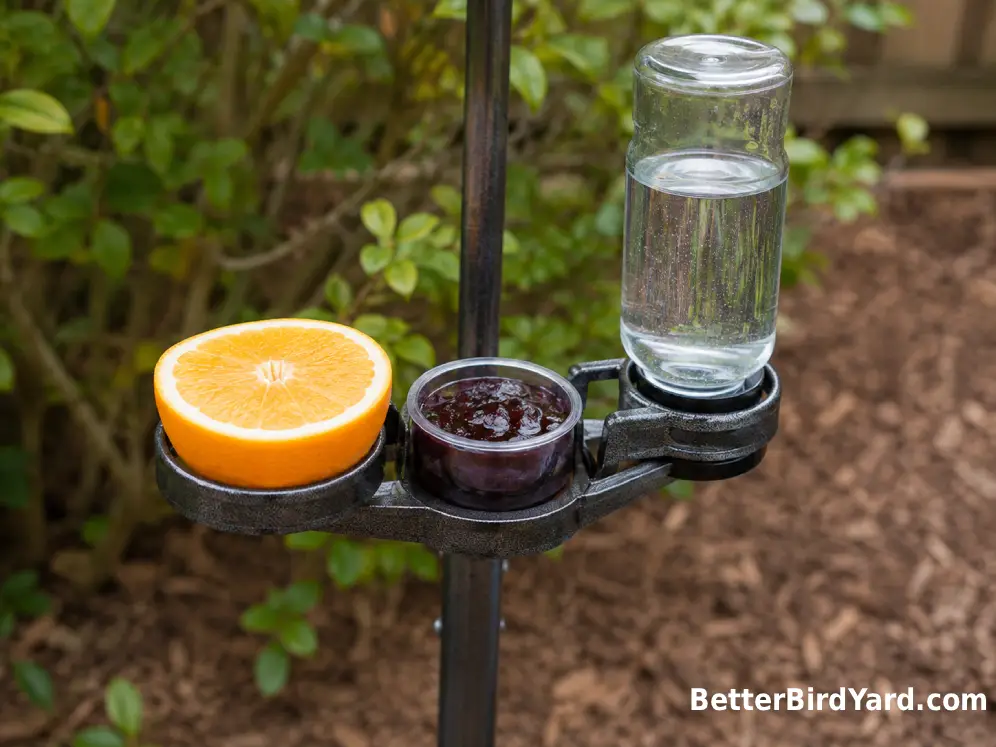
For most beginners, the best setup is a brightly colored, easy-to-clean feeder with a shallow jelly cup, one or two secure orange holders, and enough room for an oriole to perch comfortably. A separate nectar reservoir can be useful, but it also adds another item that must be emptied and washed regularly.
Start small. One feeder containing half an orange and a spoonful of jelly is easier to maintain than a large feeding station with several foods spoiling at different rates. Once orioles begin visiting consistently, you can decide whether adding nectar or a second feeder is worth the extra cleaning.
What Makes an Oriole Feeder Work?
A useful oriole feeder does not need to be elaborate. It needs to hold the food securely, give the bird a stable place to land, and come apart easily enough that you will actually clean it.
Look for these practical features when comparing bird feeders for orioles:
- Shallow, removable jelly dishes rather than deep cups
- Orange spikes or holders that keep fruit from falling
- A perch sized for a medium songbird
- Drainage that prevents rainwater from collecting around food
- Smooth surfaces without narrow seams that trap jelly or pulp
- A hook, pole mount, or railing attachment that does not sway excessively
The best oriole bird feeders sold through specialty bird stores, garden centers, and large online retailers such as Amazon tend to combine several food options. That convenience is worthwhile only when each cup, spike, and reservoir can be removed and scrubbed. A simpler feeder that stays clean is better than a feature-packed model with unreachable corners.
Which Oriole Feeder Style Should You Choose?
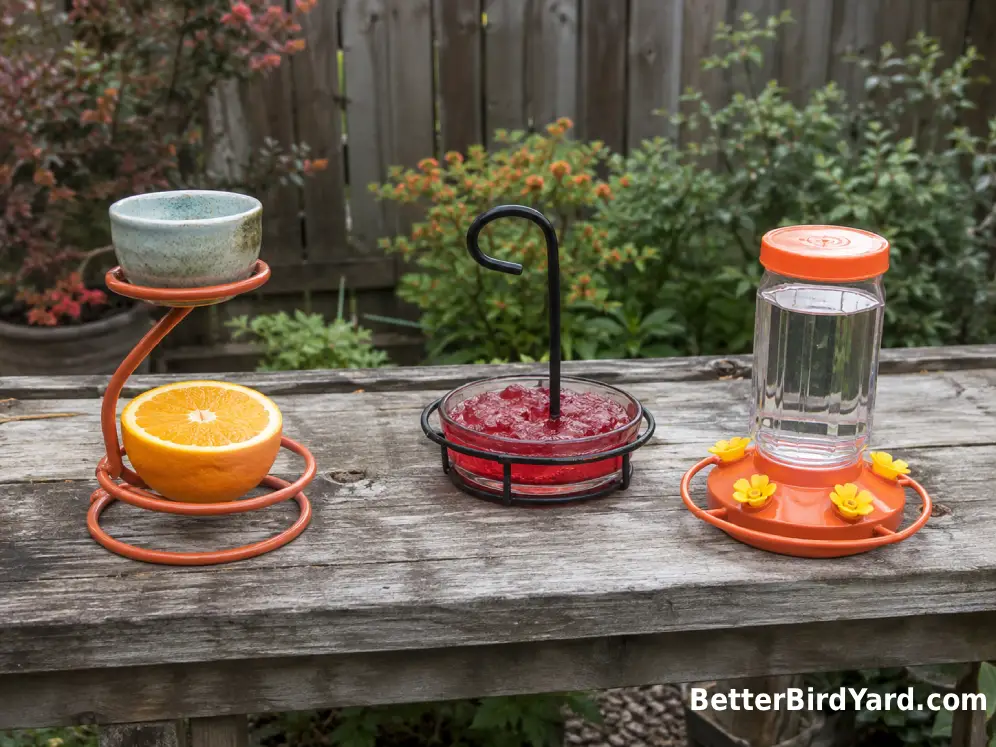
| Feeder Style | Best For | Main Advantage | Main Tradeoff |
|---|---|---|---|
| Orange feeder | Beginners and seasonal feeding | Simple, visible, and inexpensive | Fruit dries or spoils quickly |
| Jelly-cup feeder | Small patios and easy observation | Compact and easy for orioles to access | Sticky residue attracts insects and requires frequent washing |
| Nectar feeder | Homes already maintaining hummingbird feeders | Provides a familiar sugar-water option | Nectar must be replaced and the feeder scrubbed regularly |
| Combination feeder | Yards with regular oriole activity | Lets birds choose among fruit, jelly, and nectar | More components mean more cleanup |
| Platform or dish | Temporary or homemade setups | Easy to improvise and inspect | Food is exposed to rain and other wildlife |
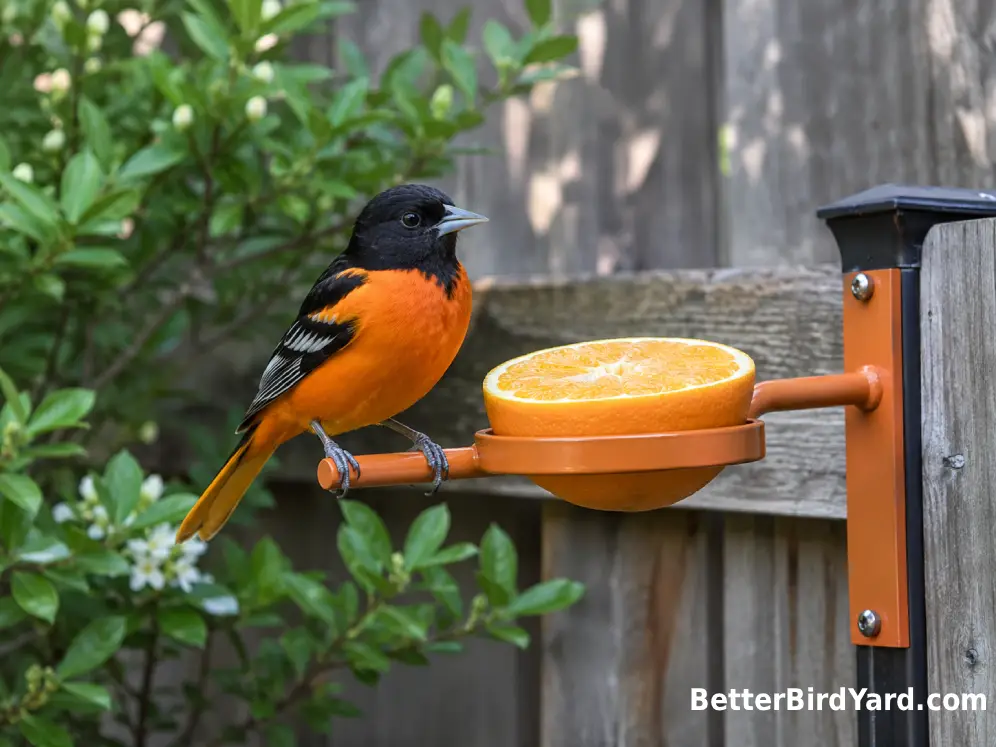
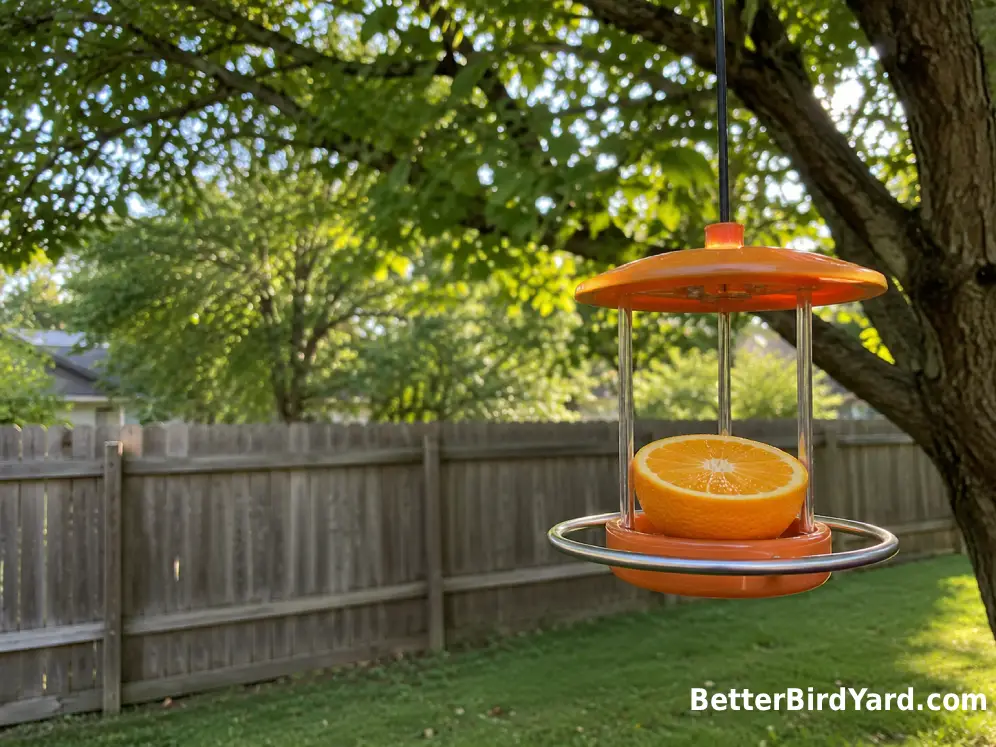
An orange feeder is usually the easiest starting point. Cornell Lab and Audubon both recommend secured orange halves for attracting orioles, and an orange can be offered without buying a specialized feeder.
A combination model makes more sense after you know orioles are passing through or nesting nearby. Otherwise, you may spend more time discarding untouched food than watching birds. In a small yard, I would choose one compact feeder with removable dishes rather than three separate feeders.
What Should You Put in an Oriole Feeder?
Fresh Orange Halves
Cut an orange in half and secure it with the flesh exposed. Orioles can pierce the pulp and drink the juice with their slender bills. Cornell Lab has documented Baltimore Orioles feeding directly from fresh orange halves at backyard stations.
Offer one half at a time unless several birds are using the feeder. Replace it when the surface becomes dry, contaminated, moldy, or otherwise unappetizing. Cornell specifically warns against leaving moldy fruit available because some molds can produce toxins harmful to birds.
Small Servings of Grape Jelly
Use a shallow cup and begin with roughly a spoonful rather than filling the dish. Cornell’s guidance for Orchard Orioles recommends offering jelly in small amounts so the feeding area does not become excessively messy.
Jelly is a supplemental food, not a replacement for the insects, fruit, and other natural foods orioles find in suitable habitat. Remove leftovers before they become crusted, diluted by rain, fermented, moldy, or crowded with insects.
Plain Sugar Water
For oriole nectar, mix one part plain white granulated sugar with four parts water. Allow it to cool fully before filling the feeder. Do not add honey or red food coloring. Cornell recommends the same one-to-four proportion used for hummingbirds, while Audubon advises against honey and dye because honey can support mold growth and coloring is unnecessary.
Make only as much nectar as you can keep fresh. An oversized reservoir may look convenient, but it often leaves more sugar water sitting outdoors than the birds can consume safely.
How Do You Set Up an Oriole Feeder?
- Choose a feeder with a stable perch and removable food dishes.
- Wash and rinse every component before its first use.
- Add half an orange or a small serving of jelly rather than filling every compartment.
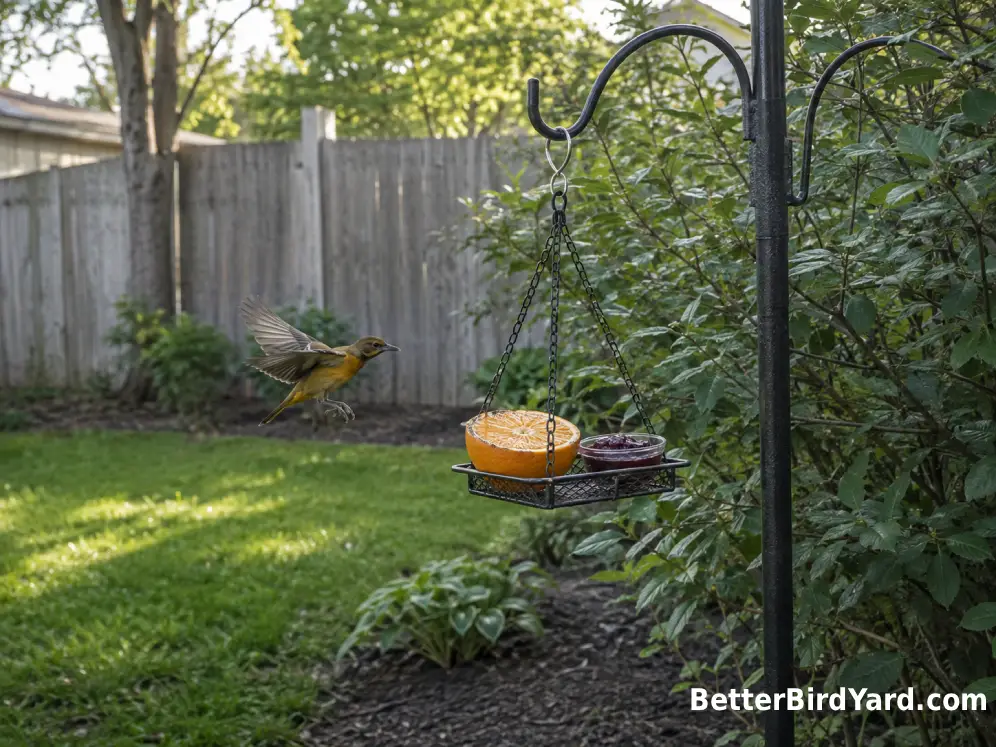
- Hang the feeder where it is visible from above but not buried deep inside foliage.
- Check the food each day and record which option the birds actually use.
- Reduce or remove unused foods instead of continuously refilling them.
Orioles often forage in trees, woodland edges, parks, orchards, and leafy suburban areas. A feeder positioned near trees or shrubs may therefore be easier for passing birds to investigate than one placed in the middle of a bare lawn. Keep enough open space around it that you can see the feeder clearly and clean beneath it.
Put the feeder out shortly before orioles normally arrive in your area rather than relying on one nationwide date. Migration and breeding schedules vary by region and species. Recent observations from eBird, a local Audubon chapter, or a nearby birding group can give you a more useful local signal than a generic calendar.
Do not assume the feeder has failed if nothing visits during the first few days. The birds may not have arrived, may be feeding elsewhere, or may have abundant natural food nearby. Keep the portions small while you wait.
Where Can You Place a Feeder Safely?
Check the view from outside before choosing a location. Glass reflecting trees or open sky can look like a flight path to a bird. Cornell recommends placing feeders no more than three feet from a window so birds leaving the feeder cannot build up as much speed before a possible collision. Effective exterior window treatments can provide additional protection.
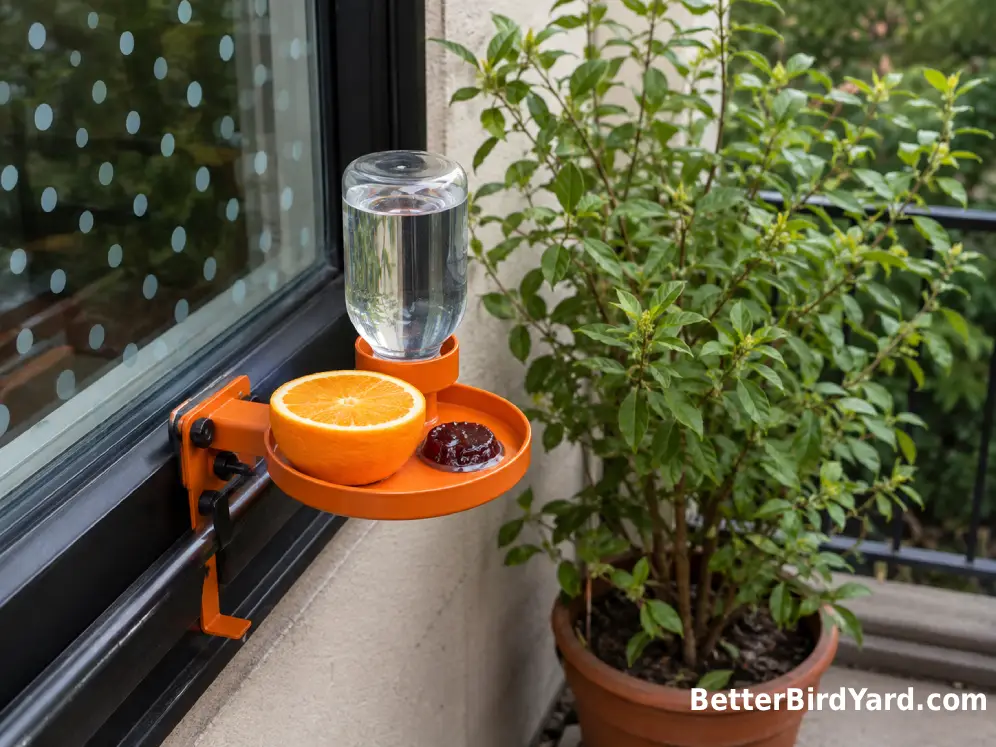
On a balcony, mounting the feeder near the window or wall is generally preferable to hanging it from the outermost edge. Cornell also advises keeping hanging plants and feeders closer to high-rise windows rather than at the balcony perimeter.
Renters should use a secure railing bracket, freestanding pole, or other attachment permitted by the lease. Check building, HOA, and local rules before mounting hardware or feeding wildlife. Place a washable mat beneath the feeder when drips could stain a shared patio or attract ants.
Keep cats indoors or separated from the feeding area, and avoid placing the feeder immediately above a low hiding spot where a predator could wait unseen.
How Do You Keep an Oriole Feeder Clean?
Fruit, jelly, and nectar demand more attention than dry seed because moisture and sugar leave sticky surfaces where mold and debris can develop. Audubon recommends cleaning sugar-water feeders every two or three days under ordinary conditions and more frequently in hot weather or whenever mold, cloudiness, or insect contamination appears.
- Inspect oranges and jelly at least daily.
- Discard food that is moldy, fermented, contaminated, dried out, or waterlogged.
- Empty nectar rather than topping off old liquid.
- Scrub feeding ports, cup rims, perches, and seams.
- Rinse thoroughly and let all components dry before refilling.
- Clean spilled jelly, fruit pulp, and droppings from the area below.
For periodic disinfection, Project FeederWatch recommends removing visible debris, using a dilute bleach solution, rinsing thoroughly, and allowing the feeder to dry completely. Follow the manufacturer’s material-care instructions, never mix bleach with other cleaners, and keep cleaning products away from children and pets.
A common mistake we see is refilling the attractive top surface while ignoring sticky residue underneath the dish. If you only change one maintenance habit, remove every food cup during cleaning instead of wiping around it.
Our bird feeder cleaning guide provides a fuller routine for washing, disinfecting, drying, and maintaining different feeder materials.
Can You Make a Homemade Oriole Feeder?
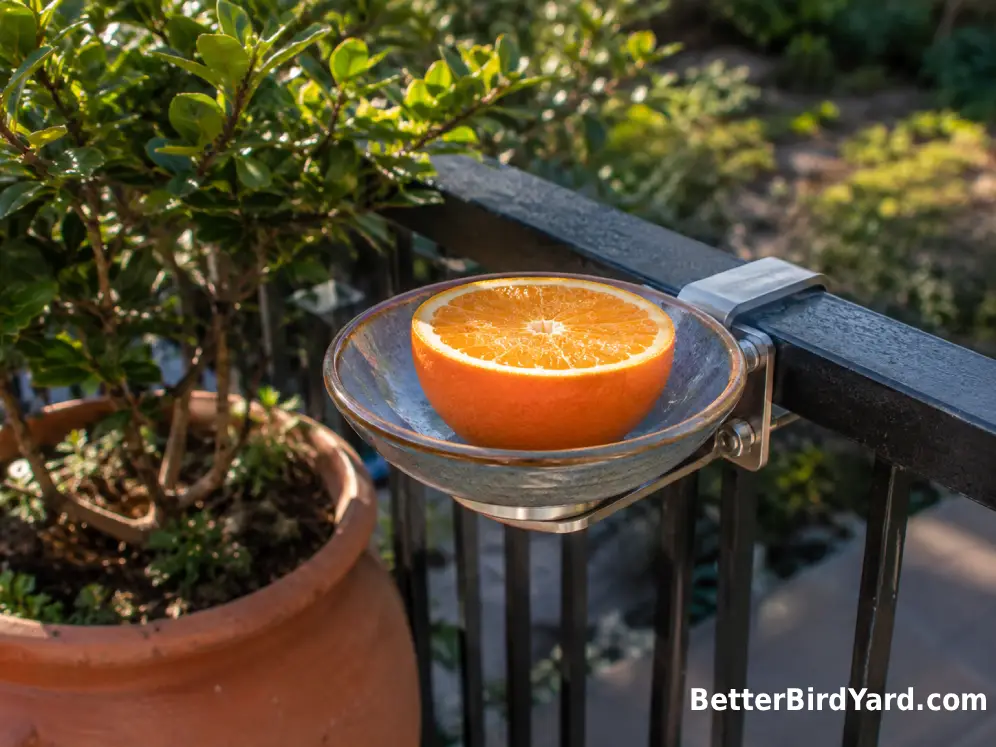
A homemade oriole bird feeder can be as simple as a clean, shallow dish that holds an orange half without tipping. Secure the dish to a railing shelf, feeder platform, or sturdy hanging base so wind and larger animals cannot knock it down.
Audubon offers a simple variation in which an orange half is secured with a thin stick and attached to a branch, fence, post, or railing. Whatever design you use, cover or remove exposed sharp points and make sure the orange cannot slide down the support.
A small glazed ceramic or stainless-steel cup can hold jelly beside the orange. Avoid rough, cracked, rusty, or porous containers that are difficult to clean. The cup should lift out easily, and it should be shallow enough for you to see whether rainwater, insects, or debris have entered it.
Skip decorative string loops, loose netting, and frayed fibers that could create an entanglement hazard. A plain, stable feeder with two washable food holders is more useful than an elaborate craft project that cannot withstand weather or regular scrubbing.
Why Are Orioles Ignoring the Feeder?
- The birds may not be in your area yet. Check recent local sightings before changing the entire setup.
- The feeder may be hidden. Move it to an open edge where a bird flying above nearby trees can notice it.
- The food may be old. Replace dried oranges, crusted jelly, or cloudy nectar instead of adding fresh food on top.
- The feeder may move too much. Shorten a swinging hanger or use a sturdier pole or bracket.
- Natural food may be abundant. Feeder visits can decline when insects, flowers, and fruit are readily available.
- Other animals may be dominating the station. Reduce portions and remove food overnight if raccoons, rodents, or other nuisance wildlife become regular visitors.
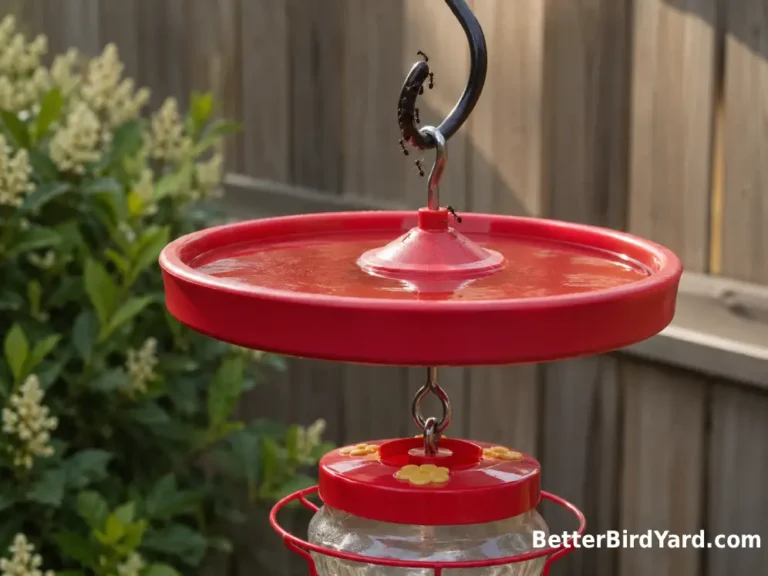
Ants and bees do not necessarily mean you need pesticides. Use smaller servings, wipe away drips, move the feeder temporarily, and add a clean ant moat when compatible with the feeder. Do not spray insecticide on the feeder, fruit, flowers, or nearby surfaces where birds may contact residues.
Orioles may also change food preferences during the season. Cornell notes that insects are especially important when adults are feeding young, so a bird that eagerly visited oranges during migration may spend more time foraging in trees later.
How Can Your Yard Support Orioles Beyond the Feeder?
An oriole feeder supplies only a small part of what these birds need. Trees, shrubs, flowers, and reduced pesticide use can support the insects, fruit, nectar, nesting locations, and shelter that feeders cannot provide. Cornell notes that native plants can supply birds with insects, fruit, seeds, nesting places, and cover throughout the year.
Choose plants through your state extension service or a reputable regional native-plant resource rather than relying on a universal national list. A plant that is valuable and well behaved in one part of the country may be unsuitable in another.
Even renters can add habitat with one or two pesticide-free container plants selected for local conditions. A small shrub, flowering perennial, or compact vine can offer cover and foraging opportunities while making the feeder feel less isolated.
For additional ideas, see our guide to creating a bird-friendly yard with native plants.
Keep Your Oriole Feeding Routine Simple
You do not need an expensive feeding station to welcome orioles. Begin with a stable, washable feeder and one fresh orange half. Add a small amount of jelly or a properly prepared nectar solution only when you can keep up with the additional cleaning.
Place the feeder where passing birds can see it, protect nearby windows, and keep food portions matched to actual use. Check the setup daily during warm weather. Fresh food in a simple feeder is more responsible and more inviting than several neglected dishes.
Results will vary. Baltimore oriole bird feeders may be active for weeks in one neighborhood and receive only brief migration visits in another. Natural habitat, weather, local species, seasonal food supplies, and the timing of migration all influence what appears in your yard.
The most useful routine is also the easiest to sustain: offer a little, watch closely, clean promptly, and let locally appropriate plants provide the lasting foundation.