Grackle vs Crow: How to Tell These Black Birds Apart
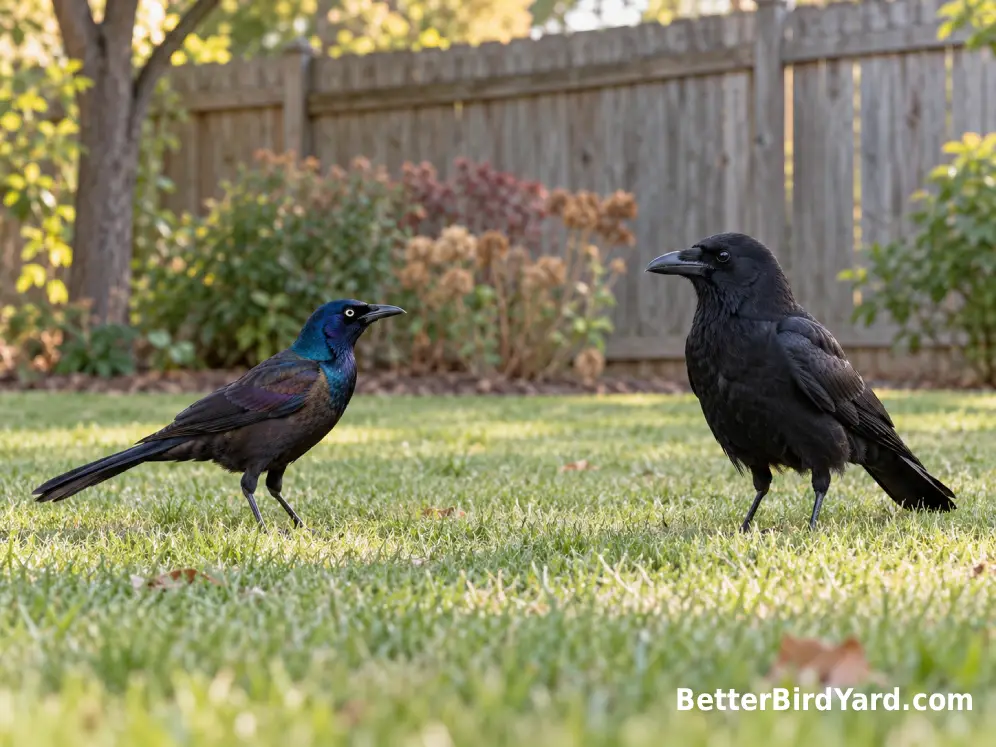
A grackle and a crow can both look like large black birds when they land across the yard, but a closer look usually separates them quickly. In a typical Common Grackle vs crow comparison, the grackle is smaller and slimmer, with a noticeably long tail, glossy or iridescent plumage, and pale yellow eyes in adults. An American Crow is substantially heavier, with a thicker neck and bill, a more uniformly black appearance, dark eyes, and a broader overall build.
Sound can make the identification even easier. American Crows give the familiar harsh caw, while Common Grackles produce a varied collection of squeaks, whistles, croaks, and metallic-sounding notes. Tail shape, flock behavior, and the way the bird moves across a lawn provide additional clues. Cornell Lab measurements put Common Grackles at about 11–13.4 inches long, compared with roughly 15.8–20.9 inches for American Crows.
Grackle vs Crow At A Glance
If you have only a few seconds to make an identification, look at the bird’s proportions rather than simply asking whether it is black. Grackles belong to the blackbird family, Icteridae, while crows belong to the corvid family, Corvidae. They are not especially close look-alikes once you learn their shapes.
| Clue | Common Grackle | American Crow | Common Raven |
|---|---|---|---|
| Length | About 11–13.4 in | About 15.8–20.9 in | About 22.1–27.2 in |
| Build | Slender and lanky | Heavy, sturdy, thick-necked | Very large and thick-necked |
| Adult Eye | Usually bright yellow | Dark | Dark |
| Plumage | Glossy, often blue-purple and bronze | Black overall | Black overall |
| Tail | Long and conspicuous | Shorter-looking, rounded or squared in flight | Long and wedge-shaped in flight |
| Typical Voice | Squeaks, whistles, croaks, harsh notes | Harsh caws | Deep croaks and varied calls |
The size figures are useful, but field identification works best when several clues agree. Cornell Lab descriptions emphasize the Common Grackle’s lanky shape and long tail, the American Crow’s broad wings and heavy straight bill, and the Common Raven’s much larger body, heavy bill, and wedge-shaped tail.
Start With Body Shape And Size
A Common Grackle often looks stretched out. The body is relatively narrow, the legs are long, and the tail extends conspicuously behind the bird. Cornell describes Common Grackles as large, lanky blackbirds and gives them a weight range of roughly 2.6–5 ounces.
An American Crow has a much more substantial body. Its neck looks thicker, its chest deeper, and its straight bill heavier. Cornell lists American Crows at approximately 11.2–21.9 ounces, so even where body length is difficult to judge, a crow usually has considerably more physical bulk than a Common Grackle.
This distinction becomes particularly useful around backyard feeders. A Common Grackle may look large beside House Finches, chickadees, or other feeder birds, which can make it seem crow-sized at first. Wait until it lands beside a fence rail, feeder tray, Mourning Dove, or another familiar object before judging scale.
If you only see a distant silhouette, use proportions: a long-tailed, relatively narrow bird points toward a grackle, while a thick-bodied bird with a heavier head and neck is more consistent with a crow.
Check The Eyes And Iridescent Feathers
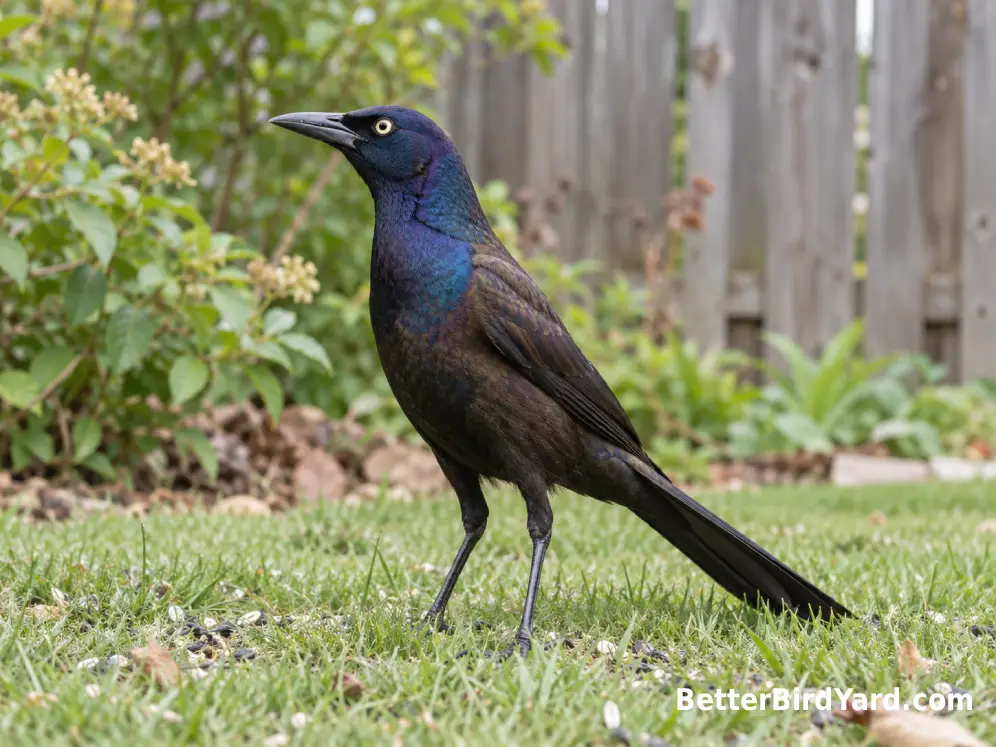
Good light can turn an uncertain identification into an easy one. Adult Common Grackles often show a bright golden or yellow eye along with glossy purple-blue on the head and bronze or other iridescent tones across the body. From across the yard or under cloudy light, those same feathers may simply look black.
American Crows look much more uniformly black. Their feathers can have some gloss, and worn feathers may look somewhat brownish, but they do not normally show the contrasting yellow eye and colorful iridescence typical of an adult Common Grackle.
Eye color is a useful clue, not a stand-alone rule. Juvenile Common Grackles are brownish and have dark eyes, so a young bird can lack one of the easiest adult identification marks. Other grackle species also complicate the picture: Boat-tailed Grackle eye color varies geographically, for example.
A practical approach is to combine three features: eye color, body shape, and tail length. When all three point in the same direction, the identification becomes much more dependable.
Watch The Tail, Wings, And Flight
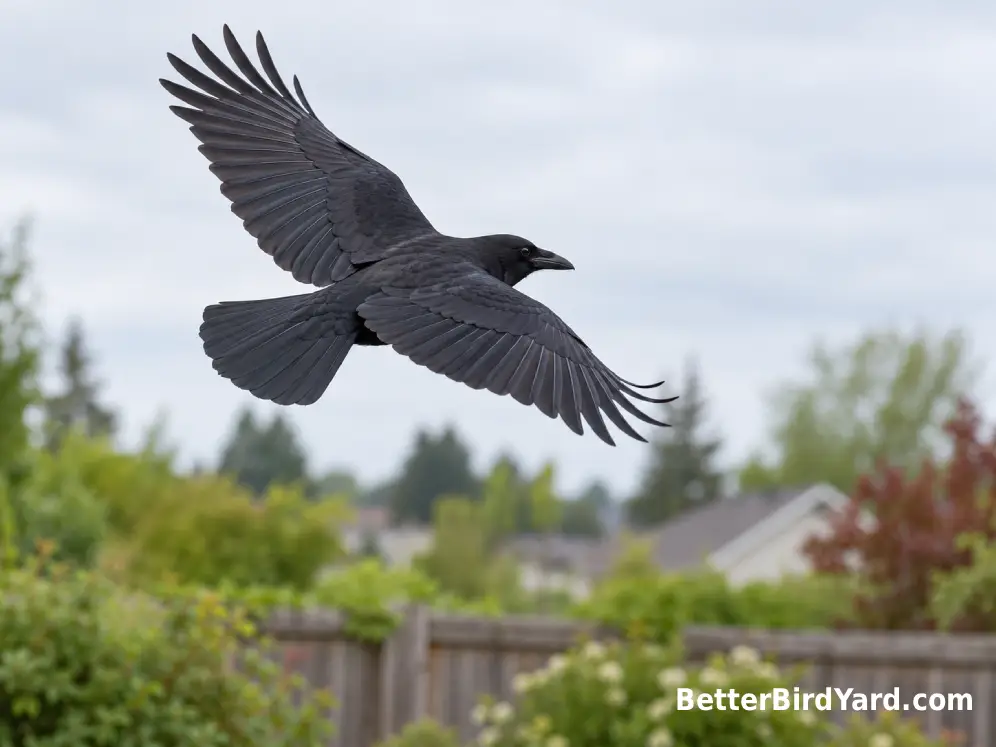
Tail shape is one of the best clues when the bird takes off. A Common Grackle carries a long tail that can look disproportionately large compared with its body and wings. In flight, that tail may trail straight behind or fold slightly along the center.
An American Crow has broad, rounded wings and a shorter-looking tail that appears rounded or fairly square across the end. Its flight often consists of steady, methodical wingbeats rather than the long-tailed silhouette of a grackle.
This becomes especially useful when the bird is strongly backlit and you cannot see eye or feather color. Instead of trying to identify a completely black silhouette, ask yourself where the bird seems to carry its visual weight. A grackle often looks tail-heavy and narrow. A crow looks broader through the chest and wings.
Flight shape is also one of the easiest ways to separate a crow from a raven, because a Common Raven’s long tail typically narrows toward a wedge or diamond shape rather than ending in the crow’s rounded outline.
Listen Before You Reach For The Binoculars
Sound is often faster than visual identification. American Crows are famous for loud, rough caws. They have a wider vocabulary than that familiar call suggests, but repeated cawing is still an excellent field clue.
Common Grackles sound noticeably different. Cornell’s recordings and descriptions include squeaks, whistles, croaks, harsh calls, and a short song whose mechanical quality is often compared with a rusty gate. A noisy group may sound more like an assortment of creaks and metallic notes than a flock of cawing crows.
Behavior helps too. Common Grackles frequently strut across lawns on long legs, pecking at the ground, and they may gather in conspicuous flocks. American Crows are also highly social and can form very large groups, so flock size alone does not settle a crow vs grackle identification. Look at how flock behavior combines with size, body shape, tail, and sound.
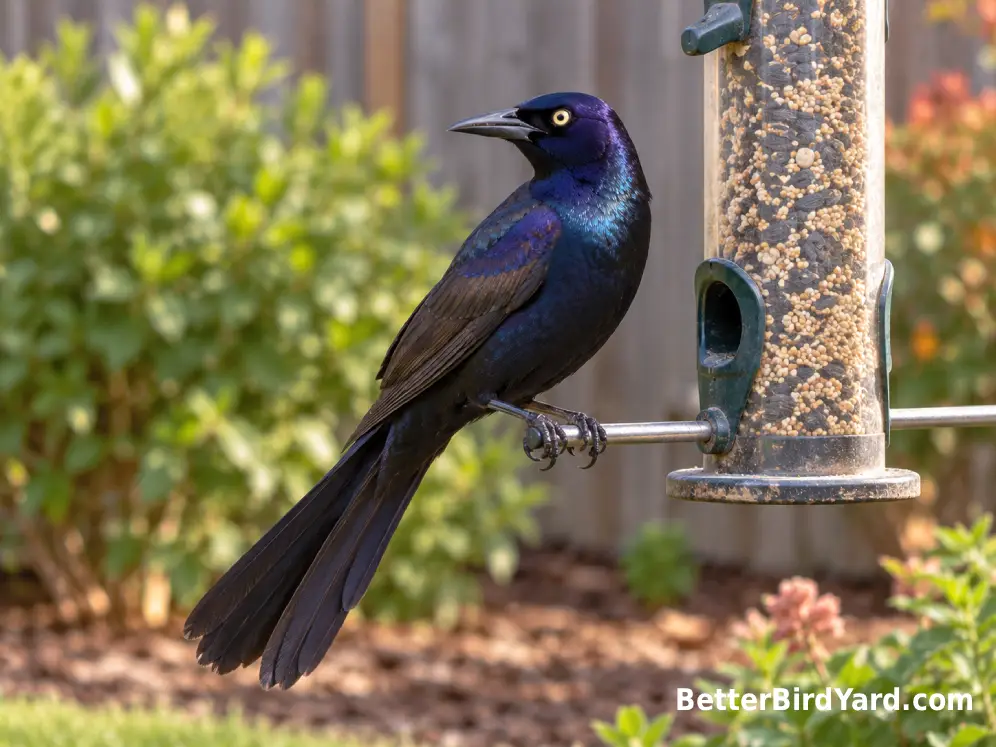
A common backyard clue is feeder behavior. Common Grackles readily use feeding stations and can dominate smaller birds when several arrive together.
Grackle vs Crow vs Raven: The Fastest Three-Way Test
If a very large black bird makes you wonder about a grackle vs crow vs raven identification, size and silhouette should be your starting point.
- Grackle: Think slender, long-legged, long-tailed, and often iridescent.
- American Crow: Think medium-large, sturdy, uniformly black, with a heavy straight bill and rounded tail in flight.
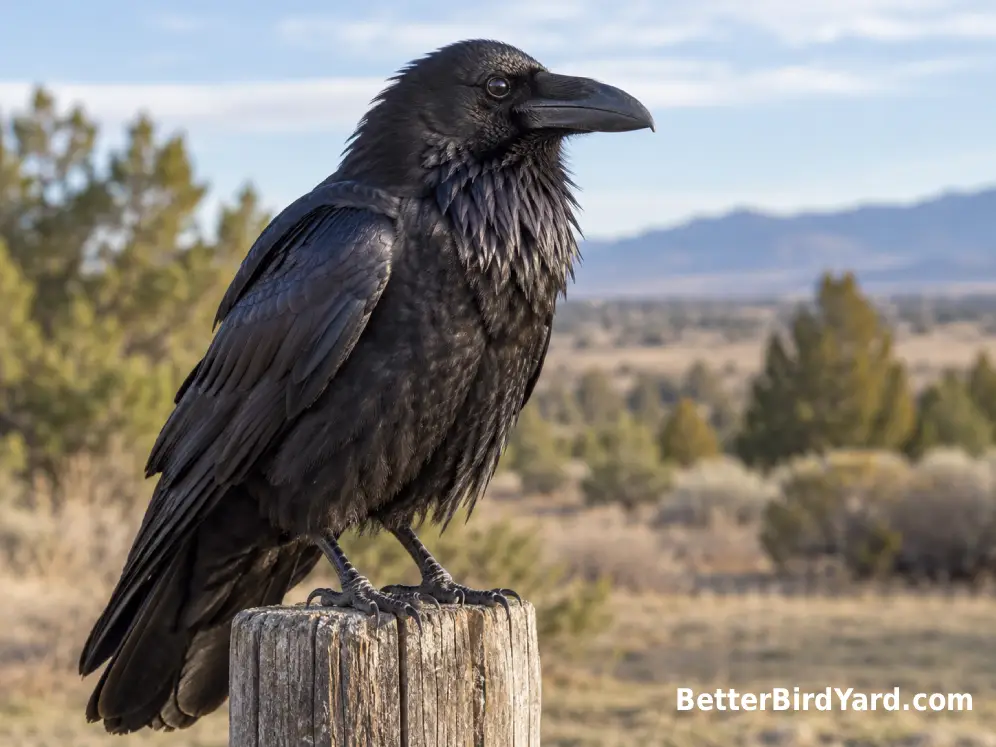
- Common Raven: Think noticeably larger, with an especially heavy bill, thick neck, shaggy throat feathers, and wedge-shaped tail.
Cornell lists Common Ravens at roughly 22.1–27.2 inches long with a wingspan around 46 inches. American Crows are roughly 15.8–20.9 inches long with wingspans around 33.5–39.4 inches. The difference can be dramatic when the birds appear together, although judging an isolated bird against an empty sky is much harder.
Sound provides another strong separator. The classic raven call is a deep, resonant croak, while a crow’s familiar voice is harsher and more caw-like. Ravens also frequently soar and glide, whereas American Crows more often use regular rowing wingbeats.
One useful shortcut is to look at the throat. A very large black bird with shaggy throat feathers and a massive bill deserves serious consideration as a raven. A slimmer bird with a long tail and a pale eye is much more likely to be a grackle.
Great-Tailed Grackle vs Crow Can Be Trickier
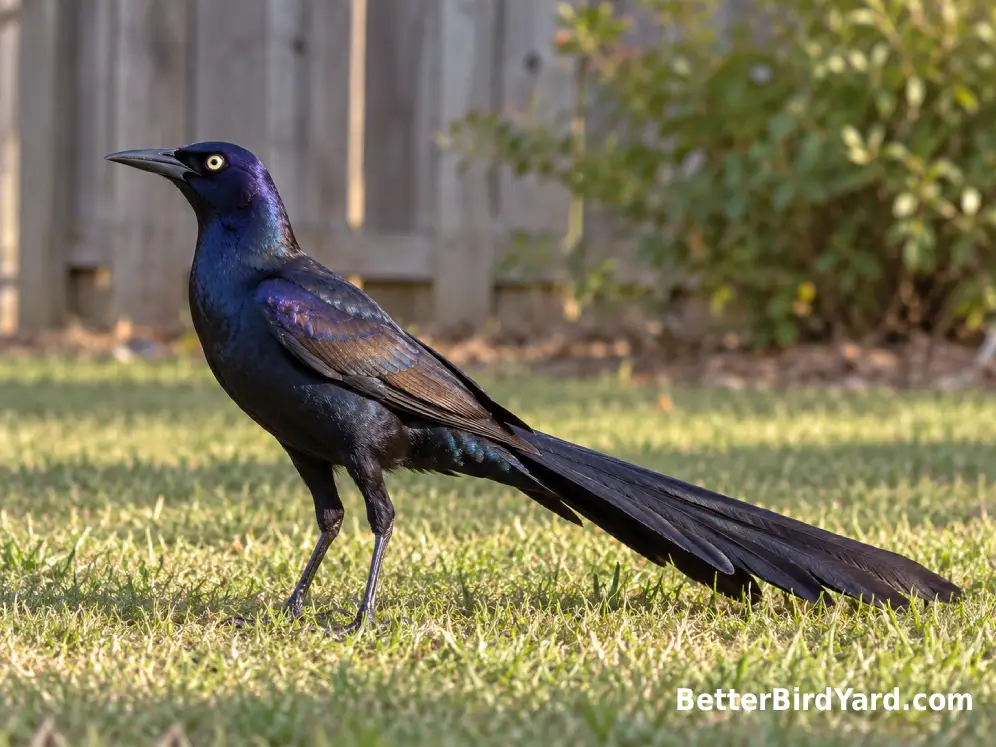
The Great-tailed Grackle explains why size alone can fail. Adult males measure about 15–18.1 inches long, putting them within the American Crow’s length range. But they are dramatically lighter in weight and have much slimmer bodies. Much of a male Great-tailed Grackle’s apparent length comes from an exceptionally long tail that can approach the length of the body.
A male Great-tailed Grackle typically shows a pale yellow eye, glossy blue-black or purple-toned plumage, long legs, and a long tail that folds into a pronounced V or keel shape. An American Crow looks thicker from almost every angle, with a heavier chest and neck and a far less exaggerated tail.
Female Great-tailed Grackles create a different identification problem because they are brown rather than glossy black and substantially smaller than males. If you see brown and black long-tailed birds together, do not assume they are different species until you have checked the possibility of male and female Great-tailed Grackles.
Geography also helps. Great-tailed Grackles are widespread in developed and open landscapes through much of the Midwest and West and have expanded considerably beyond their historical U.S. range. Boat-tailed Grackles are a separate species associated mainly with Atlantic and Gulf coastal habitats, while Common Grackles occupy many suburban, park, woodland-edge, wetland, and agricultural settings.
Location should narrow the possibilities, not override what the bird actually looks and sounds like.
Common Grackle And Crow Identification Mistakes
Most crow vs grackle mistakes happen because one obvious feature gets too much weight. Black plumage is the biggest trap. Against bright sky, a Common Grackle can look uniformly black, while poor light can hide its yellow eye completely.
A few habits make backyard identification more reliable:
- Do not estimate size without a familiar object or bird nearby.
- Do not use eye color alone, especially with juvenile grackles.
- Wait for the bird to turn so you can judge the bill, neck, and tail.
- Listen for several calls rather than relying on one unusual sound.
- Watch the bird in flight if the perched view leaves you uncertain.
Another mistake is assuming every large black corvid is an American Crow. Fish Crows overlap American Crows across parts of the eastern United States and can be extremely difficult to separate visually. Their distinctive nasal voice is often a much better clue than appearance.
For beginners, a useful routine is shape first, color second, sound third, behavior fourth. That approach keeps a single misleading feature from deciding the identification.
BetterBirdYard note: If the bird disappears before you are sure, leaving it unidentified is better than forcing an answer. A quick phone photo, even an imperfect one, can preserve useful details such as proportions, tail shape, and nearby objects for scale.
The Simplest Way To Make The Final Call
For a typical grackle vs crow sighting, start with the overall build. A slender bird with long legs and an unusually long tail suggests a grackle. A substantially heavier bird with a thick neck, strong bill, and more compact-looking tail suggests an American Crow.
Then confirm the identification with two or three additional clues. An adult Common Grackle often gives you the combination of a yellow eye, iridescent feathers, long tail, and squeaky or mechanical-sounding voice. An American Crow gives you dark eyes, an all-black heavy build, broad wings, and familiar cawing. If the bird is still larger, heavy-billed, shaggy-throated, and wedge-tailed in flight, consider Common Raven instead.
Great-tailed Grackles deserve special attention because males can approach crow length while remaining far slimmer and lighter, with an unmistakably exaggerated tail. Juveniles, females, unusual lighting, and regional grackle species can remove some of the easy clues, so the most dependable identification always comes from combining shape, plumage, voice, flight, and location.
Once you begin looking at proportions instead of simply seeing a black bird, crows and grackles stop looking nearly as similar. That small change in observation is usually all it takes to make backyard identification faster and more confident.