House Finch: Identification, Feeding, Nesting, and Backyard Tips
A House Finch can be easy to recognize once you know which details matter. Adult males usually combine a rosy-red face and upper breast with a streaky brown body, while females and immature birds are mostly brown and heavily streaked. Both have the compact shape, sturdy seed-cracking bill, and slightly notched tail you would expect from a finch.
These adaptable birds are familiar around American neighborhoods, apartment complexes, patios, farms, parks, and backyard feeders. They are especially comfortable around human-modified landscapes, so you do not need a large or elaborate bird garden to have a reasonable chance of seeing them. Cornell Lab describes House Finches as frequent visitors to backyards, urban centers, farms, and forest edges across the continent.
If you are trying to identify a small red finch at your feeder, however, color alone is not enough. House Finches can be confused with Purple Finches and other reddish birds, and a brown House Finch may look surprisingly different from the familiar red male. Shape, streaking, face pattern, behavior, and location all help complete the identification.
How To Identify A House Finch
Start with shape rather than red feathers. A House Finch is a small, fairly slender songbird with a substantial conical bill and a tail that shows a shallow notch. Cornell Lab gives an adult length of roughly 5.1 to 5.5 inches, making it about sparrow-sized.
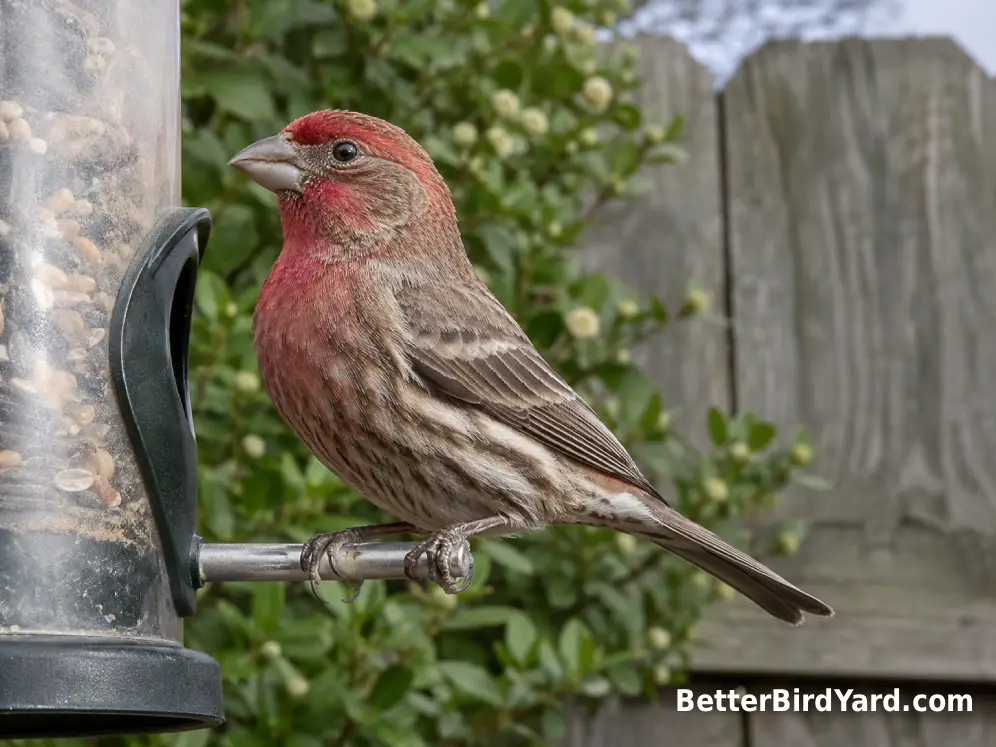
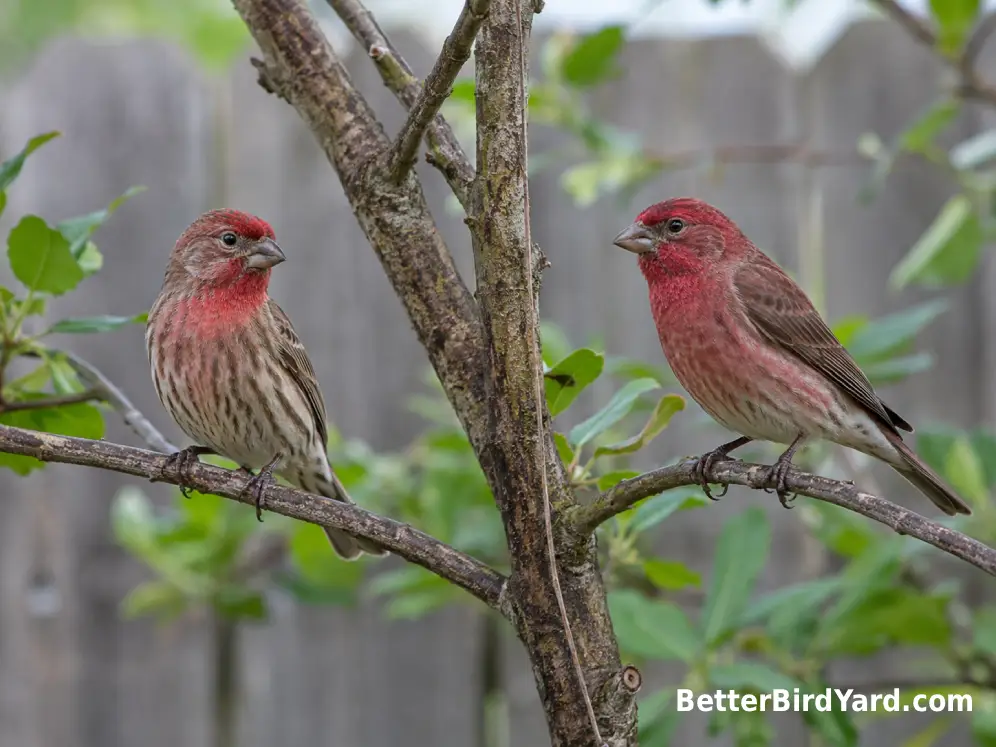
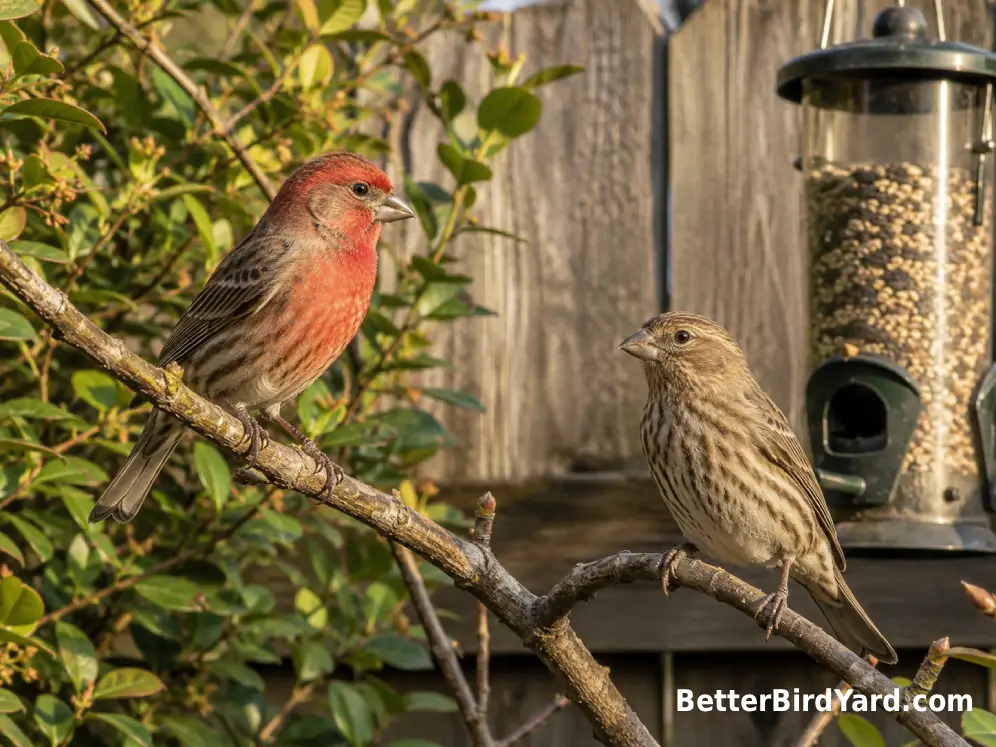
An adult male usually has rosy red around the forehead, eyebrow area, throat, and upper breast. His back remains brown, and the belly and flanks show obvious brown streaking. That streaking is one of the most useful field marks when another red finch is nearby.
Females are a very different-looking bird. A female House Finch has no red plumage: she is grayish-brown to brown overall, with blurry dark streaks running down her underparts and a fairly plain face. Immature males can resemble females before developing adult plumage.
| Feature | Adult Male | Female Or Immature |
|---|---|---|
| Head | Usually rosy red with brown areas | Plain brown or grayish-brown |
| Breast | Red on upper breast with streaking below | Brown-streaked |
| Back | Brown and streaky | Brown and streaky |
| Bill | Short, thick, conical | Short, thick, conical |
| Tail | Relatively long with a shallow notch | Relatively long with a shallow notch |
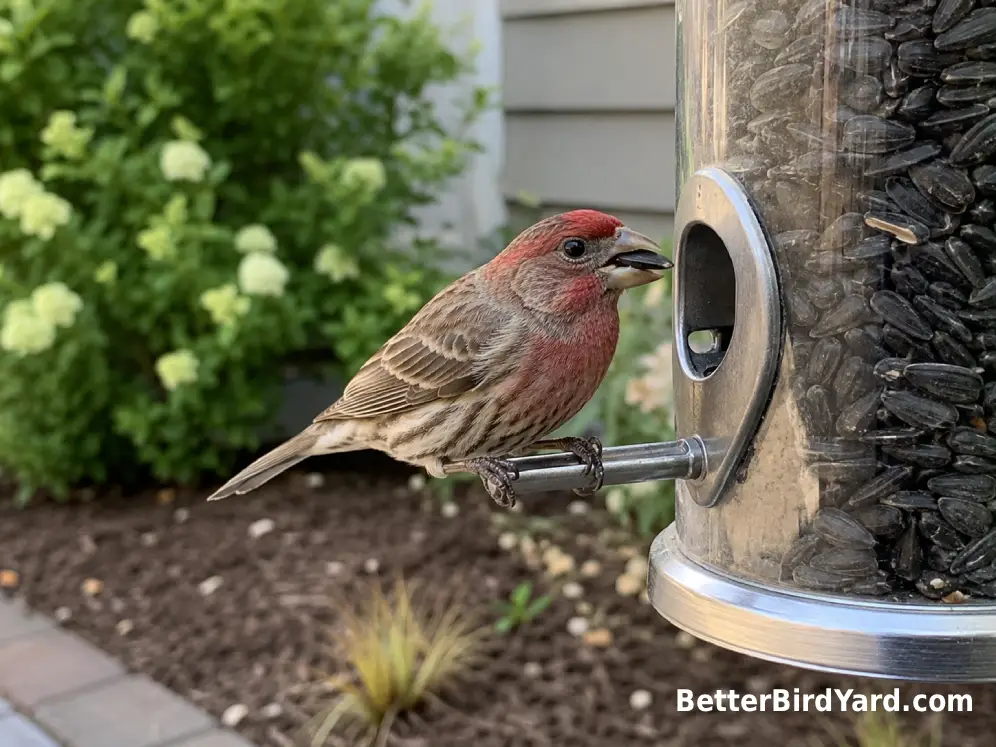
One useful backyard clue is how they handle food. House Finches often remain at a feeder while cracking seeds with their stout bills rather than immediately carrying each seed away.
Why Some Male House Finches Are Redder Than Others
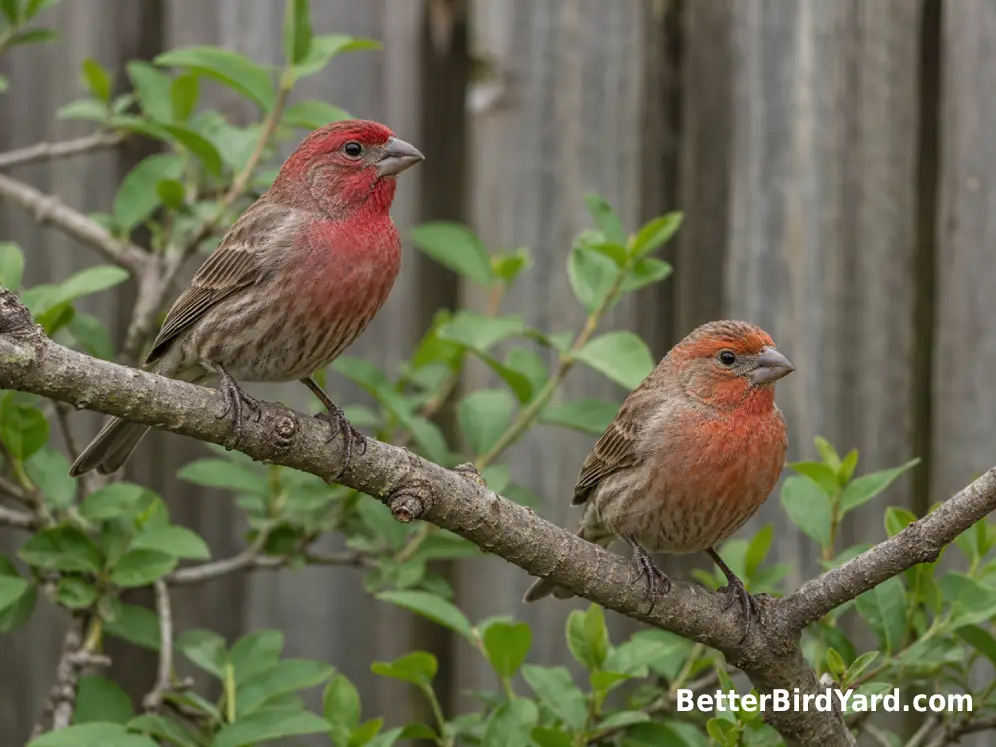
Not every male House Finch is bright crimson. Some are deeper red, some look orange-red, and a few can appear distinctly orange or yellow. Cornell Lab notes that male plumage coloration is influenced by carotenoid pigments obtained through the diet as feathers develop.
That means a pale or orange male is not automatically a different species. Look at the whole bird: the brown back, streaked flanks, thick bill, face pattern, and overall shape are more dependable than judging the shade of red by itself.
The same principle explains why descriptions such as red house finch, red-headed House Finch, or red-breasted House Finch generally refer to a male House Finch rather than separate types of House Finch. The red is concentrated mainly around the head and upper breast instead of covering the entire bird.
A brown House Finch, meanwhile, is most likely a female or immature bird rather than an unusual brown form of an adult male. When a flock arrives, watching several birds together can make these sex and age differences much easier to notice.
House Finch Vs. Purple Finch And House Sparrow
Purple Finch is the comparison that causes the most trouble for many backyard bird watchers. Both species can be roughly sparrow-sized, both have thick bills, and adult males of both species can show red.
A male House Finch usually looks more brown-and-red: the red is strongest on the face, throat, and upper breast, while the flanks remain distinctly streaked. A male Purple Finch tends to show a more extensive raspberry wash through the head and upper body, with less prominent flank streaking. Cornell Lab also notes differences in head shape and bill proportions, but those can take practice to recognize.
Females are challenging too. Female House Finches have heavily streaked underparts and a rather plain face. Female House Sparrows, another possible source of confusion around homes, are stockier and generally lack the heavy streaking across the underparts; they also show a more obvious pale eyebrow.
For a beginner, a good identification routine is:
- Check whether the bird has a thick, seed-cracking finch bill.
- Look for strong brown streaking on the belly and flanks.
- On males, notice whether red is concentrated around the face and upper chest.
- On females, look for a plain face rather than a strong pale eyebrow.
- Use several features together instead of relying on one color patch.
A photograph taken through a window can help enormously. Even an ordinary phone photo may let you compare the bill, streaking, tail shape, and facial markings after the bird has left.
Where House Finches Live And What They Do Around A Yard
House Finches are unusually comfortable around people. You can find them in residential neighborhoods, city parks, farms, forest edges, and other open or semi-open environments. In their native western range they also occupy natural settings such as desert, chaparral, grassland, and open woodland.
The species was originally native to western North America and Mexico. Birds released in the New York area in the twentieth century established an eastern population that eventually spread across much of the continent. Today House Finches are familiar across much of the United States, although local abundance and seasonal movement vary.
Watch more than the feeder itself. House Finches often perch conspicuously in trees, shrubs, on utility wires, rooflines, or other high spots before dropping down to feed. Away from feeders they also forage on the ground, in weeds, and in fruiting vegetation. They are social birds and are commonly seen with other House Finches outside the nesting season.
Their song can reveal them before their plumage does. Listen for a lively series of warbling, twittering notes delivered from an exposed perch. Once you learn the combination of that voice, a streaky body, and the typical finch silhouette, spotting House Finches becomes much easier.
What House Finches Eat And How To Feed Them Responsibly
House Finches eat mostly plant material. Their natural diet includes seeds, buds, berries, and fruits, and Cornell Lab identifies black oil sunflower as a particularly useful feeder food for them. They also take foods such as millet and milo.
If you want to make a feeder more appealing to House Finches without buying several specialized foods, black oil sunflower is a sensible place to start. Its relatively thin shell makes it accessible to many seed-eating backyard birds, not just finches. Our black oil sunflower seed guide can help if you are choosing between common seed options.
House Finches can use several ordinary feeder styles as long as they can perch comfortably and reach dry seed. A tube, hopper, or platform-style feeder can all be practical depending on the space and the other species visiting your yard. Cornell Lab’s feeder guidance emphasizes matching feeder design to the birds and food being offered rather than assuming one feeder works best everywhere.
In a small yard or patio, keep the setup simple:
- Start with one manageable feeder rather than several crowded together.
- Offer fresh, dry seed in an amount the birds can use reasonably quickly.
- Remove damp, clumped, moldy, or spoiled seed rather than topping it off.
- Clean up heavy accumulations of hulls and discarded seed underneath.
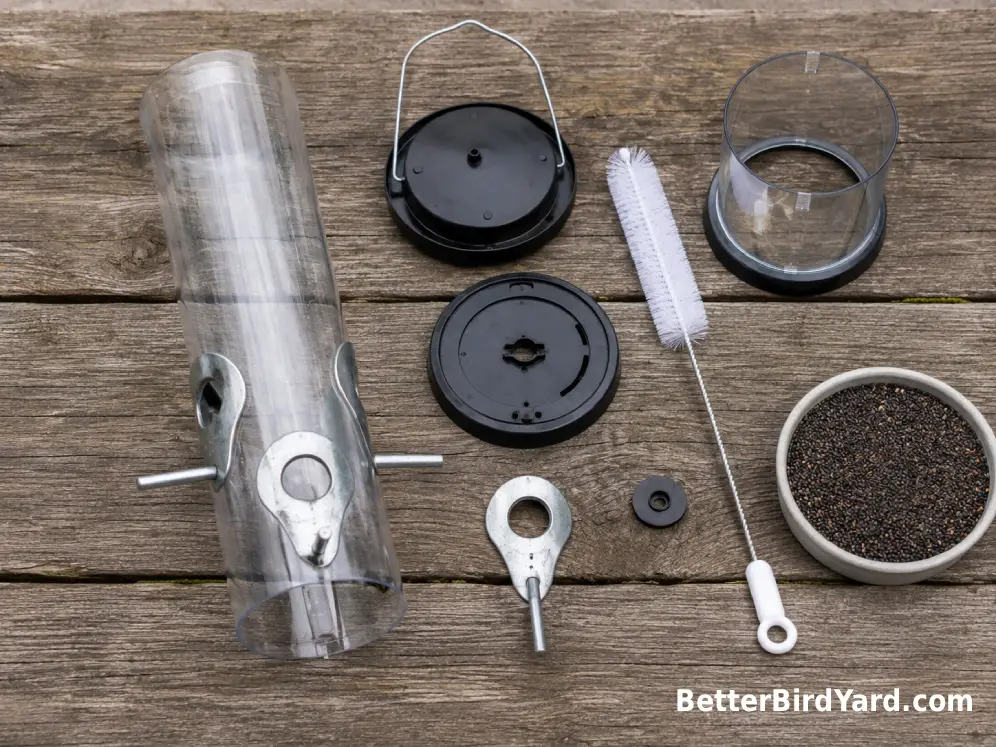
- Clean the feeder regularly and sooner whenever it becomes visibly dirty or wet.
BetterBirdYard note: a feeder that is easy for you to take apart, inspect, and clean is usually more useful than a complicated feeder that gets neglected. Bird feeding works best when maintenance is part of the setup from day one. Project FeederWatch specifically recommends regular cleaning because concentrating birds around feeding sites can create opportunities for pathogens to spread.
Nesting Around Homes, Porches, And Hanging Planters
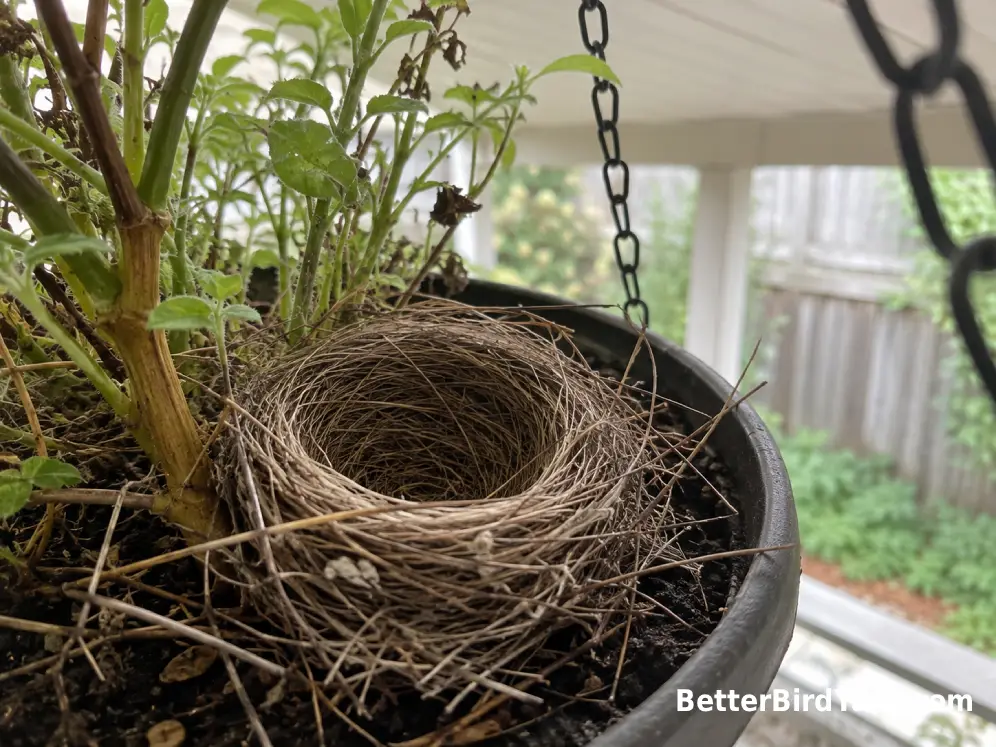
House Finches are remarkably flexible about nest sites. Cornell Lab records nests in trees and shrubs as well as on buildings, ledges, vents, street lamps, ivy, and hanging planters. Their nests are open cups assembled from fine stems, grasses, leaves, rootlets, small twigs, and other fibrous material.
That adaptability sometimes puts a nest exactly where a homeowner or renter planned to water a plant, open a door, or spend time on a porch. If you discover an active nest, avoid unnecessary disturbance and give the birds as much space as the location allows. Do not relocate eggs, nestlings, or an occupied nest yourself. Wildlife protections and appropriate next steps can depend on the species and circumstances, so contact your state wildlife agency or a qualified wildlife professional if the nest creates a genuine safety or access problem.
A common mistake is repeatedly approaching a nest for photographs because the adults appear tolerant. A bird continuing to use a porch does not mean close inspection is harmless. Watching from indoors or from a consistent distance is usually the better way to enjoy the nesting activity.
For future seasons, you can also make the surrounding yard more useful without trying to control exactly where the birds nest. Shrubs, small trees, natural seed-producing vegetation, and a reliable source of clean water can add habitat value even in modest spaces. Choose plants suited to your region and site rather than assuming one plant list is appropriate everywhere in the United States.
If A House Finch Looks Sick, Protect The Feeding Area
House Finches are associated with a well-documented eye disease that can cause visibly red, swollen, runny, or crusty eyes. Similar-looking symptoms should not be diagnosed from a backyard observation alone, but any bird with markedly swollen eyes, unusual lethargy, trouble feeding, or other obvious signs of illness is a reason to change your feeder routine.
If you notice a visibly sick bird using your feeding area, Project FeederWatch recommends taking down the feeders it is using for a period of time so birds can disperse, while thoroughly cleaning the feeders and the surrounding area. Check current guidance from Project FeederWatch and your state wildlife agency, especially if local disease or avian-health advisories are in effect.
Do not try to catch, medicate, or treat a wild House Finch yourself. If a bird appears unable to function normally and may need intervention, contact a licensed wildlife rehabilitator, state wildlife agency, animal control service, or other qualified local professional for guidance.
Good prevention is much less complicated: maintain feeders before birds look sick, discard wet or spoiled food, keep feeding surfaces reasonably clean, and avoid creating a crowded collection of poorly maintained feeders. Our bird feeder cleaning guide covers a simple maintenance routine for everyday backyard feeding.
Common House Finch Backyard Mistakes To Avoid
House Finches are adaptable enough that attracting them usually does not require complicated tricks. Many backyard problems come from doing too much rather than too little.
- Do not identify every small red bird as a House Finch. Check streaking, bill shape, face pattern, and overall proportions.
- Do not assume every House Finch is red. Females and immature birds can be completely brown and streaked.
- Do not let sunflower hulls and unused seed accumulate indefinitely underneath the feeder. Heavy waste can create sanitation problems and may attract rodents or other unwanted wildlife.
- Do not keep adding fresh seed on top of damp or spoiled food. Empty and clean the feeder first.
- Do not crowd several feeders into a tiny space unless you can maintain them properly.
- Do not repeatedly approach an active nest just because the adults built close to your home.
- Do not ignore an obviously sick bird. Temporarily changing your feeding routine is safer than assuming the problem will resolve at a busy feeder.
Also look beyond the feeder pole. Audubon emphasizes that responsible backyard feeding includes reducing other hazards around the area, including unsafe windows and poorly maintained feeding stations. A good bird-friendly yard is not simply one that attracts many birds; it is one where the feeding setup is manageable and unnecessary risks are kept low.
The Simple Way To Enjoy And Support House Finches
Once you recognize the combination of a sturdy finch bill, streaky brown body, and the male’s localized red coloring, the House Finch becomes one of the easier backyard birds to follow from day to day. Just remember that females are brown, males vary in color, and similar species deserve a second look before you settle on an identification.
Supporting House Finches can be equally straightforward. Fresh black oil sunflower seed, a clean and manageable feeder, safe water and vegetation where practical, and regular observation are more useful than an elaborate collection of feeder gadgets. Results will vary with your region, season, surrounding habitat, and the birds already living nearby, so a quiet feeder may simply need time rather than more food.
Pay attention to what changes. A new flock, an orange-colored male, a pair inspecting a porch planter, or a female you once mistook for a sparrow can turn an ordinary feeder into a useful lesson in bird behavior. And if the birds show signs of illness, shift from attraction to prevention: clean up, reduce congregation, check current local guidance, and contact qualified wildlife help when an individual bird appears to need intervention.
That balance—good identification, simple habitat support, clean feeding practices, and realistic expectations—is usually all a backyard needs to make House Finches rewarding neighbors.