Baltimore Oriole Bird: How to Identify, Find, and Support This Orange-and-Black Visitor
A Baltimore Oriole bird can be surprisingly easy to miss. An adult male may look unmistakable once you see his brilliant orange-and-black plumage, yet these birds often spend their time moving through leaves high in trees rather than sitting in the open at a feeder.
For backyard bird watchers across much of the eastern and central United States, Baltimore Orioles are mainly spring and summer visitors. They eat insects, fruit, and nectar, build distinctive hanging nests, and sometimes visit yards offering oranges, small portions of jelly, or sugar-water feeders. Feeder visits are never guaranteed, though. Your region, migration timing, mature trees, nearby habitat, weather, and natural food supply all affect whether an oriole stops by.
The most useful approach is to combine a simple seasonal feeding station with a yard that offers trees, shrubs, insects, flowers, and safe places to forage. That gives you a better chance of seeing orioles while supporting more of what they actually need.
How To Identify A Baltimore Oriole
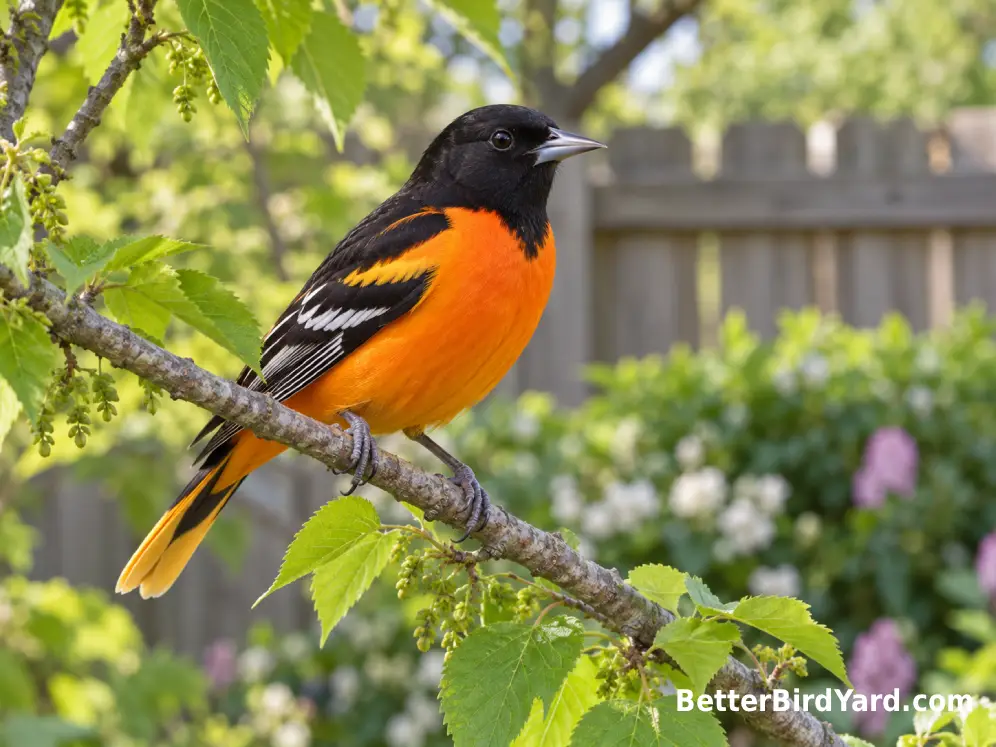
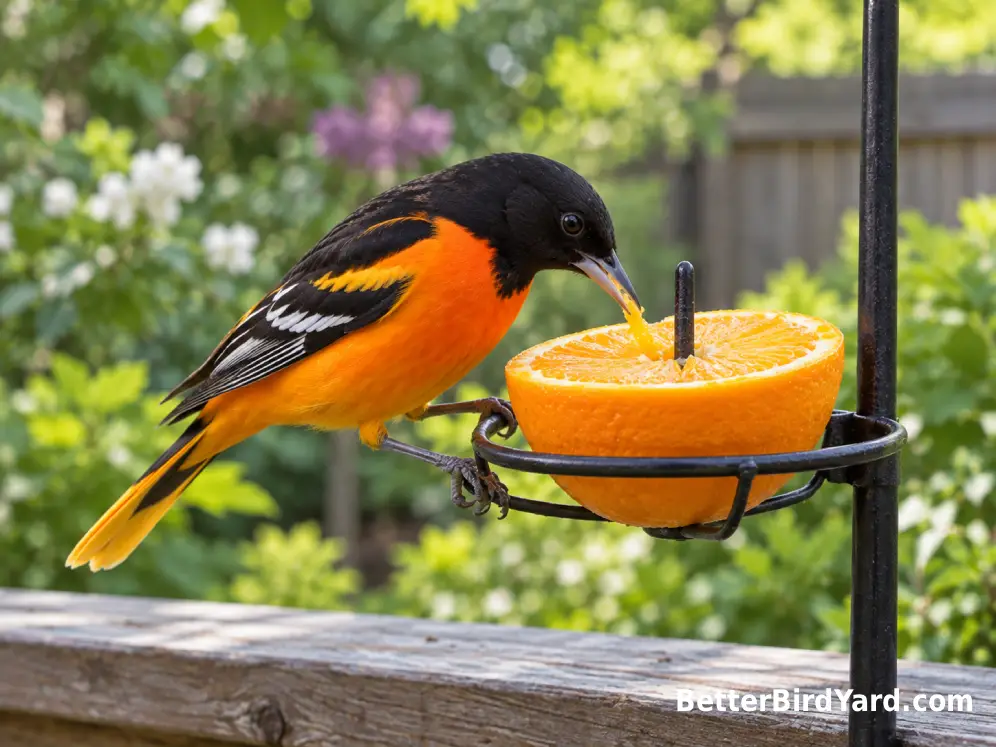
Adult male Baltimore Orioles are among the easier North American songbirds to recognize once you get a clear look. They have a black head and back set against vivid orange underparts, an orange rump, orange in the tail, and white markings on the dark wings. The bird is medium-sized and slimmer than an American Robin, with a fairly long, pointed bill.
Females and young birds require a little more attention. Female plumage varies considerably, but it is generally yellow-orange below with browner or grayish tones on the head and back. Two light wing bars can be noticeable. Immature males may also look more female-like before developing the stronger black-and-orange pattern associated with adult males. Cornell Lab measurements put Baltimore Orioles at roughly 6.7–7.5 inches long.
| Feature | Adult Male | Female Or Immature |
|---|---|---|
| Head and back | Mostly black | Usually brownish, grayish, or yellowish |
| Underparts | Bright orange | Yellow to yellow-orange |
| Wings | Black with white markings | Darker wings with two pale wing bars |
| Bill | Long and pointed | Long and pointed |
Color alone is not always enough. Watch the bird’s shape, wing pattern, habitat, and behavior as well. Baltimore Orioles commonly forage among foliage and small branches, sometimes disappearing into a tree only moments after an obvious flash of orange.
In parts of central North America, Baltimore Orioles overlap with Bullock’s Orioles, and the two can hybridize. Orchard Orioles can also cause identification confusion, especially when females or immature birds are involved. If a bird does not fit the classic Baltimore Oriole pattern, several photographs from different angles are more useful than trying to identify it from one patch of orange.
Where And When Baltimore Orioles Appear
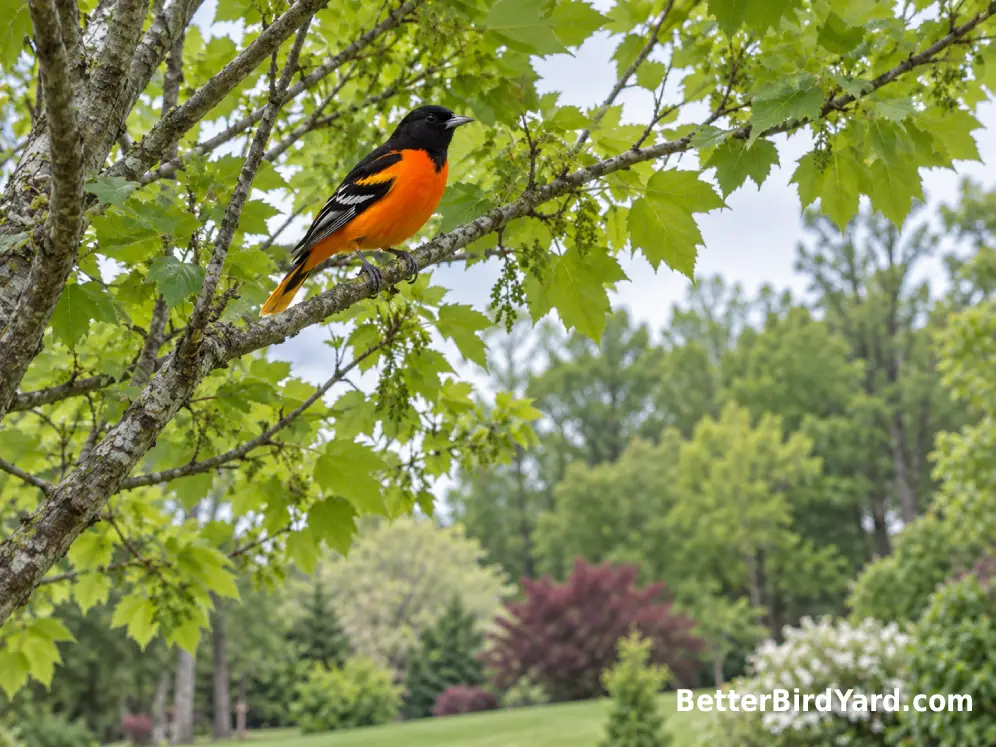
Baltimore Orioles breed across much of eastern and central North America. Good places to look include open deciduous woodland, forest edges, riverside groves, orchards, parks, neighborhoods, and backyards with mature trees. Dense forest interiors are less typical than areas where tall trees meet more open habitat.
They are migratory across most of their U.S. range. Cornell Lab range information describes spring arrival across the breeding range from roughly early April through late May, depending on latitude and local conditions. Southbound movement can begin as early as July. Wintering areas include Florida, the Caribbean, Central America, and northern South America.
Those broad dates are more useful as a planning window than as a backyard calendar. A homeowner in Missouri may see migrants weeks before someone farther north. Weather can also concentrate or delay local movements. Checking recent observations from a reputable bird-recording platform or local bird organization is often more useful than expecting orioles on a fixed date every year.
One practical clue is sound. Orioles often reveal themselves with clear, whistled phrases mixed with chattering calls. If you hear an unfamiliar rich whistle from the canopy during spring, look toward the upper branches rather than immediately scanning the lawn or seed feeder. Audubon describes substantial individual variation in Baltimore Oriole songs, so learning the general voice is more useful than memorizing a single recording.
What Baltimore Orioles Eat
Baltimore Orioles are not seed specialists. Their natural diet includes insects and other small invertebrates, fruit, and nectar. The balance changes through the year. Cornell Lab notes that insects become especially important during the breeding season, while fruit and nectar can make up more of the diet during spring and fall migration.
That explains why a perfectly busy sunflower feeder may receive no attention from an oriole. If you want to offer supplemental food, more appropriate choices include:
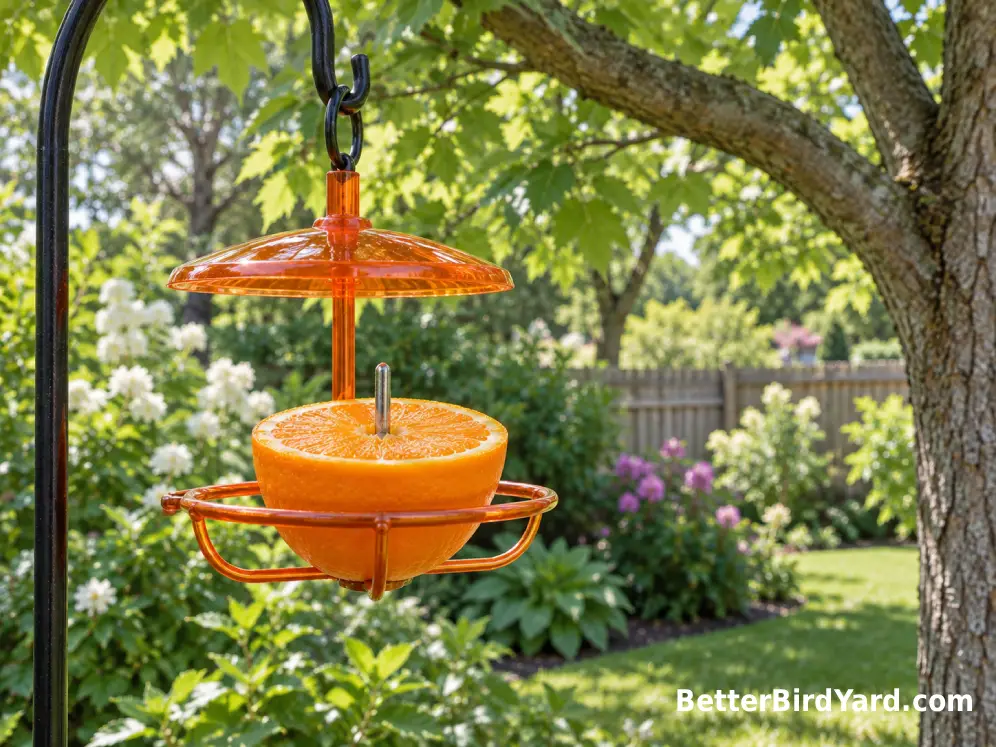
- Fresh orange halves secured so they cannot roll or fall.
- A small amount of jelly in a shallow oriole feeder.
- A clean sugar-water feeder designed so a larger songbird can perch and reach the feeding ports.
Cornell specifically recommends oranges, sugar-water feeders, and only small quantities of jelly, noting that excessive jelly can soil plumage.
Sugar water needs more attention than dry seed. Audubon recommends plain white sugar and water for nectar feeders and warns against honey and red food coloring. Nectar feeders should be cleaned frequently—about every two or three days under ordinary conditions in Audubon’s guidance, and more often when heat speeds spoilage. Project FeederWatch also stresses keeping feeders clean and free of mold and debris.
Fruit deserves the same common-sense treatment. Offer modest portions, discard anything moldy or spoiled, and clean sticky residue from the feeder. An orange half that has dried into a hard, insect-covered shell is not a reason to keep waiting another week for an oriole.
How To Attract Baltimore Orioles Responsibly
If you want Baltimore Orioles to notice your yard, keep the setup simple. Put appropriate food where a passing bird can see it, keep the station clean, and make the surrounding space useful even when the feeder is empty. A feeder can invite a closer look, but habitat is what makes a yard more valuable over time.
A practical spring setup is:
- Put out a visible orange half or clean oriole feeder before or during your normal local spring migration period.
- Place it where you can maintain it easily instead of hiding it deep inside shrubbery.
- Keep trees and shrubs nearby so birds have places to perch and forage.
- Offer only small amounts of food until you know how quickly it is being used.
- Remove leftovers and wash sticky feeder surfaces before they become dirty or spoiled.
Do not be discouraged if an oriole ignores the feeder. Natural insects, flowers, and fruit may be more attractive at that moment. Cornell Lab describes Baltimore Orioles as regular users of open woodland, forest edges, parks, orchards, and backyards, so the larger structure of the yard matters alongside feeder food.
Window safety matters too. If the feeding station is near glass, Audubon recommends placing feeders within 3 feet of a window or more than 30 feet away rather than in the higher-risk space between those distances. Exterior screens or appropriately spaced exterior window treatments can add protection when reflections are a problem.
For an apartment patio or small rental space, a compact fruit or nectar feeder can work if birds already move through nearby trees or vegetation. Keep it close enough that cleaning is easy, secure it against wind, and check your lease, building policies, or HOA rules before attaching anything to shared structures.
Editorial note: If you only change one thing, make the feeder easy to clean. A complicated feeder that stays dirty is less useful than a plain feeder you can wash quickly and refill with fresh food. Our bird feeder cleaning guide covers the basic routine in more detail.
Why The Hanging Nest Is So Distinctive
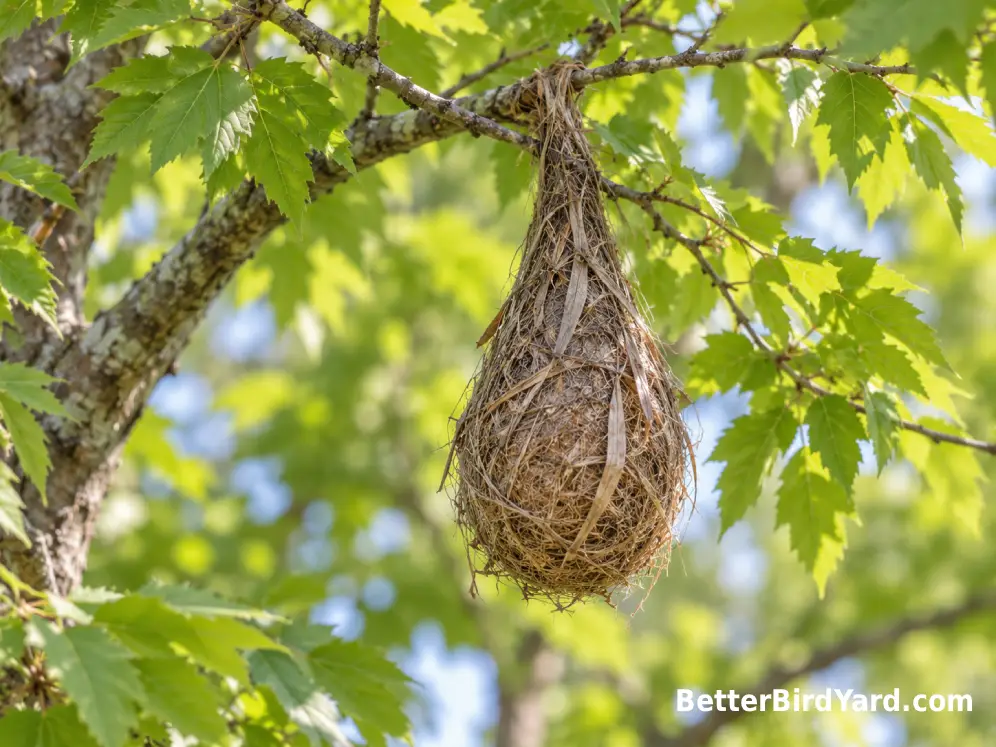
A Baltimore Oriole nest looks more like a suspended pouch than the familiar open cup built by many backyard birds. The female typically weaves flexible fibers around slender branches high in a tree, gradually forming a hanging chamber with an opening at the top. Cornell Lab describes nests in trees including elms, maples, and cottonwoods, although other suitable trees can also be used.
If orioles are nesting nearby, you may notice them carrying fine plant material or repeatedly traveling to the same section of canopy. The nest itself can remain remarkably difficult to see once leaves surround it.
Resist the temptation to make nesting easier by putting out yarn, fishing line, long string, dryer lint, or similar household materials. Birds sometimes incorporate human-made fibers, but that does not make those materials safe. Audubon warns that long yarn and string can entangle birds, while dryer lint performs poorly when wet. Natural vegetation already provides grasses, plant fibers, bark strips, and other materials birds can select for themselves.
If you discover an active nest, give it space. Avoid repeated close approaches, unnecessary branch trimming, or attempts to inspect eggs and young by hand. Observe from a comfortable distance with binoculars instead. If yard work may affect an active nest, check applicable local and wildlife-agency guidance before proceeding.
Common Baltimore Oriole Backyard Mistakes To Avoid
Most unsuccessful oriole setups are not missing a secret ingredient. They usually ask the wrong thing of the bird or create more maintenance than the homeowner can realistically keep up with.
- Expecting orioles to use an ordinary seed feeder. Their diet is centered on insects, fruit, and nectar rather than typical feeder seed.
- Putting out large quantities of jelly. A small portion is enough; more creates unnecessary mess and can soil feathers.
- Leaving oranges or nectar out after they have spoiled. Warm weather can make sugary foods deteriorate quickly.
- Ignoring feeder hygiene. Sticky residue and old food should be removed instead of being topped up indefinitely.
- Placing the feeding station carelessly near reflective glass. Use bird-safe window placement and treat hazardous reflections.
- Trying to eliminate every caterpillar and insect from the yard. Insects are an important part of the Baltimore Oriole’s natural breeding-season diet.
- Assuming one spring without orioles means the setup failed. Migration routes, weather, habitat, and natural food availability vary from year to year.
Project FeederWatch recommends regular feeder cleaning and more frequent attention during heavy use or wet weather. For seed and suet feeders, its general guidance is roughly every week or two; fruit and nectar feeding often demands closer monitoring because wet, sugary foods spoil more quickly. Any feeder should be cleaned promptly when visibly dirty.
If you notice birds that appear unusually lethargic, have obvious abnormal growths or eye problems, or allow unusually close approach, do not try to diagnose or treat them. Clean the feeding area, consider pausing feeding to reduce congregation, check your state wildlife agency’s current guidance, and contact a licensed wildlife rehabilitator or other qualified local professional when an individual bird appears to need help. Cornell’s Project FeederWatch likewise advises extra caution when visibly sick birds are gathering at feeders.
Support Orioles With More Than A Feeder
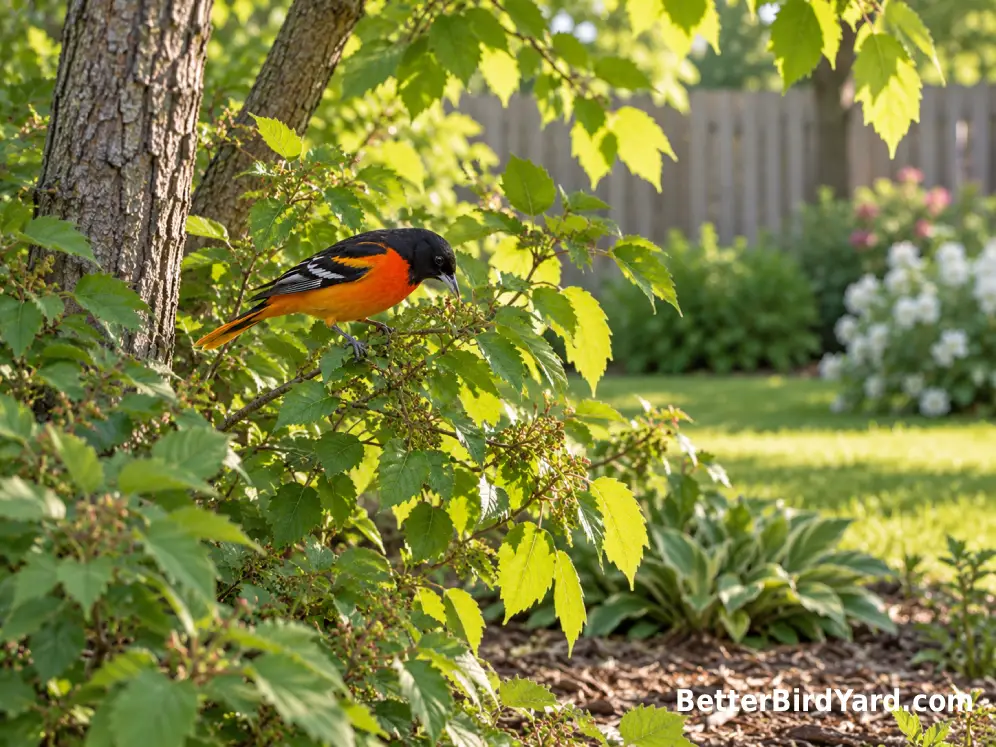
An orange half may give you a memorable close-up, but the stronger long-term strategy is a yard with living food. Baltimore Orioles forage for insects in foliage and also use fruit and nectar. Trees, shrubs, flowering plants, and a less chemically intensive yard can therefore support feeding opportunities that a single feeder cannot provide.
Choose native plants for your actual region rather than copying a generic national planting list. Native trees and shrubs can support insects, fruit, shelter, and nesting structure, but the best species for Maine will not necessarily be appropriate in Texas or Missouri. Audubon and the National Wildlife Federation both emphasize locally appropriate native plants as useful components of bird habitat.
A mature tree is especially valuable where space permits. Baltimore Orioles commonly forage and nest in deciduous trees, and a layered yard with canopy, shrubs, flowers, and some natural leaf material offers more opportunities than an open lawn alone. If you have only a patio or balcony, containers of locally appropriate flowering plants can still add cover and insect activity, even if you cannot provide nesting trees.
Be cautious with broad pesticide use around a bird-friendly garden. Orioles depend heavily on insects during the breeding season, and Audubon recommends avoiding pesticides when creating habitat for nectar-eating birds that also consume insects.
The simplest Baltimore Oriole plan is also the most sustainable: learn the bird’s voice, watch the treetops during migration, offer a small amount of fresh appropriate food if you want closer views, and keep the feeding station clean and safe. Then put most of your effort into habitat. You may not see Baltimore Orioles every season, but a yard with healthy plants, insects, fruit, shelter, and safer windows remains useful to many wild birds whether an orange-and-black visitor arrives or not.