Do Blue Jays Migrate? Why Some Stay While Others Fly South
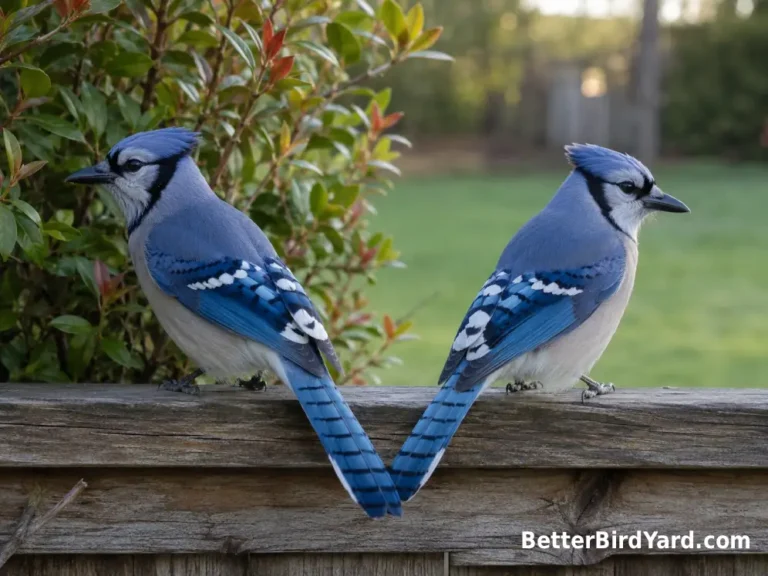
Yes, Blue Jays migrate—but not all of them do. That is what makes Blue Jay migration unusually interesting for backyard bird watchers. Some Blue Jays remain in the same general area throughout the year, while others travel south in fall and north again in spring. An individual jay may even migrate one year and remain farther north the next.
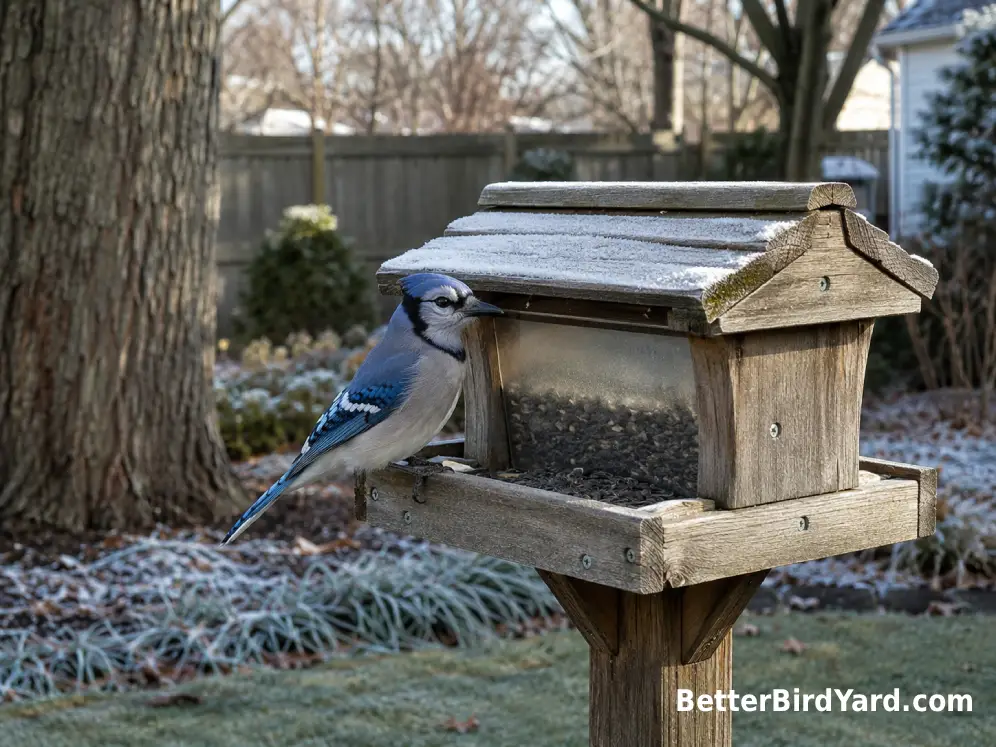
So if you see Blue Jays visiting your feeder through snow and freezing weather, you are not looking at birds that somehow missed their migration. Staying through winter is normal for many Blue Jays. At the same time, substantial numbers can be seen migrating in loose flocks, particularly along places such as the Great Lakes and Atlantic coast. Cornell Lab of Ornithology notes that the species’ migration remains surprisingly poorly understood despite how familiar Blue Jays are.
For backyard bird watchers, the most useful takeaway is simple: seasonal changes in your Blue Jay numbers are normal, but a disappearing feeder crowd does not automatically mean every jay has flown south.
The Quick Answer: How Blue Jay Migration Works
Blue Jays are best thought of as partial migrants: part of the population migrates while other birds remain resident. Cornell Lab’s Blue Jay account says the proportion that migrates is probably less than 20 percent, although migration behavior is complex enough that researchers still do not have a simple explanation for which birds leave in a given year.
This means a neighborhood can have Blue Jays all year even while other Blue Jays are passing through or leaving the region. Seeing the species in January does not prove that your summer jays stayed, just as seeing fewer jays in October does not prove that all of them migrated.
| What You Observe | What It Could Mean |
|---|---|
| Blue Jays remain all winter | Resident birds are staying within their year-round range. |
| Loose groups of jays moving through in fall | You may be seeing migrating Blue Jays. |
| Jays return or increase in spring | Northbound migrants may be moving through or returning to seasonal areas. |
| Your feeder suddenly becomes quiet | Migration is possible, but food, weather, predators, or neighborhood changes may also be involved. |
Why Do Some Blue Jays Migrate While Others Stay?
The frustratingly accurate answer is that scientists still do not fully know. Blue Jays do not follow a simple rule in which every bird north of a certain latitude leaves when cold weather arrives.
Cornell reports that migrating flocks can contain both adults and younger birds, while some individuals remain year-round throughout the species’ range. Blue Jays have even been documented showing different strategies from one year to another—migrating south during one fall but remaining north during another.
That uncertainty is important because it prevents a common backyard assumption: a cold winter alone does not mean the Blue Jays must leave. Birds that remain have access to natural foods such as acorns, nuts, seeds, fruits, and other foods, and Blue Jays are well known for caching food for later use. Cornell describes them as especially associated with forest edges, suburban areas, oaks, and bird feeders.
Food supplies and weather can certainly affect where feeder birds turn up from week to week. Project FeederWatch notes that changing natural food crops, weather, habitat, and predator activity can all cause noticeable shifts in backyard bird numbers. Those short-term movements should not automatically be interpreted as migration.
Do Blue Jays Migrate South for the Winter?
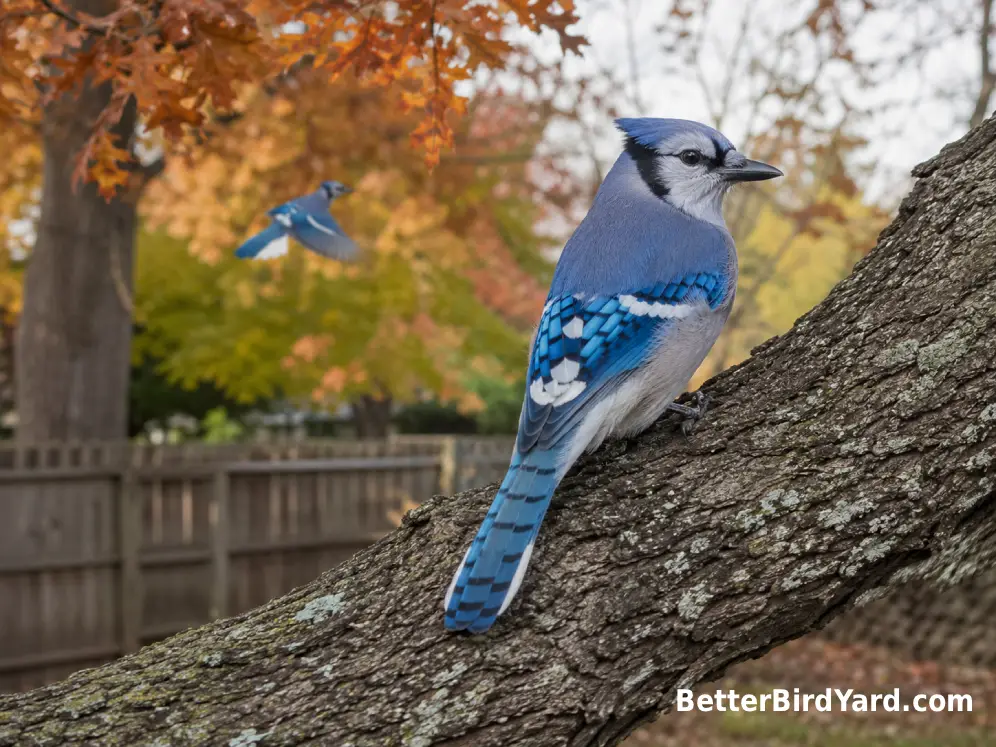
Some Blue Jays do migrate south for winter, but saying that Blue Jays as a species “go south for the winter” is too broad. Many remain farther north and can be found throughout winter in places where other members of the population migrate away.
Large migrating groups have been observed along shorelines, around the Great Lakes, and at migration overlooks. In spring, migrating birds move north again. Audubon likewise describes Blue Jays as familiar year-round birds across much of their eastern North American range while noting that substantial numbers migrate south in fall and north in spring.
That creates an interesting backyard situation: your winter Blue Jay may be a year-round resident, while another jay that used your neighborhood in summer may be spending the winter somewhere else.
It is also why range maps need a little interpretation. A map marked “year-round” means the species can occur there throughout the year. It does not necessarily mean every individual Blue Jay living in that region stays put.
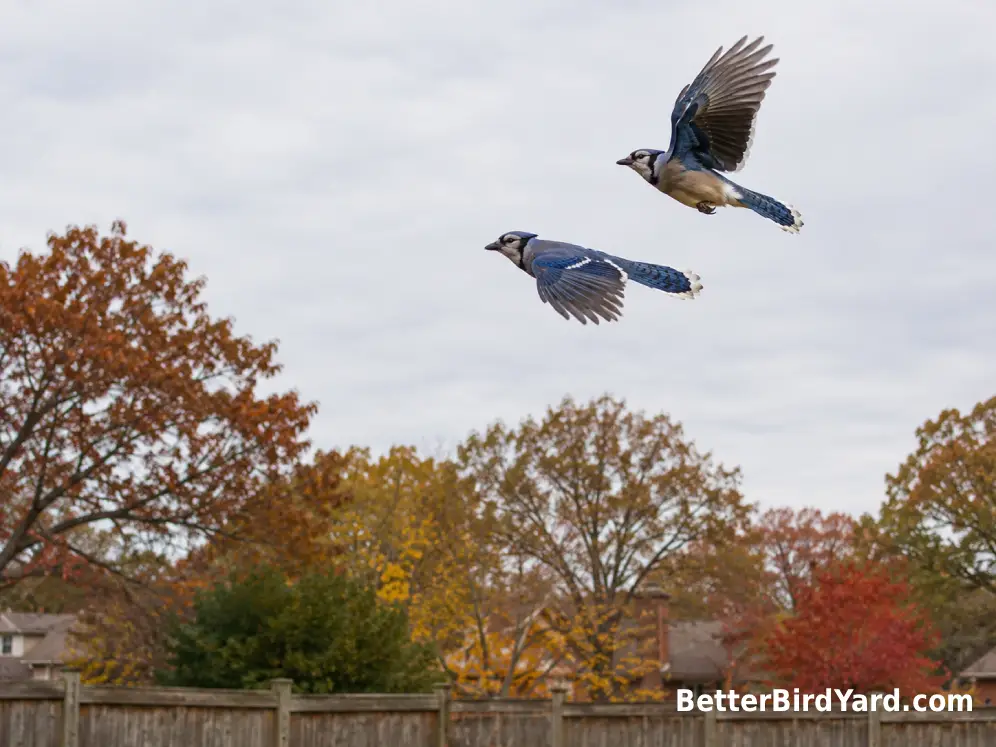
When Do Blue Jays Migrate?
Blue Jay migration occurs mainly during the familiar spring and fall migration seasons: southbound movement occurs in fall, while northbound movement occurs in spring. There is no single calendar date that works across the United States, and Cornell specifically cautions that Blue Jay migration is still poorly understood.
For that reason, be cautious with claims that Blue Jays always migrate during one particular week or leave as soon as temperatures reach a certain point. Regional conditions differ, and some birds do not migrate at all.
What you can watch for is a change in behavior. A loose group of Blue Jays traveling steadily in the same general direction is more suggestive of migration than several jays moving back and forth between neighborhood trees and feeders. Cornell notes that migrating Blue Jays can form conspicuous flocks along shorelines and at migration overlooks.
If you enjoy keeping records, write down the dates when your usual Blue Jay numbers noticeably rise or fall. Over several years, those notes can be much more useful than expecting every season to look identical.
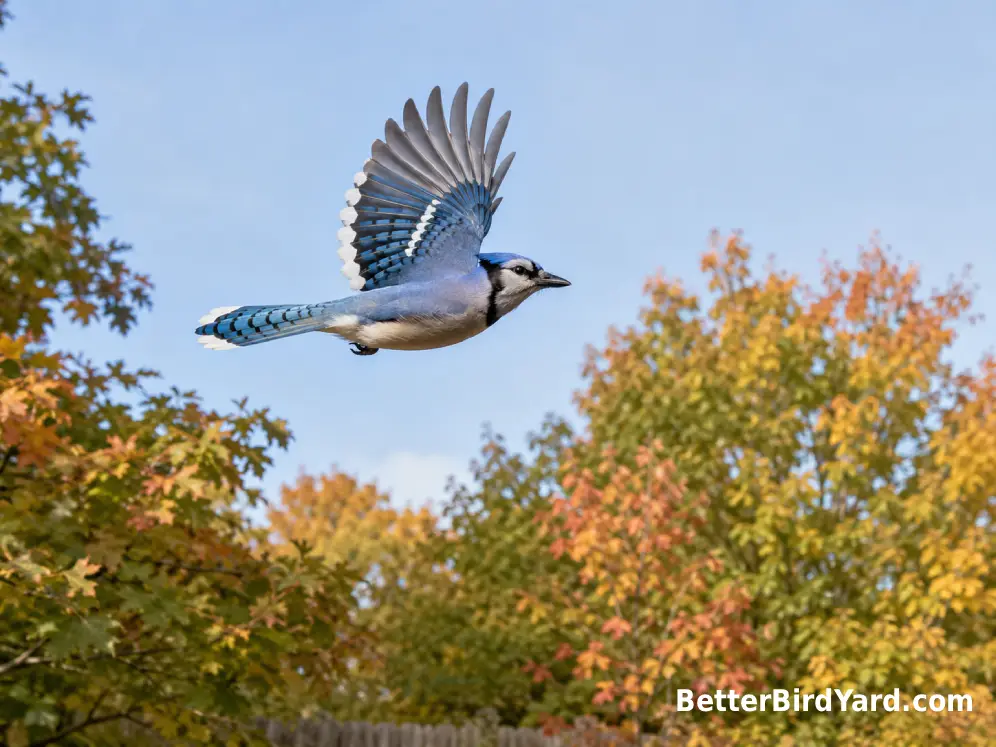
Why Did the Blue Jays Disappear From My Feeder?
A sudden drop in Blue Jay visits can happen during migration, but migration is only one possibility. This is one of those backyard observations where it helps not to jump to a single explanation.
Project FeederWatch points to several reasons feeder activity can change, including shifts in natural food supplies, weather, habitat changes, and the arrival of predators. Birds may simply be spending more time elsewhere because acorns or other natural foods are abundant nearby.
- Look at the whole neighborhood, not just the feeder. Jays calling from nearby trees have probably not left the area.
- Notice whether all feeder birds declined at once. A predator or disturbance may temporarily reduce visits.
- Check the feeder itself. Wet, old, or moldy food should be discarded rather than left out.
- Compare observations over several days instead of judging migration from one quiet afternoon.
BetterBirdYard note: A common mistake is assuming that every seasonal feeder change is migration. Blue Jays roam locally as they search for food, and backyard traffic naturally rises and falls. Keeping a simple seasonal bird list can help you recognize what is normal for your own yard.
If your feeder needs attention, Cornell recommends cleaning seed feeders regularly—generally every week or two, and more often during wet weather or heavy use—and keeping old seed and debris from building up beneath them.
How to Support Blue Jays During Fall and Winter
You do not need to convince Blue Jays to stay or migrate. Their seasonal movements are their own. A bird-friendly backyard is most useful when it simply provides clean supplemental food, water, and suitable habitat for whichever birds are present.
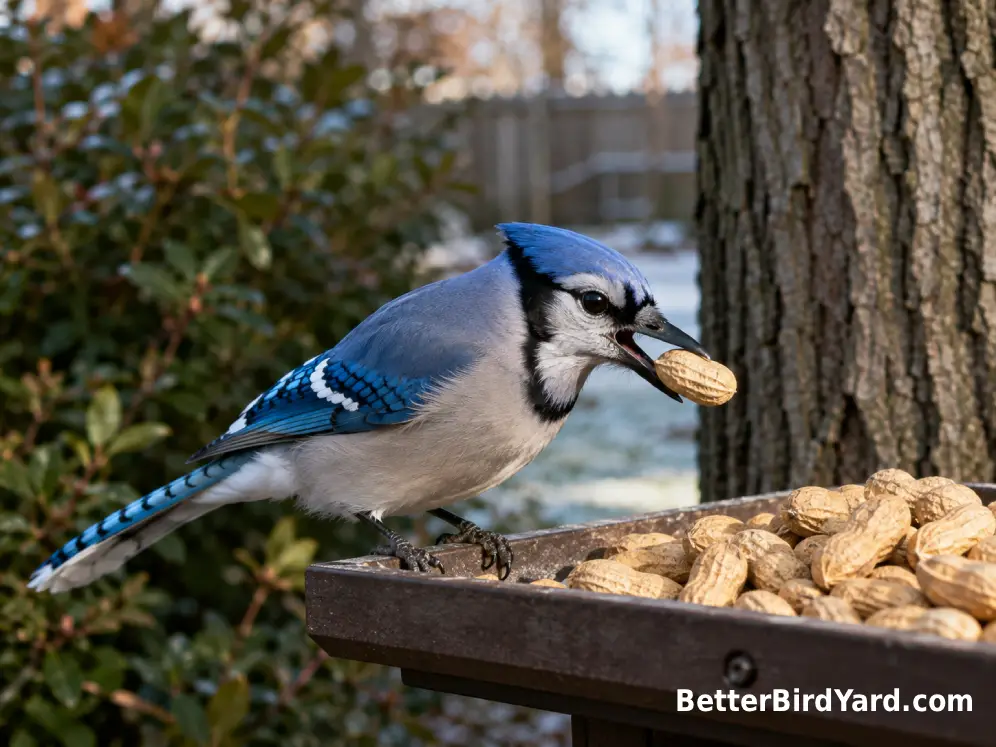
Cornell reports that Blue Jays commonly use tray and hopper feeders and may eat peanuts, sunflower seeds, and suet. They also make use of birdbaths, while oaks provide the acorns that form an important part of their natural food supply.
- Offer plain, unsalted peanuts or sunflower seed in a sturdy feeder that can comfortably support a Blue Jay.
- Discard wet, spoiled, or moldy food rather than topping it off with fresh seed.
- Keep feeders and the ground beneath them reasonably clean.
- Provide fresh water in a maintained birdbath where practical.
- If you have planting space, consider locally appropriate native oaks or other native food-producing plants suited to your region.
For a more complete setup, see our guide to attracting Blue Jays responsibly and our winter bird feeding guide.
In a small patio or rental space, there is no need to recreate a woodland. One clean feeder and a manageable water source can be plenty if your lease, building rules, or HOA allows them. Keeping the setup small also makes it easier to notice spoiled food and clean up spilled seed before it becomes a mess.
Feeding is supplemental; it does not replace the variety of foods and habitat birds find naturally. And there is no need to remove a normal feeder simply because migration season has arrived—Audubon notes that feeding birds does not stop normal migratory behavior.
What Blue Jay Migration Means for Your Backyard
So, do Blue Jays migrate? Some absolutely do, and others stay put. Southbound Blue Jays can migrate in fall and return north in spring, while resident birds may spend the entire winter within the same general part of their range. Cornell’s research summary suggests that fewer than one in five Blue Jays probably migrate, while emphasizing that scientists still have much to learn about what determines their movements.
For backyard bird watchers, that uncertainty is part of the fun. A busy flock passing overhead may be on a seasonal journey, while the jay carrying peanuts away from your feeder in January may be a winter resident. And if the feeder suddenly goes quiet, migration is only one of several possible explanations.
The best approach is to watch patterns rather than expect a fixed schedule. Keep your feeder clean, offer appropriate food if you choose to feed, maintain useful habitat where space allows, and notice how Blue Jay activity changes from one season to the next. Over time, your own backyard can become a surprisingly good window into one of the more mysterious migration stories among familiar North American birds.