Chickadees: Identification, Food, Nesting, and Yard Tips
A chickadee bird is small enough to disappear behind a handful of leaves, yet bold enough to become one of the most recognizable visitors to an American backyard. Most chickadees have a compact body, short bill, active movements, and some combination of a dark cap, pale cheeks, and gray or brown plumage. They often arrive at feeders, take a seed, and leave almost immediately rather than sitting in one place to eat.
There is also more than one kind of chickadee. Black-capped and Carolina Chickadees are familiar across much of the eastern and central United States, while Mountain and Chestnut-backed Chickadees are characteristic birds of parts of the West. Boreal, Mexican, and Gray-headed Chickadees have more specialized or restricted U.S. ranges. Cornell Lab’s species accounts recognize seven chickadee species occurring in North America, with all seven reaching the United States to some degree.
For backyard bird watchers, the useful question is not simply what a chickadee looks like. It is how to identify the species likely in your area, what these birds actually eat, and how to make a feeder or small outdoor space useful without creating unnecessary risks.
What Is a Chickadee Bird?
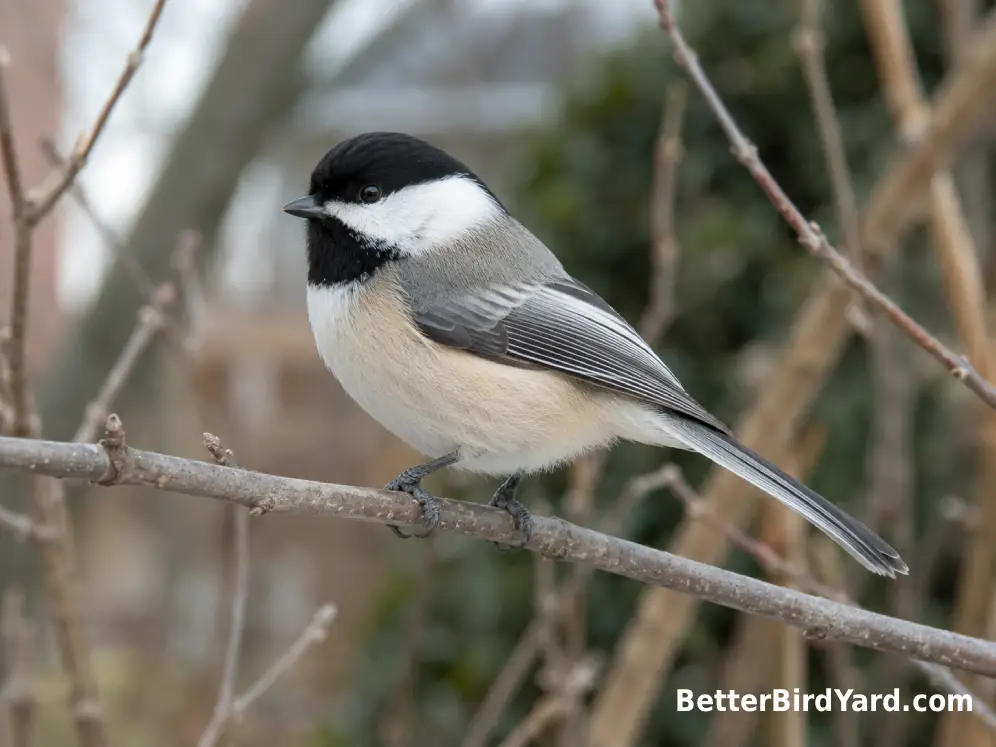
Chickadees belong to the family Paridae, the same bird family that includes titmice and the tits of Europe and Asia. The familiar Black-capped Chickadee is a good example of the basic body plan: a round-looking head, small body, short bill, black cap and throat patch, white cheeks, gray back and wings, and pale underparts. Cornell lists adult Black-capped Chickadees at roughly 4.7–5.9 inches long, making them distinctly smaller than many familiar backyard sparrows.
They are woodland birds rather than feeder specialists. Trees, shrubs, insects, seeds, natural cavities, and protective cover all matter. Feeders simply provide an additional concentrated food source. That distinction becomes especially important during the nesting season, when insect-rich habitat can be more useful than adding another tube of seed.
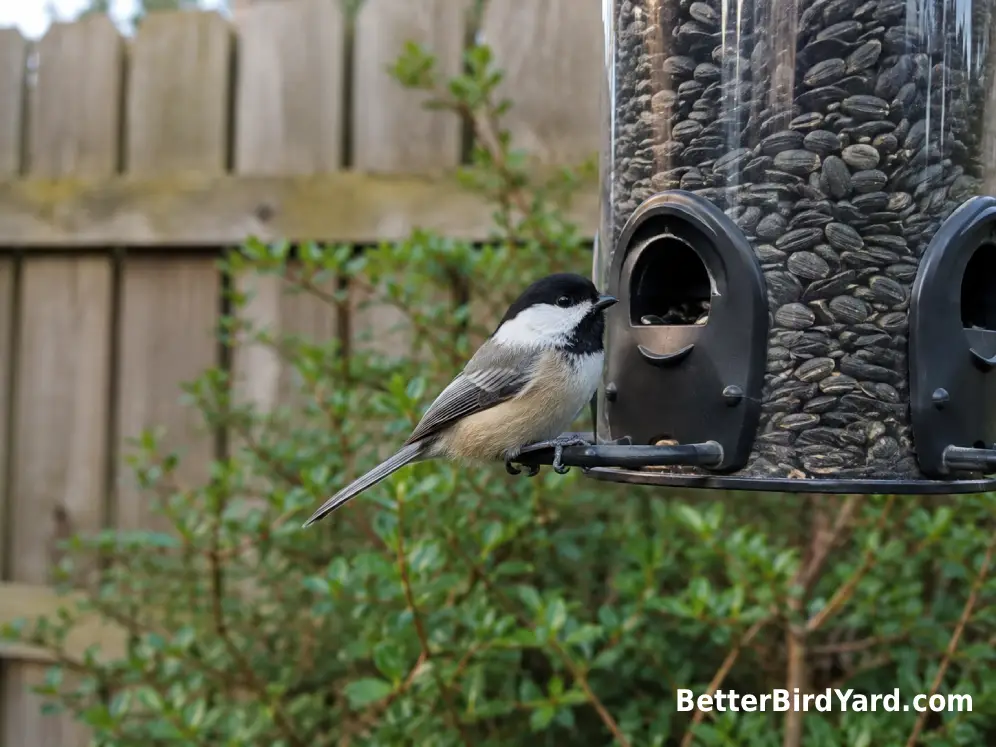
Chickadees are also exceptionally active. Look for a small bird hopping through thin branches, hanging sideways or upside down while inspecting foliage, and repeatedly moving between cover and a feeder. A bird that lands, takes one sunflower seed, and immediately carries it into a shrub is behaving much more like a chickadee than a finch that settles onto a perch and eats several seeds in place. Cornell describes this grab-and-go feeding behavior for both Black-capped and Carolina Chickadees.
How to Identify Chickadees
Start with shape and behavior before trying to separate individual species. A chickadee is typically compact, short-billed, quick-moving, and comfortable working through small branches. Many have dark head markings and pale cheeks, but color alone does not identify every species.
When comparing photos of chickadees, concentrate on a few useful details:
- Head pattern: Is the cap black or brown, and is there a pale eyebrow?
- Back and sides: Are they gray, buff, or noticeably chestnut?
- Habitat: Is the bird in a southeastern neighborhood, a western pine forest, or a northern conifer stand?
- Voice: Listen as well as look, especially where similar species meet.
- Range: Eliminate species that would be highly unusual in your location before relying on tiny plumage differences.
The Black-capped and Carolina Chickadee are the classic identification challenge. Both have black caps and bibs, white cheeks, and gray bodies. Black-capped Chickadees are broadly northern, while Carolina Chickadees occupy much of the Southeast and parts of the south-central and mid-Atlantic regions. The species meet and sometimes hybridize in a contact zone, making appearance alone particularly unreliable there. Cornell confirms that the two hybridize where their ranges overlap.
Voice can help. Audubon notes that a Black-capped Chickadee’s familiar whistled song generally contains fewer notes, while Carolina Chickadees commonly give a longer series with alternating pitches. Local birds and hybrids can complicate that simple rule, so combining voice, location, habitat, and appearance is more dependable than trying to identify a difficult bird from one photograph.
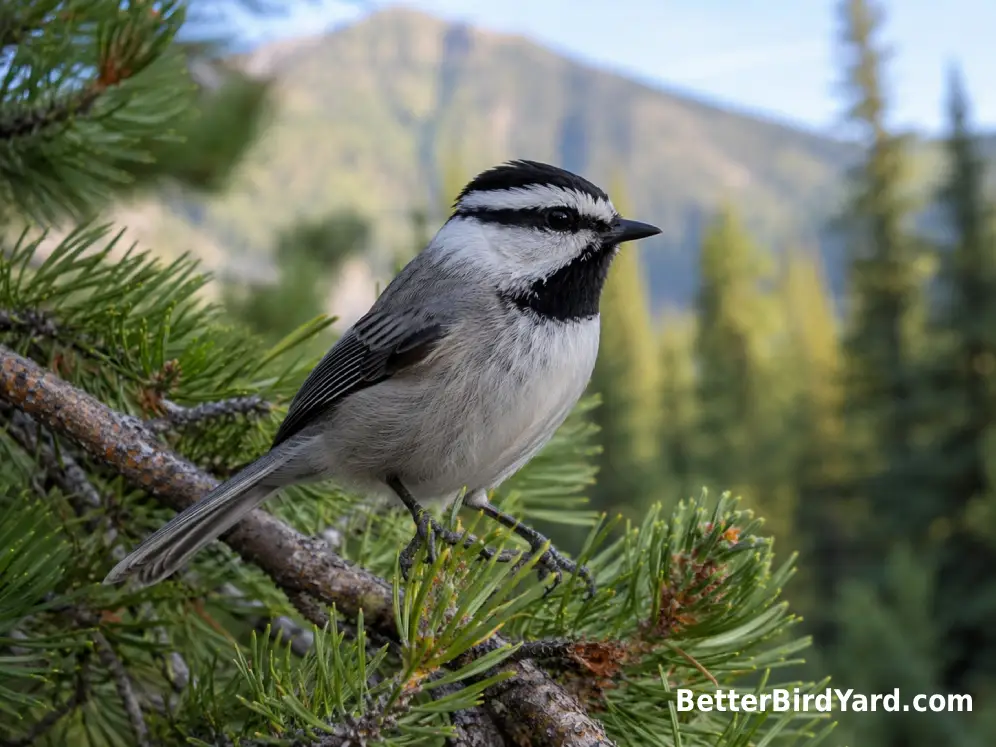
Mountain Chickadees offer an easier clue: the pale eyebrow cutting through the dark cap is often conspicuous. Chestnut-backed Chickadees replace much of the usual gray back with rich chestnut brown, while Boreal Chickadees have a brown cap instead of the familiar glossy-black look.
Types of Chickadees in the United States
Seven types of chickadees can occur in the United States, but your realistic backyard possibilities are usually narrowed quickly by geography and habitat. The ranges below are intentionally simplified; always check a current regional field guide or Cornell Lab range map when identifying an unexpected bird.
| Species | Useful Identification Clue | Where U.S. Bird Watchers May Encounter It |
|---|---|---|
| Black-capped Chickadee | Black cap and bib, white cheeks, gray back | Much of the northern United States and parts of Alaska |
| Carolina Chickadee | Very similar to Black-capped; voice and range help | Southeast and portions of the south-central and mid-Atlantic U.S. |
| Mountain Chickadee | Distinct pale eyebrow through the dark cap | Mountainous conifer forests of the western U.S. |
| Chestnut-backed Chickadee | Rich chestnut back rather than plain gray | Pacific Coast forests, including the Pacific Northwest and parts of California |
| Boreal Chickadee | Brown cap and northern conifer association | Alaska and northern coniferous regions, with much of its range farther north in Canada |
| Mexican Chickadee | Dark overall appearance and relatively large black bib | Very restricted high-elevation areas of southeastern Arizona and southwestern New Mexico |
| Gray-headed Chickadee | Gray-brown head and extremely northern distribution | A rare resident of Alaska; much of the species’ range is in Eurasia |
The two most geographically restricted U.S. species deserve extra caution during identification. Cornell reports Mexican Chickadees in only two small U.S. areas: the higher Chiricahua Mountains of southeastern Arizona and the Animas Mountains of southwestern New Mexico. Gray-headed Chickadees are rare residents in Alaska and are otherwise primarily Eurasian.
Chestnut-backed Chickadees are tied strongly to coniferous and mixed forests along the Pacific Coast, although they also use parks and suburban landscapes with suitable trees. Mountain Chickadees are characteristic birds of western evergreen forests. Those habitat clues can be much more useful than trying to memorize subtle feather patterns from pictures of chickadees taken under different lighting.
What Chickadees Eat in the Wild and at Feeders
A chickadee’s natural menu contains much more than birdseed. These birds forage among bark, leaves, buds, and small branches for insects, caterpillars, spiders, seeds, and other foods. The balance changes with the season and species. Cornell reports that insects and other animal foods make up most of the Black-capped Chickadee’s diet through much of the warmer part of the year, while seeds, berries, and other plant foods become more important in winter.
That is why a feeder should be viewed as supplemental food rather than the entire chickadee habitat.
For common feeder-visiting chickadees, useful choices include:
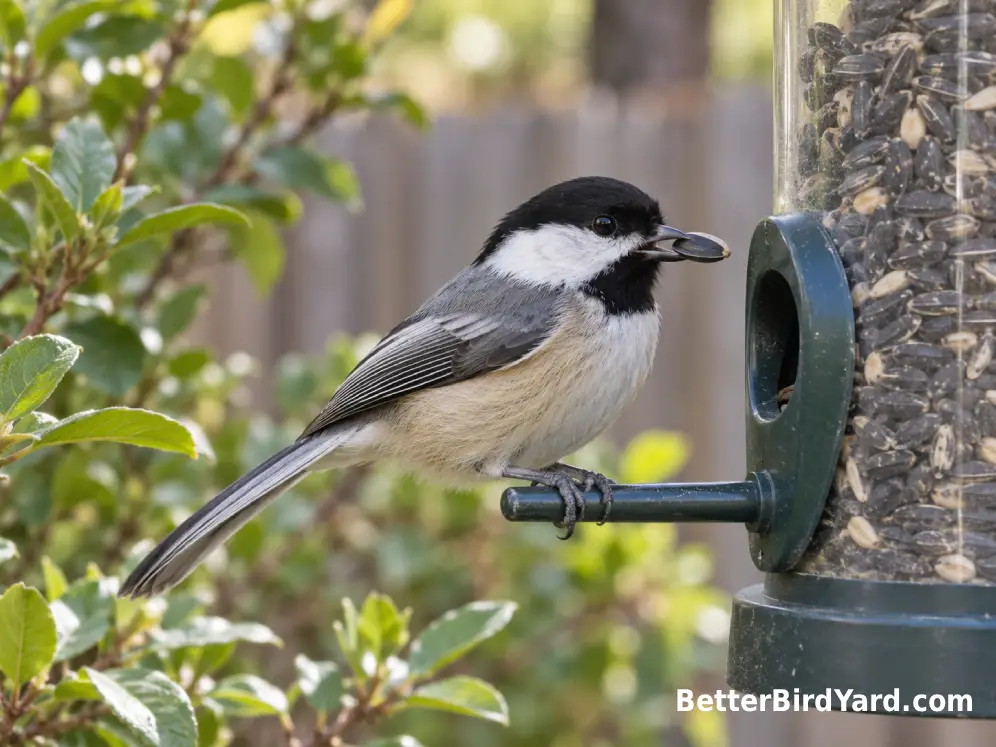
- Black-oil sunflower seed, which Project FeederWatch lists among the favored foods of chickadees.
- Hulled sunflower seed if you need to reduce shell debris on a small patio, provided it is kept dry because hull-free seed can spoil faster.
- Plain, unsalted shelled peanuts or peanut pieces kept dry and discarded if mold develops.
- Suet, particularly during cooler weather, while watching for spoilage in heat.
- Mealworms as an optional supplemental food rather than a requirement.
Project FeederWatch specifically lists chickadees among birds that use sunflower, peanut hearts, peanuts, mealworms, and suet. It also warns against moldy food and recommends avoiding salted or flavored peanuts.
In a small yard, black-oil sunflower is the simplest starting point. A feeder full of inexpensive filler grains may produce more waste without being particularly useful to chickadees. If seed is getting wet, clumping, smelling stale, or accumulating below the feeder faster than birds eat it, reduce the amount you put out rather than continuing to top it off.
How to Attract Chickadees to a Backyard or Patio
You do not need a large property to make a useful chickadee stop. A clean feeder, nearby woody cover, regionally appropriate plants, and safe access to water can provide more value than filling a small space with several different feeders.
A practical setup looks like this:
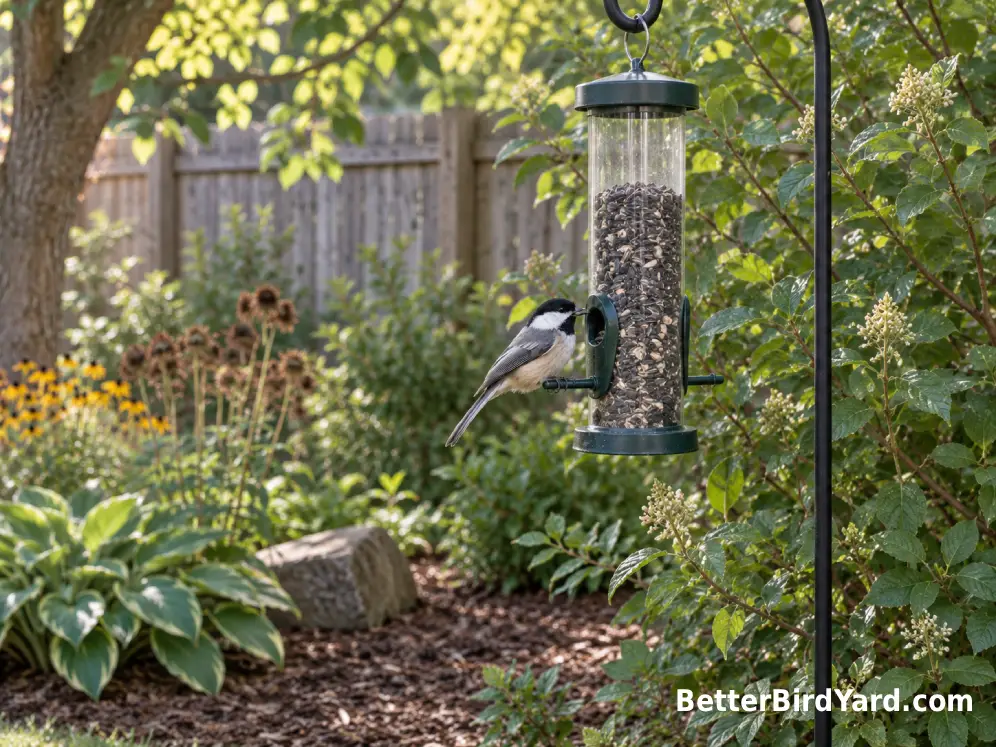
- Start with one small tube or hopper feeder that is easy to disassemble and clean.
- Offer black-oil sunflower seed or another appropriate chickadee food.
- Provide nearby shrubs or trees so birds can move between feeding and cover.
- Add locally native plants where space permits, even if that means only a few patio containers.
- Keep a simple bird bath clean and refresh the water regularly.
- Watch the site for window reflections, roaming cats, excessive seed waste, and rodents.
Project FeederWatch notes that small tube feeders accommodate small birds and keep seed relatively dry, while Cornell describes chickadees as regular users of sunflower, suet, and peanuts.
The habitat around the feeder matters just as much. Audubon recommends locally native plants because they support insects, seeds, fruit, and shelter that birds can use naturally. Its chickadee guidance specifically highlights woody native vegetation as an important source of insects and other foods. Plant choice should always be regional rather than based on a generic national plant list.
BetterBirdYard note: In a small yard or rental patio, I would keep this simple. One feeder that you can actually maintain is better than four feeders that stay wet, dirty, or half-forgotten. Add a shrub or container planting before adding another feeding station.
Nesting, Flocks, and Seasonal Behavior
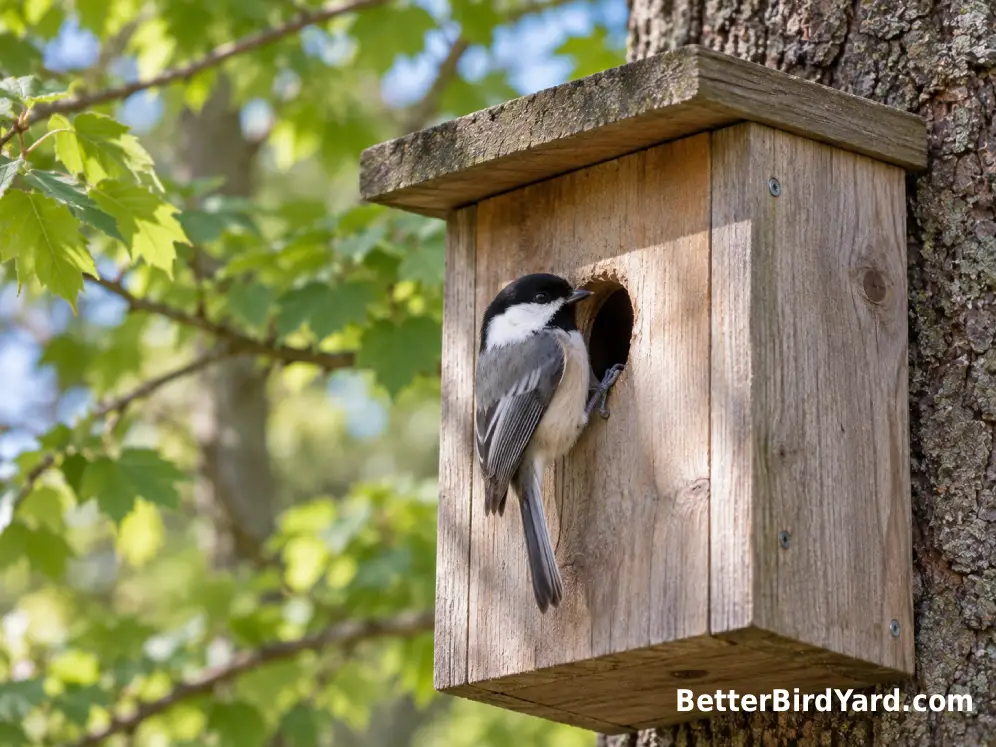
Chickadees are cavity nesters. Depending on the species and available habitat, they may use natural holes, old woodpecker cavities, soft decaying wood they can excavate, or suitable nest boxes. Cornell reports Black-capped Chickadees nesting in natural cavities, abandoned Downy Woodpecker holes, and nest boxes, and sometimes excavating their own sites in rotten wood.
If you want to provide a box, use a species-appropriate design from a reputable source such as Cornell Lab rather than improvising the entrance and interior dimensions. Put it up before the local nesting period, use a predator guard where appropriate, and leave an active nest alone. Breeding timing varies substantially with latitude, elevation, weather, and species, so a single national calendar is not very helpful.
Outside the breeding season, chickadees are often social. They can move through a neighborhood as part of a small flock and may associate with nuthatches, woodpeckers, kinglets, and other small birds. That can explain a familiar backyard pattern: the feeder may seem empty for twenty minutes, then suddenly become busy as a flock passes through. Cornell notes that Black-capped Chickadees frequently serve as part of mixed-species winter flocks.
Many chickadees also carry food away from a feeder instead of eating it there. Some species cache food for later, so the repeated feeder-to-branch trips are not necessarily signs that your feeder is in the wrong place. Audubon describes chickadee flocks cycling through feeders one bird at a time, often carrying sunflower seeds elsewhere to eat.
Seasonal movements vary. Some chickadees remain in the same general region year-round, while mountain or northern populations may make shorter local or elevational movements. Avoid assuming a bird has migrated away simply because feeder visits change for a few weeks; natural food availability and flock movements can change what you see from one day to another.
Common Mistakes and Safety Problems to Watch For
Attracting chickadees also means taking responsibility for the places where birds congregate. The biggest beginner mistake is treating a feeder as something you fill but rarely inspect.
- Do not keep adding fresh seed on top of damp, clumped, or spoiled seed.
- Do not leave thick layers of hulls, droppings, and uneaten food accumulating beneath the feeder.
- Do not place a busy feeding area where roaming cats can easily stalk birds.
- Do not ignore reflective windows close to concentrated bird activity.
- Do not rely heavily on pesticides in the same yard where you are trying to support insect-eating birds.
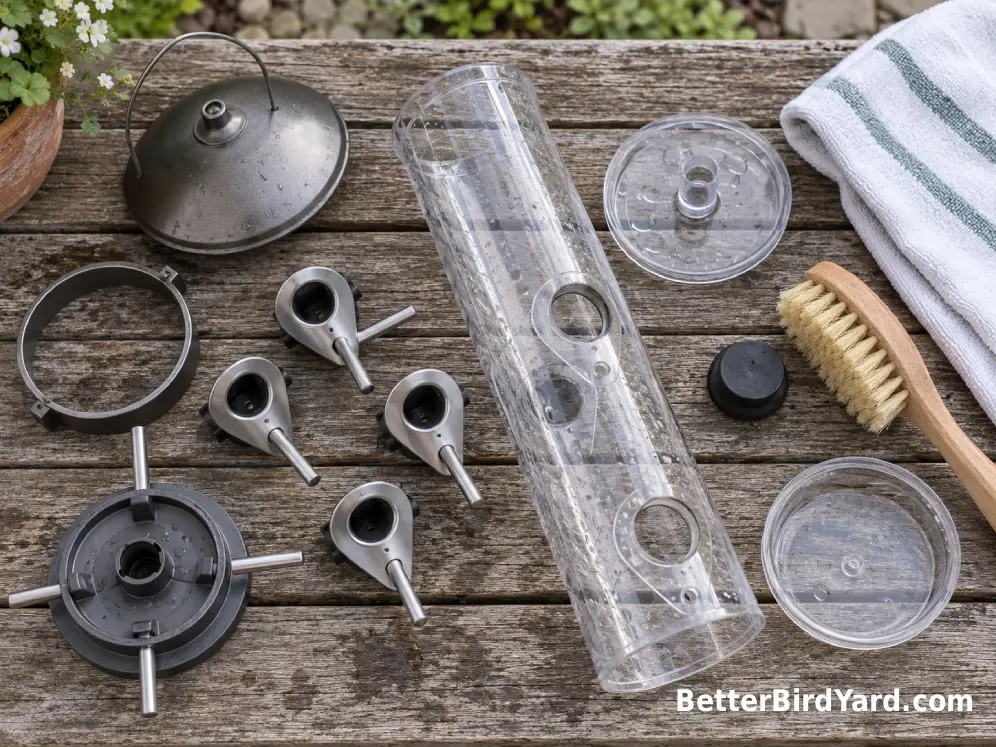
Project FeederWatch currently recommends cleaning seed and suet feeders regularly, roughly every week or two as a general practice and more often during heavy use or wet weather. Feeders should be taken apart, scrubbed free of debris, washed thoroughly, rinsed, and allowed to dry completely before refilling. The ground below should also be kept free of spoiled food and excessive waste.
For a practical routine, see our bird feeder cleaning guide.
If a Chickadee Looks Sick or Injured
A chickadee that remains puffed up for an unusually long time, appears lethargic, has abnormal-looking eyes or growths, cannot fly normally, or repeatedly stays on the ground may be compromised, but those observations are not enough to diagnose a disease or injury.
Do not try to medicate or casually handle the bird. Clean feeders and bird baths promptly, and follow current Project FeederWatch or local wildlife agency guidance about reducing or temporarily pausing feeding if sick birds are appearing. Project FeederWatch specifically recommends additional cleaning precautions and notes that temporarily removing feeders may help in some circumstances.
If a bird is injured, unable to fly, or otherwise clearly in distress, contact a licensed wildlife rehabilitator, local wildlife agency, animal control office, or another qualified local professional for instructions rather than trying to treat it yourself. Cornell’s Project FeederWatch likewise advises against attempting to care for compromised wild birds without licensed professional guidance.
A Better Backyard for Chickadees
Chickadees are rewarding backyard birds partly because they make ordinary spaces interesting. A small tube feeder outside an apartment patio, a few native shrubs along a suburban fence, or a mature tree beside a bird bath can all become places to watch these quick little birds forage, call, and move through their daily routines.
The best setup is not the one with the most equipment. Start with clean sunflower seed, maintain the feeder consistently, provide nearby vegetation, keep water fresh, and make the surrounding yard safer from windows and predators. Then watch what the birds actually do. You may notice that a chickadee rarely stays at your feeder for more than a moment, that an entire flock seems to arrive at once, or that feeder activity falls when natural insects and seeds become plentiful.
Identification becomes easier the same way. Learn the chickadee species expected in your region first, then pay attention to head pattern, habitat, voice, and behavior. Over time, the small differences that seem difficult in photos start to make much more sense in a real backyard.
And if chickadees do not appear immediately, that does not mean the yard has failed. Their presence varies with region, season, habitat, weather, and the birds already living nearby. A clean feeder paired with healthy local habitat gives them an opportunity to visit without pretending that any seed, feeder, or plant can guarantee the result.