Costa’s Hummingbird: A Practical Backyard Guide
Costa’s hummingbird is a tiny, compact hummingbird of the desert Southwest and parts of coastal California, best known for the adult male’s vivid purple crown and flared purple throat feathers. For backyard bird watchers, it is also one of the hummingbirds that can feel both flashy and confusing: a male in perfect light is hard to miss, while a female Costa’s hummingbird can look subtle, pale, and easy to mix up with female Anna’s, Black-chinned, or other western hummingbirds. Cornell Lab describes Costa’s as small and compact, with females greenish above, whitish below, and marked by a white eyebrow stripe and grayish cheek patch.
The good news is that you do not need expert-level birding skills to start recognizing Costa’s hummingbirds. Focus on region, size, shape, face pattern, and behavior before relying on color alone. If you live in the right part of the U.S., especially desert, sage scrub, chaparral, or nearby suburban neighborhoods, a clean hummingbird feeder and well-chosen native nectar plants may give you a closer look. Results still vary by season, local habitat, drought, flowers, and the birds already moving through your area.
What Makes Costa’s Hummingbird Distinctive?
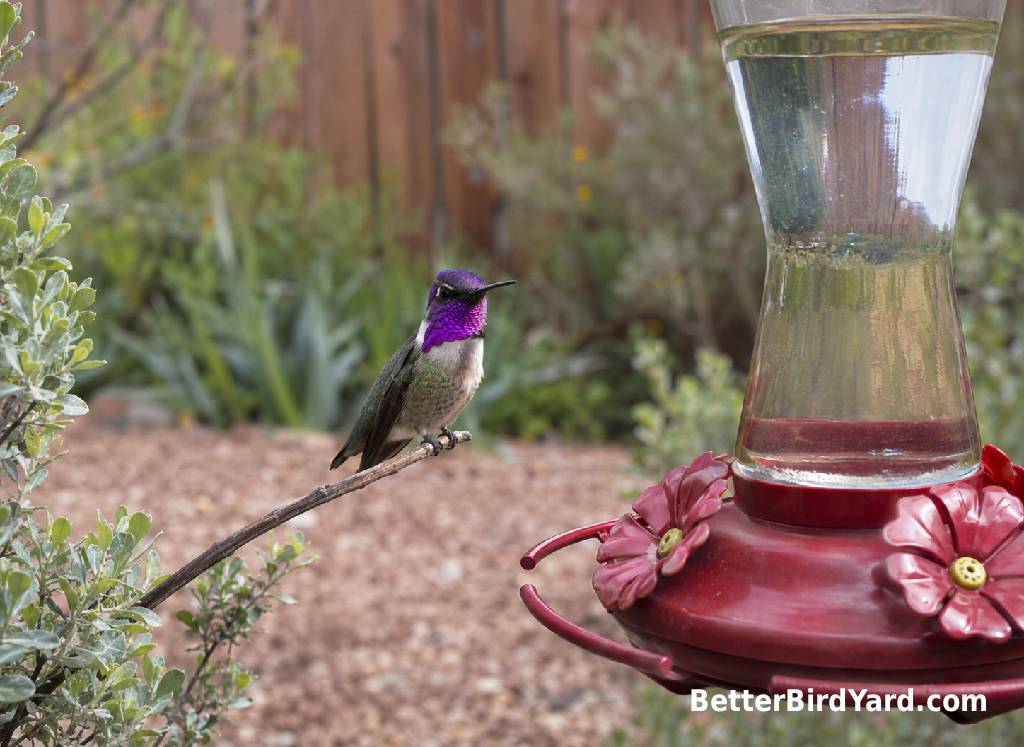
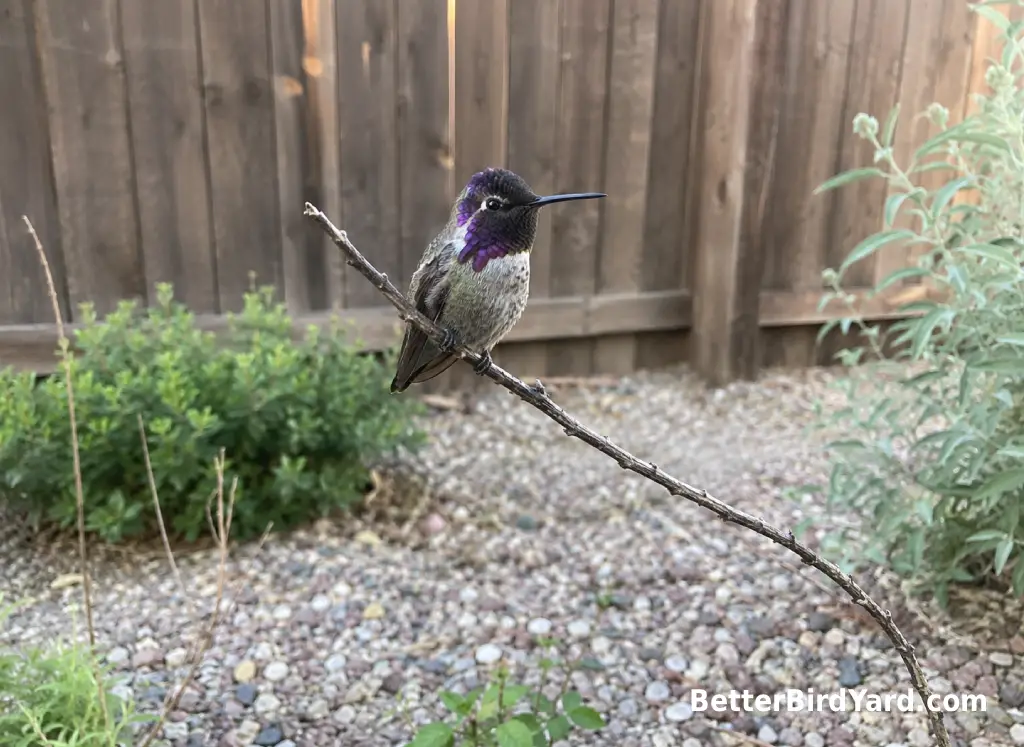
The adult male Costa’s hummingbird is the one most people remember. In good light, he shows an iridescent purple crown and a purple gorget that spreads out along the sides of the neck. Cornell Lab notes that this flared throat can look almost like an overgrown mustache, which is a helpful mental image for beginners.
Shape matters just as much as color. Costa’s hummingbirds are small and compact, often looking short-tailed and slightly hunched when perched. Cornell Lab also notes that the wings barely extend beyond the tail when the bird is perched, a useful clue when the throat color is hidden or the light makes the purple look dark.
In the yard, start with a simple three-part check:
- Is the bird tiny and compact rather than stocky?
- Does the perched bird look short-tailed, with wings that barely pass the tail?
- On a male, do the throat feathers flare out to the sides instead of forming a neat round patch?
A common beginner mistake is trying to identify every hummingbird from color alone. Iridescent feathers can flash purple, pink, black, or gray depending on the angle. Watch the bird for a few seconds, note its shape, and compare several field marks before deciding.
How To Identify A Female Costa’s Hummingbird
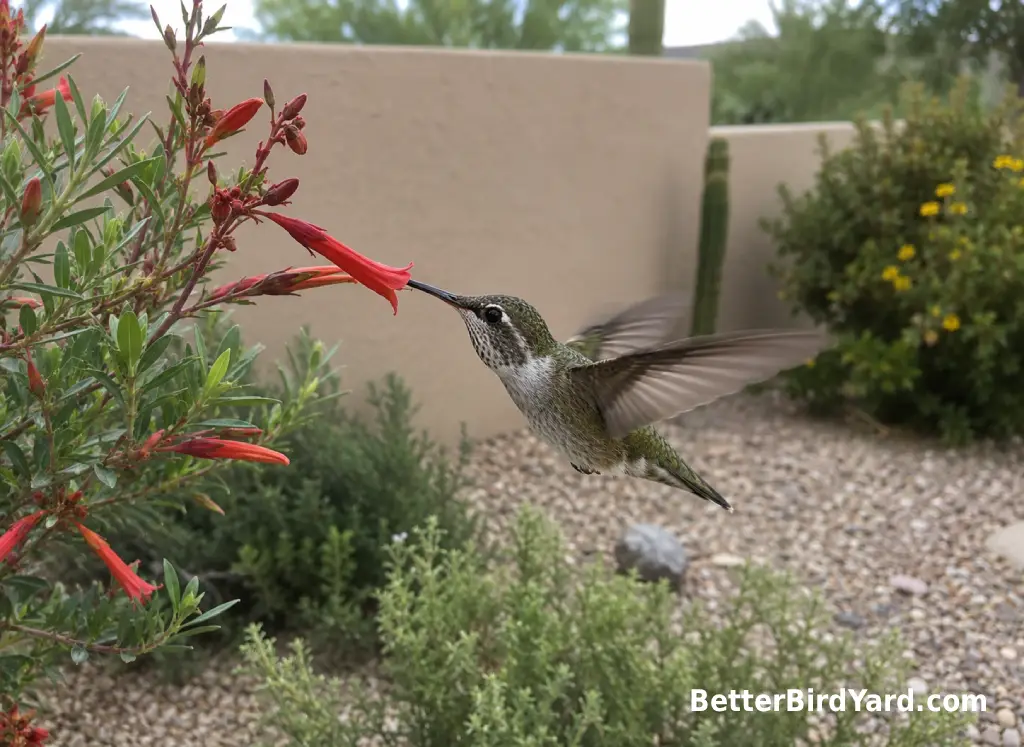
A female Costa’s hummingbird is much less dramatic than the male, but she has her own quiet clues. Look for greenish upperparts, whitish underparts, a pale eyebrow line, and a grayish cheek patch. Cornell Lab gives those same marks as key features for females, and Audubon adds that female Costa’s can look smaller and shorter-billed than female Anna’s or Black-chinned hummingbirds.
For a backyard view, the face pattern is often more useful than the body color. A female Costa’s hummingbird may look pale-faced compared with a female Anna’s, especially when you can see the white eyebrow stripe and grayish cheek. She also tends to look compact, with a short tail and a small overall build.
Do not worry if you cannot confirm every female hummingbird right away. Female and immature hummingbirds are often the hardest IDs at backyard feeders. Take a photo if you can do so without crowding the bird, note the date and location, and compare the bird’s shape against a trusted field guide or Cornell Lab’s All About Birds. If the bird is outside Costa’s normal range, be especially cautious before calling it a Costa’s.
Costa’s Hummingbird Vs. Anna’s Hummingbird
Anna’s and Costa’s hummingbird overlap in parts of the West, especially in California and the Southwest, so this comparison comes up often at feeders. Anna’s is generally stockier, and adult males have a rose-pink throat and crown rather than the Costa’s purple crown and flared purple gorget. Cornell Lab describes Anna’s females and immature males as green above with a small pinkish throat patch and a white spot behind the eye; Audubon also notes that Anna’s is more stocky than Costa’s.
| Field Mark | Costa’s Hummingbird | Anna’s Hummingbird |
|---|---|---|
| Overall Shape | Tiny, compact, short-tailed look | Somewhat stockier hummingbird |
| Adult Male Color | Purple crown and flared purple throat | Rose-pink crown and throat |
| Female Clues | Pale eyebrow, grayish cheek, whitish underparts | Green above, grayish below, often with pinkish or reddish throat spots |
| Backyard Impression | Often delicate, compact, desert-adapted | Often bolder and more familiar around western yards and parks |
In practice, location and season help narrow the choice. Anna’s hummingbirds are common around many western yards, parks, and neighborhoods, while Costa’s is more tied to desert scrub, sage scrub, chaparral, and suitable gardens within its range. Use the table as a starting point, not a final verdict.
Where Costa’s Hummingbirds Live And When You Might See Them
Costa’s hummingbirds are strongly associated with dry, open habitats in the Southwest. Cornell Lab lists desert scrub in the Sonoran and Mojave Deserts, plus chaparral and sage scrub in coastal California. Audubon describes deserts, washes, sage scrub, dry canyons, and coastal sage scrub as important habitats, while also noting that the species can use some suburban gardens where flowers are present.
Seasonal movement can be confusing. Audubon notes that many Costa’s hummingbirds that nest in deserts in spring move west toward the coast for other seasons, while some now remain year-round where gardens provide flowers through the year. That does not mean every yard in the Southwest will have them, but it does explain why a hummingbird that seems seasonal in one neighborhood may be more regular in another.
For most U.S. backyard bird watchers outside the Southwest and coastal California, Costa’s is not a regular feeder bird. If you see a small, pale female hummingbird far outside expected range, it is safer to document it carefully than to make a quick ID. Local bird clubs, eBird reviewers, or a state bird records committee can help when a sighting seems unusual.
How To Support Costa’s Hummingbirds With Feeders
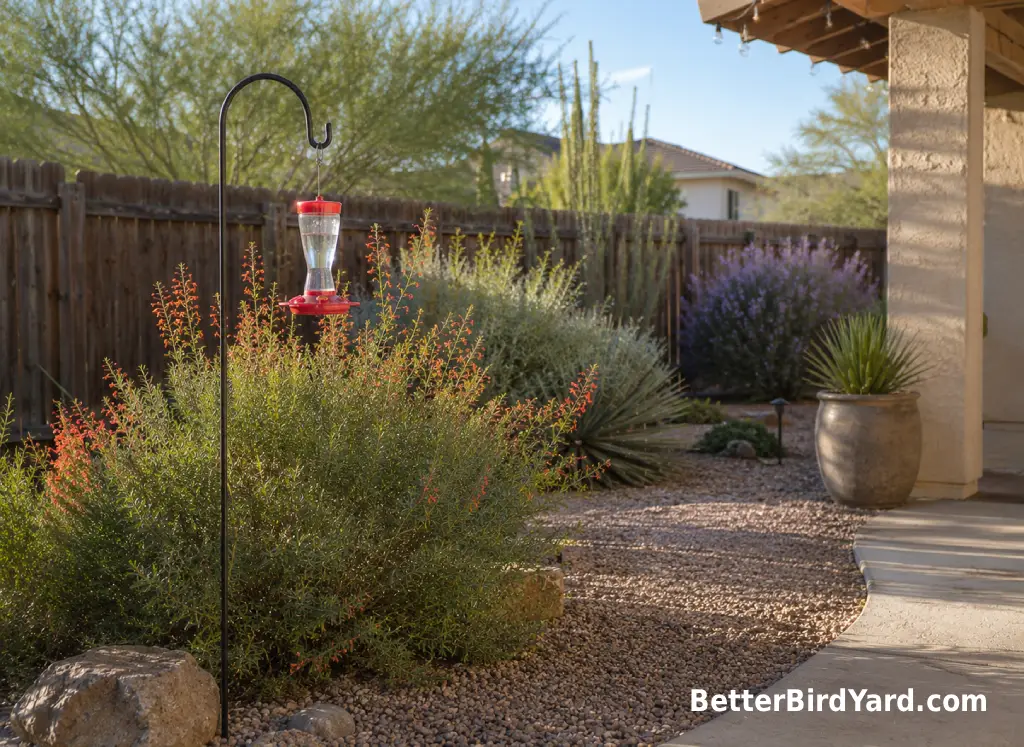
A feeder can help you observe Costa’s hummingbirds within their range, but it should be treated as a small, high-maintenance food station rather than a set-it-and-forget-it decoration. The safest basic hummingbird nectar recipe is plain white sugar and water, commonly one part sugar to four parts water. National Wildlife Federation recommends white sugar with water, no honey, no artificial sweeteners, and no red nectar solutions; Cornell Lab also says red food coloring is unnecessary and may be harmful.
Choose a feeder that is easy to take apart and scrub. Cornell Lab advises that sugar water should not sit out for more than two or three days and should be changed daily in very hot weather because bacteria, mold, and fermentation become problems. National Wildlife Federation similarly recommends choosing a size that hummingbirds can empty within about two to three days.
In a small yard, renter patio, or balcony, keep the setup simple:
- Use one small, easy-clean feeder instead of a large feeder that stays full too long.
- Hang it where you can reach it easily for cleaning and refilling.
- Give hummingbirds open space to hover, with shrubs or sheltered perches nearby but not blocking the ports.
- Empty, wash, and refill before nectar looks cloudy or sticky.
- Take the feeder down temporarily if you cannot keep up with cleaning during extreme heat.
For more detailed maintenance routines, see our internal guide to cleaning hummingbird feeders.
Native Plants Are Better Than A Feeder Alone
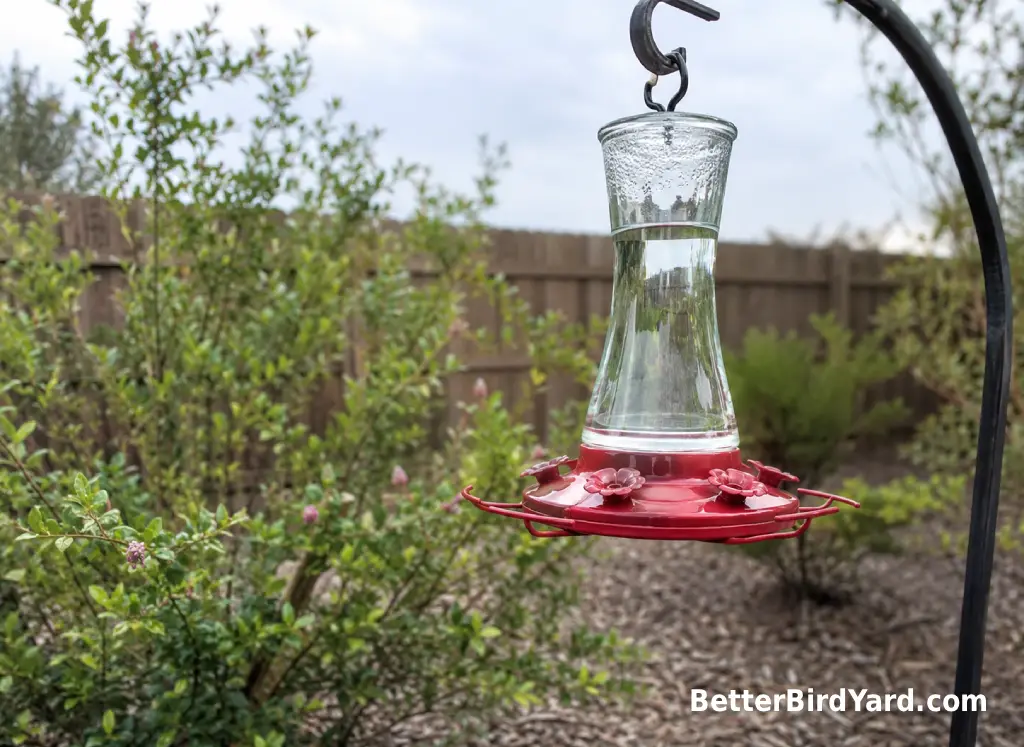
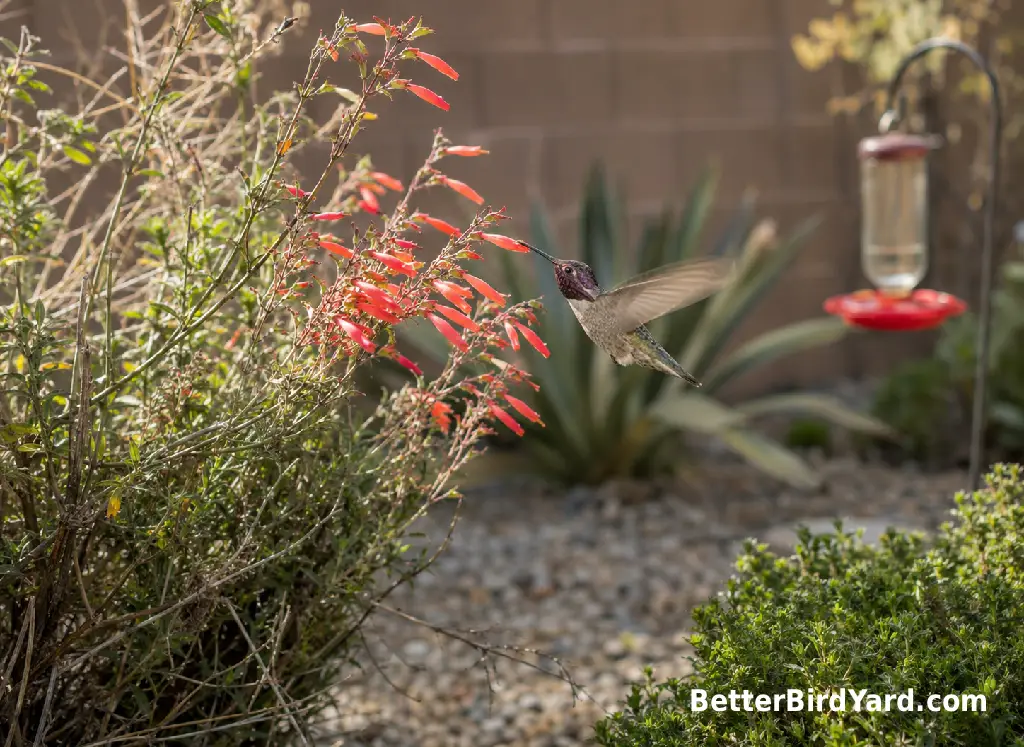
Feeders are useful for viewing, but plants build a more complete hummingbird-friendly yard. Costa’s hummingbirds feed on nectar and tiny insects; Audubon lists desert natives such as agave, chuparosa, desert honeysuckle, and fairy-duster among the plants they visit, while Cornell Lab notes that they also take small flying insects.
The best plant choices depend on where you live. A California coastal garden, a Phoenix patio, and a high-desert yard do not all need the same plant list. Start with your state extension office, local native plant society, or a reputable regional native plant nursery, and ask for nectar-rich plants that fit your soil, water restrictions, sunlight, and local rules.
A practical small-space approach is to plant in layers: one or two nectar-rich flowers in pots, a small native shrub for cover if space allows, and a clean feeder only if you can maintain it. Avoid pesticide use around hummingbird flowers and feeder areas whenever possible; hummingbirds eat tiny insects, and pesticides can reduce the small prey that helps support their diet.
For broader habitat ideas, see our internal guide to native plants for hummingbirds.
Common Backyard Mistakes To Avoid
Most Costa’s hummingbird backyard mistakes are not dramatic. They are small maintenance lapses that become risky in heat, crowding, or busy seasons.
- Using red dye: The feeder can have red parts, but the nectar should stay clear. Cornell Lab and National Wildlife Federation both advise against red coloring in nectar.
- Leaving nectar out too long: Replace it before it clouds, ferments, or smells off. In hot weather, daily changes may be needed.
- Buying an oversized feeder: A large feeder is not better if it takes too long to empty. Smaller feeders are often easier and safer for ordinary yards.
- Placing the feeder too close to clutter: Hummingbirds need room to hover. Nearby shelter is helpful, but branches should not block access to the ports.
- Assuming every western female is a Costa’s: Female Costa’s, Anna’s, and other western hummingbirds can be subtle. Use range, size, shape, and face pattern together.
Editorial note: If you only change one habit, make feeder cleaning easier. A feeder you can scrub quickly is far more useful than a decorative feeder that looks pretty but has hidden corners you avoid cleaning.
Watching Behavior Without Disturbing The Bird
Costa’s hummingbirds can be active, territorial, and surprisingly easy to overlook between visits. Cornell Lab notes that males may return to a few favorite perches and sing a thin, high-pitched whistle from their territory. Males also perform courtship dives, while Costa’s hummingbirds feed at flowers, feeders, and on tiny insects.
For backyard watching, the best approach is patience. Sit where you are not directly under the feeder or blocking a favorite flight path. Notice where the bird perches between visits. A bare twig, dead branch tip, fence wire, or open shrub stem can become a regular lookout post.
If you discover a hummingbird nest, give it distance. Audubon describes Costa’s nests as small cups built by the female in shrubs, small trees, yucca, or cactus, often on a horizontal or diagonal branch. Do not trim around an active nest, touch the nest, or try to move it. If a bird appears sick, injured, stunned, orphaned, or unusually unable to fly, contact a licensed wildlife rehabilitator, local wildlife agency, or animal control for location-specific guidance rather than attempting home treatment.
Feeder Placement, Windows, Cats, And Local Rules
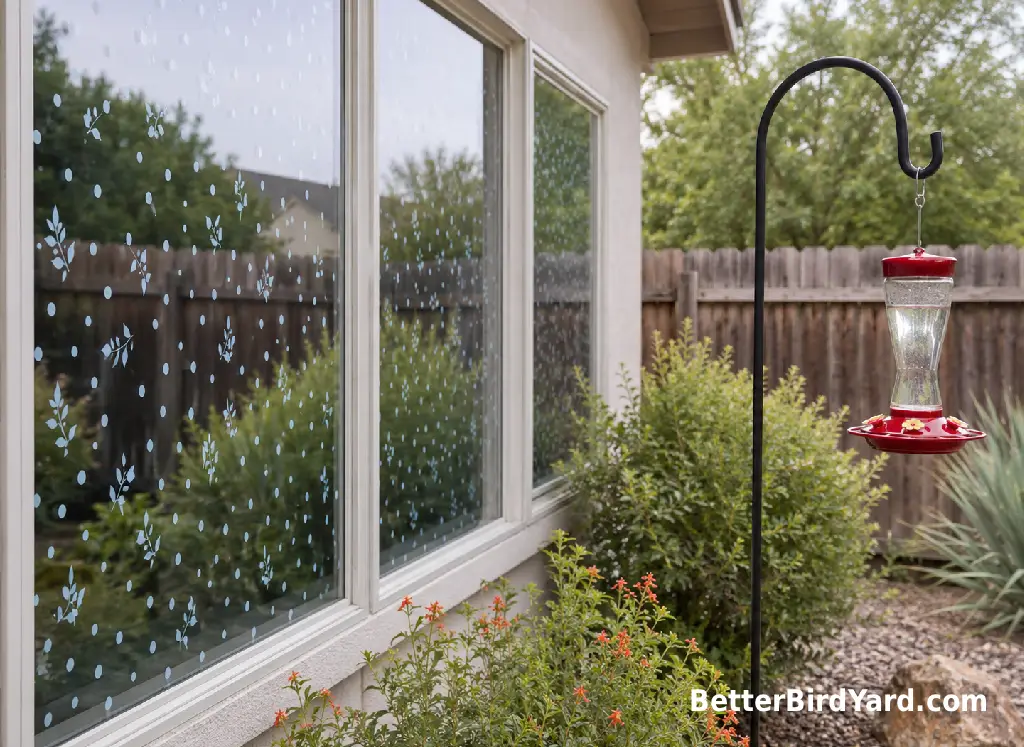
Hummingbird feeders belong where birds can find them and where you can clean them, but safety matters. National Wildlife Federation recommends making feeders visible, placing them near shelter while leaving open space for hovering, and considering window collision risk. Their guidance notes that feeders very close to a window, within about three feet, can be safer than feeders in the middle collision zone, while feeders farther out should be placed with window risk in mind.
Outdoor cats are also a serious backyard risk for hummingbirds and other birds. Place feeders away from low hiding cover where a cat can crouch and pounce, and avoid creating a dense ambush spot directly below a feeder. If you have a cat, keeping it indoors or using a fully enclosed outdoor catio is the bird-friendlier choice.
Renters and HOA homeowners should also check local rules before hanging feeders from balcony rails, shared structures, or common-area trees. Rules vary by apartment complex, city, county, state, and HOA, especially where feeders may attract ants, bees, rodents, bears, or other wildlife. A small, clean, well-managed feeder is much easier to defend than a messy setup that drips nectar or draws pests.
Quick FAQ About Costa’s Hummingbirds
Are Costa’s Hummingbirds Rare?
Costa’s hummingbirds are not rare within suitable parts of their range, but they are regional. Audubon lists them as common within their range, while noting that desert development has affected habitat in some places. Outside the Southwest and coastal California, a suspected Costa’s hummingbird should be documented carefully.
Do Costa’s Hummingbirds Come To Feeders?
Yes, Costa’s hummingbirds can use sugar-water feeders. Audubon notes that they will feed on sugar-water mixtures in hummingbird feeders, but feeders should be clean, small enough to empty quickly, and filled with plain clear nectar rather than dyed mixtures.
What Does A Female Costa’s Hummingbird Look Like?
A female Costa’s hummingbird is greenish above and whitish below, with a white eyebrow stripe and grayish cheek patch. She is subtler than the male and can be confused with other female western hummingbirds, so use range, size, shape, and face pattern together.
Can I Attract Costa’s Hummingbirds Anywhere In The U.S.?
No. You can make a yard more hummingbird-friendly, but you cannot attract a species that is not normally present in your region. Costa’s hummingbird attraction is most realistic in parts of its western and Southwestern range, especially where habitat, flowers, water, season, and local movement patterns line up.
Final Thoughts On Costa’s Hummingbirds
Costa’s hummingbird is a wonderful species to learn because it rewards careful watching. The male’s purple crown and flared gorget are memorable, but the real backyard skill is learning the compact shape, short-tailed impression, pale-faced female pattern, and dry-country habitat clues that separate Costa’s from similar hummingbirds.
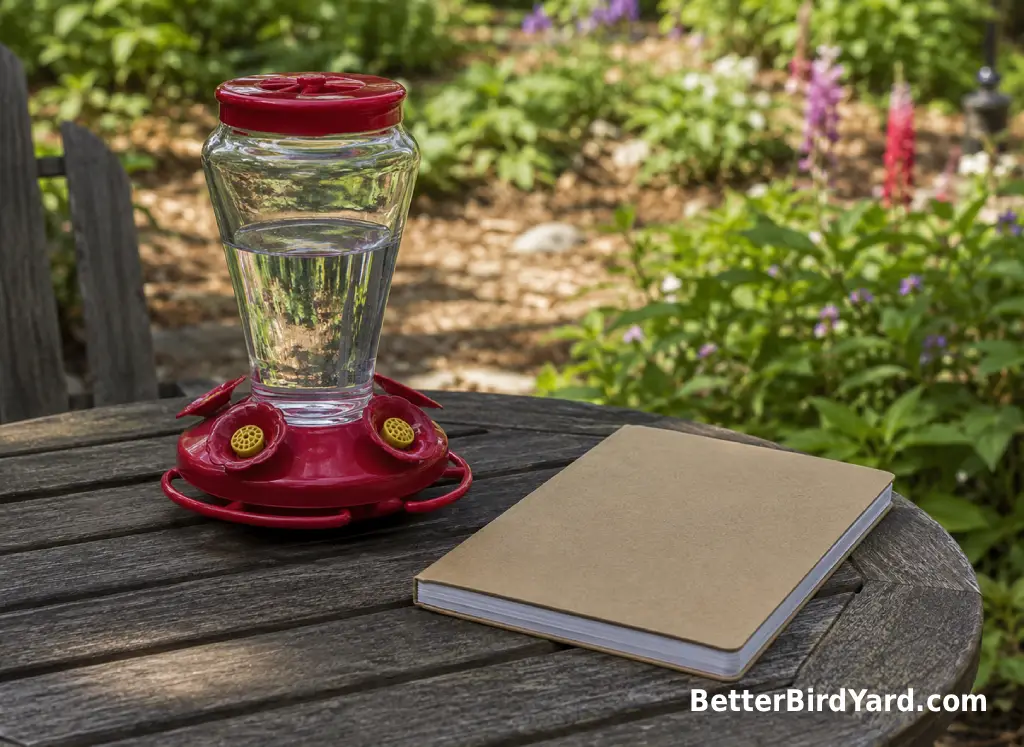
For most yards, the responsible approach is simple: plant region-appropriate nectar flowers, keep any feeder clean and small enough to manage, avoid red dye and honey, reduce window and cat risks, and stay realistic about range. A good Costa’s hummingbird yard does not have to be large or fancy. Even a small patio can be useful when it offers safe nectar, nearby cover, open hovering space, and consistent care.
And if a bird looks sick, injured, stunned, orphaned, or unable to fly normally, step back from identification mode and switch to safety mode. Contact a licensed wildlife rehabilitator, local wildlife agency, or animal control for local guidance. That calm, cautious response is one of the best ways backyard bird watchers can support wild birds responsibly.